

Commentary
Dmitri Trenin
{
  "authors": [
    "Dmitri Trenin"
  ],
  "type": "commentary",
  "centerAffiliationAll": "",
  "centers": [
    "Carnegie Endowment for International Peace",
    "Carnegie Russia Eurasia Center"
  ],
  "collections": [],
  "englishNewsletterAll": "",
  "nonEnglishNewsletterAll": "",
  "primaryCenter": "Carnegie Russia Eurasia Center",
  "programAffiliation": "",
  "programs": [],
  "projects": [],
  "regions": [
    "Russia"
  ],
  "topics": [
    "Security",
    "Military"
  ]
}
Source: Getty
As Russia proceeds with its massive rearmament program, its arms exports, a lifeline in the 1990s, will be important, but no longer critical. The truly critical question is, what Russia itself will be arming against.
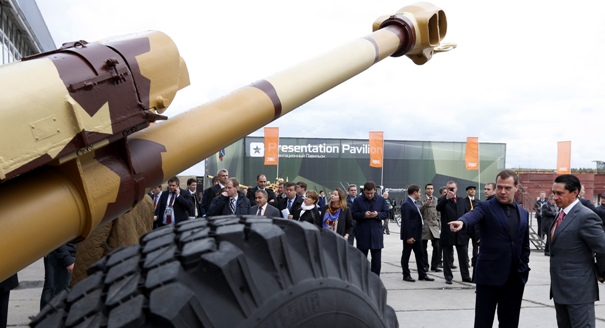
Russia Arms Expo has been held since the mid-1990s, but never on such a grand scale. Dmitri Rogozin, the deputy prime minister in charge of the defense industry, seeks to turn Nizhny Tagil into an international fair of land forces weapons and equipment—on a par with Moscow’s MAKS for aerospace systems and St. Petersburg’s naval show. True to form, Russian defense manufacturers rolled out T90S main battle tanks, self-propelled guns and howitzers, and their newest product, a tank support system proudly called Terminator. The performance they staged was nothing if not impressive.
The going from here, however, is likely to be hard. Perhaps what is most impressive about the Russian defense industry is that it had survived nearly a decade and a half of starvation and neglect. Russia is able to churn out new weaponry, but is yet to produce a weapons system which is truly post-Soviet. All the “new” tanks and personnel carriers are still modernized versions of Soviet models. Speaking in Nizhny Tagil, Rogozin admitted to the huge structural problems plaguing the industry, even though he himself looked supercharged and enviably enthusiastic.
Despite the current economic stagnation, the looming recession, and the resultant budget crunch, the Russian defense industry remains a priority for the Kremlin. Yuri Borisov, deputy defense minister, denied reports of a 5 percent sequestration; Andrei Klepach, deputy minister of economic development, called defense modernization a vehicle for new industrialization and technological innovation. This runs contrary to the current trends in Europe and even the United States, but Russia has been developing increasingly out of synch with both of them.
Russia Arms Expo was international in the sense of having its doors open to potential customers. Those came from Asia, the Middle East, and Africa. Russian arms are still attractive to many due to their relative simplicity and moderate price. However, the market is changing because of the enhanced competition from new producers such as China, Brazil, and South Africa, and the new demand for more sophisticated weaponry. Coproduction is becoming a way to raise competitiveness—but there, Russia’s only serious partner so far has been India. With Ukraine entering into an association with the EU, the future of joint military production with Russia is in question.
As Russia proceeds with its massive rearmament program, its arms exports, a lifeline in the 1990s, will be important, but no longer critical. The truly critical question is, what Russia itself will be arming against. As Prime Minister Dmitri Medvedev visited Nizhny Tagil, President Vladimir Putin was observing military maneuvers code-named Zapad-2013 in Belarus and Kaliningrad. Just before that, Putin announced the building of a military base in the Arctic. Earlier in the year, the President ordered snap exercises in the Black Sea. Yet the biggest display of Russia’s reemerging military power since the fall of the Soviet Union has been in the Far East. With a tous-azimuts defense policy, there should be no problem with demand for arms. As a British defense expert on hand in Nizhny Tagil quipped, “never leave home without a tank.” It is the supply that matters.
Former Director, Carnegie Moscow Center
Trenin was director of the Carnegie Moscow Center from 2008 to early 2022.
Recent Work
Dmitri Trenin
Dmitri Trenin

The armed forces champion a form of capitalism that is generating revenue, but its reliance on rent faces diminishing returns, leaving the country with massive sunk costs and deferred returns, deepening dependency on external borrowing.

Yezid Sayigh

Just look at Iraq in 1991.

Marwan Muasher

Baku may allow radical nationalists to publicly discuss “reunification” with Azeri Iranians, but the president and key officials prefer not to comment publicly on the protests in Iran.

Bashir Kitachaev

The country’s leadership is increasingly uneasy about multiple challenges from the Levant to the South Caucasus.

Armenak Tokmajyan
In an interview, Daniela Richterova speaks about her book on Czechoslovakia’s Cold War ties to Palestinian groups and others.

Michael Young