

In The Media
Lilia Shevtsova
{
  "authors": [
    "Lilia Shevtsova"
  ],
  "type": "commentary",
  "centerAffiliationAll": "",
  "centers": [
    "Carnegie Endowment for International Peace",
    "Carnegie Russia Eurasia Center"
  ],
  "collections": [],
  "englishNewsletterAll": "",
  "nonEnglishNewsletterAll": "",
  "primaryCenter": "Carnegie Russia Eurasia Center",
  "programAffiliation": "",
  "programs": [],
  "projects": [],
  "regions": [
    "Russia",
    "Eastern Europe",
    "Ukraine"
  ],
  "topics": [
    "Democracy",
    "Foreign Policy"
  ]
}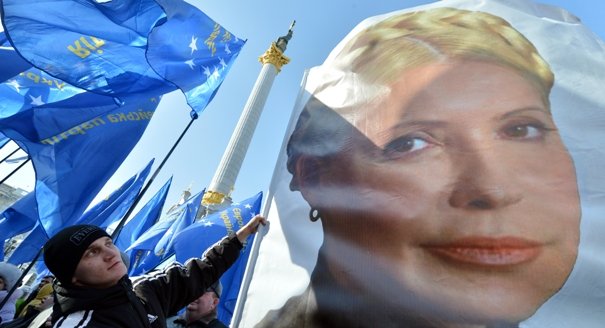
Source: Getty
The Ukrainian elite has reached consensus on what it does not want—it does not want to be suffocated by the Kremlin’s embrace. For Putin the growing readiness of Ukraine to turn to Europe despite the formidable costs of this decision is a real disaster: his Eurasian Union cannot be a serious entity without the second large Slavic state limping along.
Ukraine undermining Russia’s dream? Are you serious?—one would ask. Who and what could undermine today the Russian leader?! Vladimir Putin is supposedly enjoying global triumph having rescued the West from the Syrian trap and saving it from humiliation. Who would have expected a month ago that this leader, both disliked and loathed by many, would become the most efficient, powerful, and lucky?
Yet here you are: not even a slap in the face of the Triumpher but the end of his survival plan, and an uncertain future ahead. This is what the loss of Ukraine means for Putin’s Kremlin. What we see unraveling before our eyes these October days is exactly this—Ukrainian escape from the Russian embrace. Yulia Tymoshenko’s consent to get medical treatment in Germany, transfer of Renat Kuzmin, the first deputy prosecutor and the key figure in her persecution, to the back bench, and Viktor Yanukovych’s declaration that Ukraine will sign the Association Agreement with the EU at the November Vilnius summit—all this looks like a trilateral deal between the Ukrainian leader, Ukrainian opposition, and Europe. One can see signs accumulating that the official Kiev has embarked on its path to join Europe. True, it will be a long way and Ukrainians will have to cross a valley of tears before their country becomes a truly European state. They still have fights to fight and not let themselves get lured into blind allies. But what is happening these days indicates that the Ukrainian elite has reached consensus on what it does not want—it does not want to be suffocated by the Kremlin’s embrace.
It was the Kremlin with its impudence and intimidation that has succeeded in consolidating the conflicting Ukrainian elite clans on a pro-European basis. The recent Moscow trade war with Kiev was a perfect illustration of how the Law of Unintended Consequences works! Ukrainians have to build a monument to Putin surrounded by his team, with Sergey Glazyev at the forefront, acknowledging their input into helping the Ukrainian elite to overcome their doubts as to their country’s trajectory.
For Putin the growing readiness of Ukraine to turn to Europe despite the formidable costs of this decision is a real disaster. Putin’s Eurasian Union cannot be a serious entity without the second large Slavic state limping along. It needs Ukraine as an anchor. Eurasia simply cannot exist without Ukraine. And without the Eurasian Union the Kremlin cannot reenergize the system of personalized power which needs satellite states. The new Putin’s Doctrine that he offered the world recently at Valdai is based on the linkage between the Russian “state-civilization” and the Eurasian Union, which is supposed to be like a galaxy with Russia as the pole. The galaxy will be a pathetic one without Ukraine. It would not be an exaggeration to say that Ukraine running away from Moscow will mean a devastating blow to the resilience of the Russian “state-civilization” that Putin tries to build.
No doubt that Moscow will pressure, cajole, and intimidate Kiev to try to make it “rejoin” Russia’s orbit. The more difficulties Ukrainians experience in their attempt to build a European state, the better for the “elder brother.” Ukraine’s ability to embark on its new path will have not only geopolitical, but tremendous civilizational implications. Ukraine will demonstrate a capacity of a state-dominated society for transformation. In case it succeeds, it can become a role model for the rest of Eurasia. If it fails, this would be our failure, too.
I wonder to what extent Europe understands the seriousness of the Ukrainian challenge? Does the EU comprehend that embracing Ukraine will not only secure the future of the stagnating European Partnership but also help Europe to return to its values? Could Europe help Ukrainians to walk through their valley of tears?
We shall see soon. In fact, we shall see it this October when the EU Council at the level of the EU countries’ foreign affairs ministers meets on October 21 to take a decision on how Ukraine has succeeded in meeting the EU association criteria.
How Ukraine, the EU, and Russia will live through October will tell us a lot about the readiness of the Ukrainian elite and Ukrainian society to start a new life, about the EU’s ability to think about its future, and about the desire of Putin’s Russia to fight for the right to remain in the past.
Former Senior Associate, Russian Domestic Politics and Political Institutions Program, Moscow Center
Shevtsova chaired the Russian Domestic Politics and Political Institutions Program at the Carnegie Moscow Center, dividing her time between Carnegie’s offices in Washington, DC, and Moscow. She had been with Carnegie since 1995.
Recent Work
Lilia Shevtsova
Lilia Shevtsova
Carnegie does not take institutional positions on public policy issues; the views represented herein are those of the author(s) and do not necessarily reflect the views of Carnegie, its staff, or its trustees.

By failing to address Palestinian representation, the current process is bound to lead to just another temporary arrangement.

Nathan J. Brown

Just look at Iraq in 1991.

Marwan Muasher

A coalition of states is seeking to avert a U.S. attack, and Israel is in the forefront of their mind.

Michael Young

Baku may allow radical nationalists to publicly discuss “reunification” with Azeri Iranians, but the president and key officials prefer not to comment publicly on the protests in Iran.

Bashir Kitachaev

The country’s leadership is increasingly uneasy about multiple challenges from the Levant to the South Caucasus.

Armenak Tokmajyan