

In The Media
Lilia Shevtsova
{
  "authors": [
    "Lilia Shevtsova"
  ],
  "type": "commentary",
  "centerAffiliationAll": "",
  "centers": [
    "Carnegie Endowment for International Peace",
    "Carnegie Russia Eurasia Center"
  ],
  "collections": [],
  "englishNewsletterAll": "",
  "nonEnglishNewsletterAll": "",
  "primaryCenter": "Carnegie Russia Eurasia Center",
  "programAffiliation": "",
  "programs": [],
  "projects": [],
  "regions": [
    "Russia",
    "Western Europe"
  ],
  "topics": [
    "Democracy",
    "Foreign Policy"
  ]
}
Source: Getty
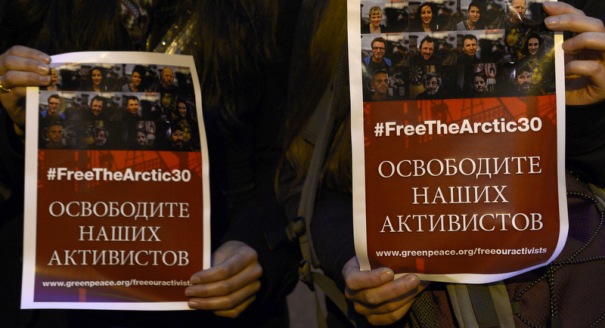
The Netherlands filed a claim against Russia in the International Tribunal for the Law of the Sea, in connection with detaining the activists and crew of Greenpeace’s Arctic Sunrise. Acting by challenging the state that no one wants to irritate, the Dutch decided to take a principled stand and stick to it to the very end.
In history, there are examples of states behaving like people—acting courageously when their courage is viewed by many as recklessness. That is exactly the way the Netherlands is acting today by challenging the state that no one wants to irritate. I am talking about the Dutch confronting Putin’s Russia. The Netherlands filed a claim against Russia in the International Tribunal for the Law of the Sea, in connection with detaining the activists and crew of Greenpeace’s Arctic Sunrise. The Dutch are demanding that Moscow release them and dismiss the criminal charges against them.
Let me remind you that the Russian special forces detained the activists of the Arctic Sunrise back in September, as the latter attempted to hang their banners on the Prirazlomnaya oil rig to protest against the environmental damage associated with the oil production in the Arctic. Moscow initially charged the environmentalists with piracy. But since this charge appeared ludicrous, they are now accused of hooliganism. Incidentally, the term “hooliganism” has no match in maritime law. It is worth noting that, if convicted, the arrested are facing up to seven years in prison. Since the Russian courts are used as an instrument of attaining the regime’s political goals, should the Kremlin order it the environmentalists will definitely be punished and do as much jail time as the authorities here deem necessary.
By the way, the Russian side failed to appear at the hearings of the Hamburg Tribunal, thus putting its disdain toward this international entity on display. Moreover, the Russian Foreign Ministry accused the Netherlands of knowing “that the ship purposefully came to the Russian economic zone with an intention to commit illegal actions.”
Meanwhile, this seemingly minor incident, which does not rise to the level of the Syrian drama or even the struggle for Ukraine between Russia and the EU, is no doubt an important test. It is first of all a test of Europe’s ability to unite behind the Dutch, defending European citizens of various nationalities that found themselves incarcerated. Second, it is a test of the international judicial system and its ability to ensure a fair legal process. As evidenced by the decisions rendered by the European Court of Human Rights, this process is not always flawless, so the decisions often result in political compromise (see, for instance, the Court’s ruling that the charges against Khodorkovsky were not politically motivated). Third, it is a test of Moscow’s commitment to a tactic that can be summarized as “We don’t give a damn what you think about us.” This tactic is not simply a reflection of the new Kremlin doctrine entitled “We Are Back—Fear Us!” In this particular instance, the incident is also another opportunity for the Kremlin to reaffirm Russia’s claims to the Arctic. Finally, the Russian authorities seem to be testing the waters to see how much Europeans can swallow if Russia starts to go around flexing its muscles.
But let us get back to the Netherlands. Until now, the Dutch have been regarded as pragmatists. They could now very well forget about their ship and the Greenpeace activists. After all, the activists come from a number of countries whose representatives keep mum lest they irritate the Kremlin. However, the Dutch decided to take a principled stand and stick to it to the very end!
It is actually a rather risky undertaking on their part. Moscow does not bury grudges and has no patience for demands—especially if they come from less powerful states that it views as insignificant. In fact, Moscow may indeed punish for defiance, as it did numerous times with regard to a whole host of countries—Ukraine, Georgia, Lithuania, and Poland.
The Sea Tribunal has to render its verdict on November 21-22. Let us suppose it will rule in favor of the Netherlands. What will the Kremlin do next? Will it refuse to comply and instead send the environmentalists to jail? If that happens, what will Europe and its major powers do? And how will the whole story affect the upcoming Sochi Olympics—Putin’s pet project?
We will soon see how the standoff between the Dutch and the muscle-flexing “civilization-state” will end. For all we know, having mustered more courage, the daring Dutch may take one more step that is expected of them—they may actually approve their own Magnitsky List!
Yet so far, we can only say this: Bravo, dear Dutch! Show the rest of Europe what it means to have principles!

Former Senior Associate, Russian Domestic Politics and Political Institutions Program, Moscow Center
Shevtsova chaired the Russian Domestic Politics and Political Institutions Program at the Carnegie Moscow Center, dividing her time between Carnegie’s offices in Washington, DC, and Moscow. She had been with Carnegie since 1995.
Recent Work
Lilia Shevtsova
Lilia Shevtsova
Carnegie does not take institutional positions on public policy issues; the views represented herein are those of the author(s) and do not necessarily reflect the views of Carnegie, its staff, or its trustees.

By failing to address Palestinian representation, the current process is bound to lead to just another temporary arrangement.

Nathan J. Brown

Just look at Iraq in 1991.

Marwan Muasher
A coalition of states is seeking to avert a U.S. attack, and Israel is in the forefront of their mind.

Michael Young
Baku may allow radical nationalists to publicly discuss “reunification” with Azeri Iranians, but the president and key officials prefer not to comment publicly on the protests in Iran.

Bashir Kitachaev
The country’s leadership is increasingly uneasy about multiple challenges from the Levant to the South Caucasus.

Armenak Tokmajyan