

Commentary
Dmitri Trenin
{
  "authors": [
    "Dmitri Trenin"
  ],
  "type": "commentary",
  "centerAffiliationAll": "",
  "centers": [
    "Carnegie Endowment for International Peace",
    "Carnegie Russia Eurasia Center"
  ],
  "collections": [],
  "englishNewsletterAll": "",
  "nonEnglishNewsletterAll": "",
  "primaryCenter": "Carnegie Russia Eurasia Center",
  "programAffiliation": "",
  "programs": [],
  "projects": [],
  "regions": [
    "Russia",
    "Western Europe"
  ],
  "topics": [
    "Political Reform",
    "Security",
    "Foreign Policy",
    "Civil Society",
    "Religion"
  ]
}
Source: Getty
Today, the Russian leaders position themselves as defenders of Europe’s 19th century values which marked the continent’s heyday, against what they term as ultra-liberalism. The value gap between the EU and Russia has gained a new dimension.
In Russia, during the first ten days in January the country virtually shuts down for mid-winter holidays. After the president's traditional New Year toast there are few political developments worth any attention. This year, Vladimir Putin addressed the nation from Khabarovsk in the Far East, an area badly hit in 2013 by record-high floods. This was the first time the president's address was broadcast live, and from a place other than Moscow, rather than having been recorded in the Kremlin. By traveling so far east in Russia, all the way to China's border and the Pacific coast, Putin appeared to be sending also a geopolitical message: Russia will keep a balance in its foreign policy between the Euro-Atlantic and the Asia-Pacific worlds.
After Khabarovsk, the president dashed to Volgograd, the scene of the double terrorist attack two days before, which had claimed three dozen lives. This move reminded some of Putin's first New Year trip to Chechnya in 2000, when the newly appointed acting president celebrated the start of the new millennium with the soldiers on the battlefield. To the sympathetic observers, Putin appeared as resolute and full of energy as at the beginning of his reign. To Putin's would-be detractors, the occasion was the grim evidence that the issue of terrorism was as alive as ever, and that the security of Russian citizens was not fully assured. In any event, Putin's 2014 New Year speech rhymed with his famous slogan that won him the presidency in 2000: kill the terrorists! The mission is still in progress.
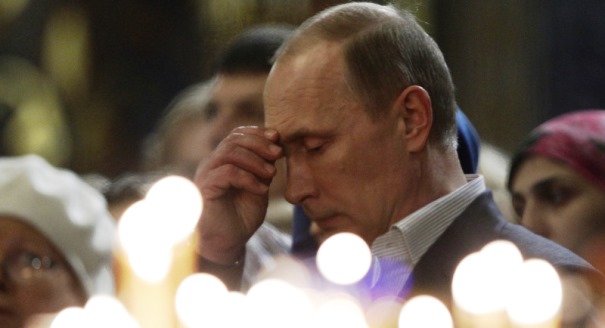
There were other public remarks in this holiday season that are worth noting. Patriarch Kirill, the head of the Russian Orthodox Church, made a televised appearance on Christmas Day, January 7. The outspoken Patriarch, known for his socially conservative views, went farther than before in criticizing the current trends in the West which he called anti-Christian and anti-religious. He put the blame for this directly on Western elites. These accusations are consonant with President Putin's own judgment on Europe as having lost the way. A small news item this week about a St. Petersburg assemblyman starting a new NGO to defend Serbian religious rights in Kosovo points in the direction of Russia's new push—promoting religious freedom in increasingly "post-Christian" Europe.
For years, European politicians criticized Russia for its human rights deficit. No conversation about EU-Russia relations was complete without a reference to the value gap which separated Russia from its neighbors to the west. The 2012 Pussy Riot case, in retrospect, looks like a turning point. From then on, the Russian leaders, spiritual and temporal, have been mounting a counter-push. They position themselves as defenders of Europe's 19th century values which marked the continent's heyday, against what they term as ultra-liberalism which they claim leads people astray. The value gap between the EU and Russia has gained a new dimension.
This gap is not perfect. Liberal trends have not all been snuffed out in Russia, and Russian conservatives count a number of potential allies in the EU countries. The Patriarch and the Pope have overlapping agendas, and their historic meeting looks more likely now than ever before. As 400,000 Russians went for Christmas shopping and skiing to Finland alone, dozens of thousands of others stood in line for 9 hours at Moscow's Our Savior Cathedral to see the Gifts of the Magi, the relics that had come from Mount Athos. Both within Russia and between Russia and Europe, there is a need for debate.
Former Director, Carnegie Moscow Center
Trenin was director of the Carnegie Moscow Center from 2008 to early 2022.
Recent Work
Dmitri Trenin
Dmitri Trenin
Carnegie does not take institutional positions on public policy issues; the views represented herein are those of the author(s) and do not necessarily reflect the views of Carnegie, its staff, or its trustees.

By failing to address Palestinian representation, the current process is bound to lead to just another temporary arrangement.

Nathan J. Brown

Just look at Iraq in 1991.

Marwan Muasher

A coalition of states is seeking to avert a U.S. attack, and Israel is in the forefront of their mind.

Michael Young

Baku may allow radical nationalists to publicly discuss “reunification” with Azeri Iranians, but the president and key officials prefer not to comment publicly on the protests in Iran.

Bashir Kitachaev
The country’s leadership is increasingly uneasy about multiple challenges from the Levant to the South Caucasus.

Armenak Tokmajyan