

Commentary
Thomas de Waal
{
  "authors": [
    "Thomas de Waal"
  ],
  "type": "commentary",
  "centerAffiliationAll": "",
  "centers": [
    "Carnegie Endowment for International Peace",
    "Carnegie Europe",
    "Carnegie Russia Eurasia Center"
  ],
  "collections": [],
  "englishNewsletterAll": "",
  "nonEnglishNewsletterAll": "",
  "primaryCenter": "Carnegie Europe",
  "programAffiliation": "",
  "programs": [],
  "projects": [],
  "regions": [
    "Caucasus",
    "Russia",
    "Eastern Europe",
    "Ukraine"
  ],
  "topics": [
    "Political Reform",
    "Security",
    "Foreign Policy"
  ]
}
Source: Getty
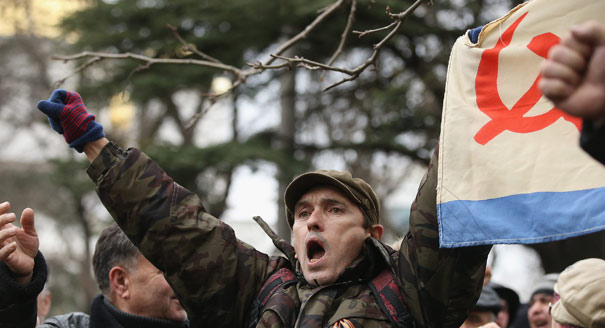
Some kind of political crisis in Crimea looks almost inevitable. At the moment the priority has to be stop having a military one as well.
As Crimea threatens to turn into a dangerous new European flash point, many are drawing parallels with the 2008 war in Georgia.
Needless to say, there are obvious differences. Crimea is bigger and Russia’s stake there is bigger.
It is also naturally less combustible. Many people on Ukraine’s Black Sea coast do not feel “Ukrainian” or “Russian” but both. It is no accident that Crimea avoided meltdown and conflict in the early 1990s when many predicted it. Indeed, one of the biggest protests I recall, when working in Moscow in that period, came in 1995 when Ukrainian television dubbed Santa Barbara into Ukrainian, rather than Russian.
But a crisis can take a life of its own. Who could have anticipated two weeks ago that 100 people would die in Kiev?
Some kind of political crisis in Crimea looks almost inevitable. At the moment the priority has to be stop having a military one as well. The conflicts in the Caucasus, including the 2008 war, were all avoidable. Here are three lessons from how that unfortunate conflict began:The armed men trying to take over bits of Crimea may be acting on direct orders from Russia, they may not be, or the answer may be somewhere in the middle.
In any case, some local politicians in Crimea are working to a local agenda that is much narrower than that of Moscow. Quite possibly this is to provoke a reaction from Kiev in order to seek Russian intervention.
Many people still use the phrase “Russia invaded Georgia” in August 2008. That was in fact only the last of a whole sequence of actions. South Ossetians and Georgians were involved in local skirmishes on the ground. The Russian 58th Army was on standby. A panicky Georgian leader Mikheil Saakashvili attacked first and the Russian army responded a few hours later, soon escalating this into a broader brutal attack on Georgia as a whole.
In the compelling BBC documentary about the 2008 war, both U.S. Assistant Secretary of State Dan Fried and Russian Deputy Foreign Minister Grigory Karasin volunteered that they had talked to each other and to their friends in Tbilisi and Tskhinvali respectively, right on the eve of fighting, and believed the situation was under control.
But the war happened anyway. One figure who did not get much attention at the time but may have played a fateful role was South Ossetian leader Eduard Kokoity, who had a lot of incentives to want the Russians to dig him out of a hole. So it is worth asking, “Will someone try to play Kokoity in Crimea?” and whether there are forces on the other side who also want a fight and working out how to rein in these actors.
This is about ordinary people, not the politicians. In 2008, South Ossetians were sadly overlooked as agents in their own story. Likewise, Crimean Russians are not mere stooges of the Kremlin and have their own story to tell. It threads a tale from Nazi occupation in World War II to Nikita Khruschev’s alleged betrayal to serial disappointment with governments in Kiev and fears about “Ukrainization.”
This is a one-sided narrative. But it is one that the government in Kiev needs to take on board and respond to with inclusive messages from its side—preferably delivered in the Russian language.
Some Western commentators are already arguing that the West needs to make a pre-emptive response to a hypothetical threat—Russian President Vladimir Putin’s supposed plans to annex Crimea and Ukraine. I have again read that Putin wants to re-create the USSR, using a quotation that I and others have pointed out does not actually imply that.
Any Russian escalation deserves a strong response from the West. But if you read what Putin is actually saying he is being more equivocal. He is ruthless, but he is not Sauron in Lord of the Rings. He almost certainly wants the government in Kiev to fail, but he is also hosting the G8 summit in Sochi in June.
What is Russia’s strategic game in Crimea? In South Ossetia in 2008 what made it absolutely certain that Moscow would intervene militarily was the presence of Russian peacekeepers on the ground. (Two years later, the Russians did not intervene in Osh in Kyrgyzstan, even when there were calls for them to do so.)
Russia has one overwhelming strategic asset in Crimea: the Black Sea naval base in Sevastopol. My guess is that Putin’s main goal in Crimea is to maintain that base at all costs.

Senior Fellow, Carnegie Europe
De Waal is a senior fellow at Carnegie Europe, specializing in Eastern Europe and the Caucasus.
Recent Work
Thomas de Waal
Thomas de Waal, ed.
Carnegie does not take institutional positions on public policy issues; the views represented herein are those of the author(s) and do not necessarily reflect the views of Carnegie, its staff, or its trustees.

A coalition of states is seeking to avert a U.S. attack, and Israel is in the forefront of their mind.

Michael Young

Baku may allow radical nationalists to publicly discuss “reunification” with Azeri Iranians, but the president and key officials prefer not to comment publicly on the protests in Iran.

Bashir Kitachaev
The country’s leadership is increasingly uneasy about multiple challenges from the Levant to the South Caucasus.

Armenak Tokmajyan
The countries of the region have engaged in sustained competition that has tested their capacities and limitations, while resisting domination by rivals. Can a more stable order emerge from this maelstrom, and what would it require?
Hamza Meddeb, Mohamed Ali Adraoui
As Washington reduces its presence in the country, the success of its withdrawal and continued containment of the Islamic State will hinge on adopting an approach of flexible oversight built around three priorities, as well as balancing Turkish and Israeli red lines.

Kheder Khaddour, Issam Kayssi