

Commentary
Dmitri Trenin
{
  "authors": [
    "Dmitri Trenin"
  ],
  "type": "commentary",
  "centerAffiliationAll": "",
  "centers": [
    "Carnegie Endowment for International Peace",
    "Carnegie Russia Eurasia Center"
  ],
  "collections": [],
  "englishNewsletterAll": "",
  "nonEnglishNewsletterAll": "",
  "primaryCenter": "Carnegie Russia Eurasia Center",
  "programAffiliation": "",
  "programs": [],
  "projects": [],
  "regions": [
    "Russia",
    "Eastern Europe",
    "Ukraine"
  ],
  "topics": [
    "Security",
    "Foreign Policy"
  ]
}
Source: Getty
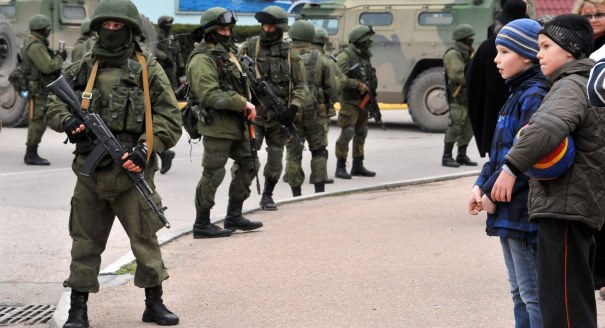
The possibility of a Russian military operation in Ukraine that is not limited to Crimea is real. Russia and the West are on the verge a confrontation far worse than over Georgia in 2008.
President Putin has received approval from the upper house of parliament to use Russian military forces in Ukraine. Even before this, Russian troops were sighted landing in Crimea.
Thus, I would not rule out a military operation in Ukraine not limited to Crimea, but also covering eastern and southern regions of the country. The Ukrainian turmoil has pushed Russia to looking for a solution to the Ukrainian issue that would probably include a Crimea within the Russian Federation and eastern and southern regions of Ukraine forming a separate entity integrated with Russia economically and aligned with it politically. It is not clear at this point whether Kiev will be left to build a rump Ukraine with the western regions or whether it will be swayed to join the eastern regions.
The situation is extremely tense. The Russian parliament even asked Putin to recall the ambassador to the United States in response to President Obama's recent reference to the "high price" Russia would pay for intervening in Ukraine. Russia and the West find themselves on the brink of a confrontation far worse than in 2008 over Georgia.
Former Director, Carnegie Moscow Center
Trenin was director of the Carnegie Moscow Center from 2008 to early 2022.
Recent Work
Dmitri Trenin
Dmitri Trenin
Carnegie does not take institutional positions on public policy issues; the views represented herein are those of the author(s) and do not necessarily reflect the views of Carnegie, its staff, or its trustees.

By failing to address Palestinian representation, the current process is bound to lead to just another temporary arrangement.

Nathan J. Brown

Just look at Iraq in 1991.

Marwan Muasher

A coalition of states is seeking to avert a U.S. attack, and Israel is in the forefront of their mind.

Michael Young

Baku may allow radical nationalists to publicly discuss “reunification” with Azeri Iranians, but the president and key officials prefer not to comment publicly on the protests in Iran.

Bashir Kitachaev
The country’s leadership is increasingly uneasy about multiple challenges from the Levant to the South Caucasus.

Armenak Tokmajyan