

Commentary
Alexey Malashenko
{
  "authors": [
    "Alexey Malashenko"
  ],
  "type": "commentary",
  "centerAffiliationAll": "",
  "centers": [
    "Carnegie Endowment for International Peace",
    "Carnegie Russia Eurasia Center"
  ],
  "collections": [],
  "englishNewsletterAll": "",
  "nonEnglishNewsletterAll": "",
  "primaryCenter": "Carnegie Russia Eurasia Center",
  "programAffiliation": "",
  "programs": [],
  "projects": [
    "Eurasia in Transition"
  ],
  "regions": [
    "Central Asia",
    "Kazakhstan"
  ],
  "topics": [
    "Political Reform",
    "Foreign Policy"
  ]
}
Source: Getty
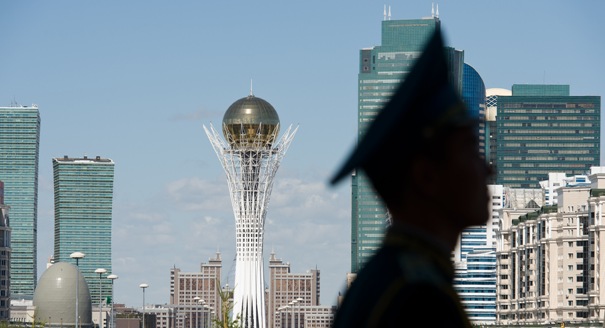
Kazakhstan’s new Prime Minister, Karim Massimov, is “the president’s most trusted man.” If his term lasts long enough, he may become a sort of political double for President Nursultan Nazarbayev.
One of the publications devoted to the recent change at the helm of the Kazakh cabinet was entitled “Foretelling the Prime Ministers.” In some sense, the appointment of 48-year-old Karim Massimov, who previously served as the head of presidential administration, seems quite natural. The country’s economic outlook is complicated. As President Nursultan Nazarbayev put it, “our country may experience problems due to the global economic crisis.” The Kazakhstan 2050 Strategy is facing some difficulties as well. In February 2014, Kazakhstan devalued its currency (tenge) by 20 percent, which turned the people against the government and the regime as a whole.
The new prime minister did not really crave his position, but he probably understood that he would become the head of the government sooner or later. As was expected, all 105 Majilis members voted in favor of his appointment. Massimov already served as prime minister from 2007 to 2012. He displayed professionalism and successfully dealt with complex problems during the economic crisis of 2007-2009.
It is widely believed that Massimov will primarily serve as a “technical manager.” It is clear, however, that his responsibilities will extend beyond that. First, his tenure comes at an extremely important, perhaps even critical juncture of Eurasian integration, which Moscow desperately wants to accelerate. However, an unbiased look at the proposed Eurasian Union and its predecessor, the Customs Union, suggests that these projects are not yet fully developed. Besides, the events in Ukraine confirm that the Eurasian Union will not and cannot be merely an economic association. The Kremlin repeatedly denied that the integration is driven by Russia’s political ambitions, but now everyone can clearly see that it is. Second, with the unprecedented escalation of tensions between Russia and the West, which is likely to last for quite some time, Kazakhstan needs to brace itself for serious diplomatic maneuvering. Also, sanctions against Russia may indirectly affect its Eurasian partners. Karim Massimov, whom some call “the president’s most trusted man,” is to partly share this heavy burden with Nursultan Nazarbayev. In this light, he cannot be treated as simply a “technical manager.”
Finally, any change in the makeup of Kazakhstan’s ruling elite restarts the discussions on power transition. True, Massimov's return to the post of prime minister did not generate excessive rumors on the president’s successor. People have gotten used to changes at the top already. Nevertheless, it should be noted that Massimov is indeed “the president’s most trusted man.” And if his term lasts long enough, he may become a sort of political double for the Kazakh president, which will make him the person best prepared to advance the country’s development strategy and foreign policy.
But as of now, the process of “foretelling the prime ministers” continues.
Former Scholar in Residence, Religion, Society, and Security Program
Malashenko is a former chair of the Carnegie Moscow Center’s Religion, Society, and Security Program.
Recent Work
Alexey Malashenko
Alexey Malashenko
Carnegie does not take institutional positions on public policy issues; the views represented herein are those of the author(s) and do not necessarily reflect the views of Carnegie, its staff, or its trustees.

By failing to address Palestinian representation, the current process is bound to lead to just another temporary arrangement.

Nathan J. Brown

Just look at Iraq in 1991.

Marwan Muasher

A coalition of states is seeking to avert a U.S. attack, and Israel is in the forefront of their mind.

Michael Young

Baku may allow radical nationalists to publicly discuss “reunification” with Azeri Iranians, but the president and key officials prefer not to comment publicly on the protests in Iran.

Bashir Kitachaev

The country’s leadership is increasingly uneasy about multiple challenges from the Levant to the South Caucasus.

Armenak Tokmajyan