

Commentary
Dmitri Trenin
{
  "authors": [
    "Dmitri Trenin"
  ],
  "type": "commentary",
  "centerAffiliationAll": "",
  "centers": [
    "Carnegie Endowment for International Peace",
    "Carnegie Russia Eurasia Center"
  ],
  "collections": [],
  "englishNewsletterAll": "",
  "nonEnglishNewsletterAll": "",
  "primaryCenter": "Carnegie Russia Eurasia Center",
  "programAffiliation": "",
  "programs": [],
  "projects": [],
  "regions": [
    "North America",
    "United States",
    "East Asia",
    "China",
    "Japan",
    "Russia"
  ],
  "topics": [
    "Foreign Policy"
  ]
}
Source: Getty
Strong Japanese-Russian relations are economically beneficial and a strategic counterbalance against China’s influence. But the Ukraine crisis and Japan’s U.S. loyalties could have damaging effects.
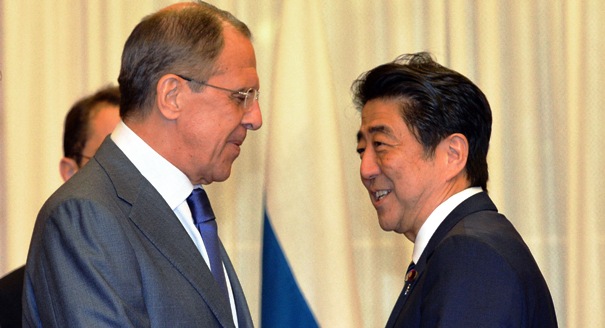
As Russian Foreign Minister Sergey Lavrov was visiting Beijing last week, it was announced that the visit to Moscow by Japan's Foreign Minister Fumio Kishida was being postponed. The announcement, of course, came amid the rising tensions in Ukraine and the continuing fundamental deterioration of the West's relations with Russia. Japan, after all, is a loyal ally of the United States.
Yet, both Tokyo and Moscow have gone to some lengths to limit the damage. The joint announcement was couched in most polite phrases. The Russian foreign ministry spokesman, Alexander Lukashevich, allowed no criticism in his public comments on the postponement decision. Clearly, with the threats of economic sanctions against Russia still on the table in Washington and in EU capitals, even after the recent Geneva agreement on Ukraine, Moscow looks to Tokyo to make up for the likely losses in Europe and North America.
None of this is going to be easy, but none of this is totally impossible either—provided the Japanese do their part by becoming what Germany, until recently, has been to Russia: a major technological partner, a leading investor, and a gateway to the wider region. Doing this will be exceedingly difficult, of course, in the current environment of intensifying U.S.-Russian rivalry. However, Abe may have a few useful arguments to offer to President Barack Obama when he comes to Tokyo soon.
Why should the U.S.-Russian rivalry be allowed to strengthen Beijing? Who benefits when the United States is less comfortable and Japan feels less safe? In this new cold period in Russian-Western relations, there are already a few protected areas of collaboration, like nonproliferation. Why not a vibrant Japan-Russia link too? After all, wasn't it the one missing piece, even a strategic oversight in the original U.S. "pivot to Asia" concept?
Former Director, Carnegie Moscow Center
Trenin was director of the Carnegie Moscow Center from 2008 to early 2022.
Recent Work
Dmitri Trenin
Dmitri Trenin
Carnegie does not take institutional positions on public policy issues; the views represented herein are those of the author(s) and do not necessarily reflect the views of Carnegie, its staff, or its trustees.

In an interview, Rozina Ali discusses her new book on the rise and manifestations of Islamophobia in the United States.

Michael Young

In an interview, Ian Lustick and Eli Clifton discuss their new book on why a prominent ally has so much influence in America.
Michael Young

As the U.S. stumbles in its war with Iran, we are likely to see an acceleration of its disengagement from the region.
Michael Young

Middle Eastern states should welcome an accelerated U.S. disengagement from their region.
Michael Young

In an interview, former ambassador Charles Freeman assesses the Trump administration’s war against Iran.
Michael Young