

Paper
Yezid Sayigh
{
  "authors": [
    "Yezid Sayigh"
  ],
  "type": "legacyinthemedia",
  "centerAffiliationAll": "dc",
  "centers": [
    "Carnegie Endowment for International Peace",
    "Malcolm H. Kerr Carnegie Middle East Center"
  ],
  "collections": [],
  "englishNewsletterAll": "menaTransitions",
  "nonEnglishNewsletterAll": "",
  "primaryCenter": "Malcolm H. Kerr Carnegie Middle East Center",
  "programAffiliation": "MEP",
  "programs": [
    "Middle East"
  ],
  "projects": [],
  "regions": [
    "Levant",
    "Israel",
    "Palestine",
    "Middle East"
  ],
  "topics": [
    "Political Reform",
    "Security",
    "Foreign Policy"
  ]
}
Source: Getty
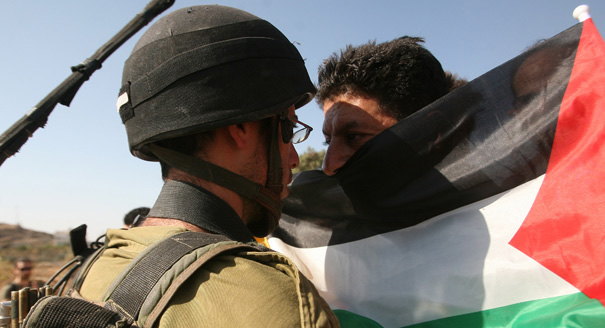
Israel and Hamas have found themselves sucked into a conflict that neither side really wanted and that outside powers seem reluctant or unable to stop.
Source: France 24
ARMEN GEORGIAN: It’s a depressingly familiar pattern. Middle East peace talks collapse and a fresh round of Israeli-Palestinian bloodletting begins. With a grim inevitability, Israel and Hamas found themselves sucked into a conflict that neither side really wanted and that outside powers seems reluctant or impotent to stop. To discuss this situation, I’m pleased to welcome a very distinguished Middle East Analyst. Yezid Sayigh joins me from Beirut. In the early 90s, he was a negotiator in the Palestinian delegation in peace talks with Israel. He’s also an academic who has taught at Cambridge and at King’s College London. Yezid Sayigh has authored numerous books on the Middle East and he’s now senior associate at the Carnegie Middle East Center think tank.
France 24 the Interview’s Armen Georgian spoke with Carnegie’s Yezid Sayigh about why the Israeli-Egyptian blockade of the Gaza Strip is a dead-end strategy, the diplomatic efforts to stop the fighting, and the impact of the Gaza conflict both on Hamas and on the Palestinian Authority.
This interview was broadcasted on France 24’s the Interview.

Senior Fellow, Malcolm H. Kerr Carnegie Middle East Center
Yezid Sayigh is a senior fellow at the Malcolm H. Kerr Carnegie Middle East Center in Beirut, where he leads the program on Civil-Military Relations in Arab States (CMRAS). His work focuses on the comparative political and economic roles of Arab armed forces, the impact of war on states and societies, the politics of postconflict reconstruction and security sector transformation in Arab transitions, and authoritarian resurgence.
Recent Work
Yezid Sayigh
Yezid Sayigh
Carnegie does not take institutional positions on public policy issues; the views represented herein are those of the author(s) and do not necessarily reflect the views of Carnegie, its staff, or its trustees.

In an interview, Ian Lustick and Eli Clifton discuss their new book on why a prominent ally has so much influence in America.

Michael Young

As the U.S. stumbles in its war with Iran, we are likely to see an acceleration of its disengagement from the region.
Michael Young
The Zaidi government’s objective to collect weapons is constrained by regional conflict, but it can take certain measures at home.
Ali Al-Mawlawi
It is improbable that Israel’s forthcoming elections will alter much in terms of how the country thinks about security.

Nathan J. Brown

Huawei pushed hard to enter the Egyptian data centers market, until the Americans made a better offer.

Angie Omar