

In The Media
Petr Topychkanov
{
  "authors": [
    "Petr Topychkanov"
  ],
  "type": "commentary",
  "centerAffiliationAll": "",
  "centers": [
    "Carnegie Endowment for International Peace",
    "Carnegie Russia Eurasia Center"
  ],
  "collections": [],
  "englishNewsletterAll": "",
  "nonEnglishNewsletterAll": "",
  "primaryCenter": "Carnegie Russia Eurasia Center",
  "programAffiliation": "",
  "programs": [],
  "projects": [],
  "regions": [
    "South Asia",
    "India",
    "Russia"
  ],
  "topics": [
    "Foreign Policy"
  ]
}
Source: Getty
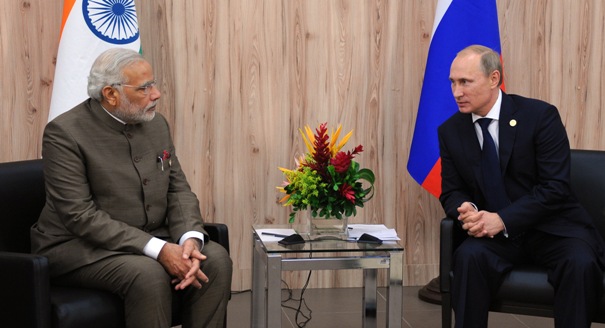
Narendra Modi’s and his associates’ foreign policy experience will guide them toward a balanced policy in which Russia will play one of the key roles.
New figures are at the helm in India. An outside observer might think that some of them have little foreign policy experience. Some may call Narendra Modi’s international relations’ expertise into question.
In reality, Modi and his associates do have foreign policy experience. This experience will guide them toward a balanced policy in which Russia will play one of the key roles.
Narendra Modi has given Russia special attention more than once. Russian Deputy Prime Minister Dmitry Rogozin became only the second foreign politician to be seen by the new Indian prime minister on June 19 (Chinese Foreign Minister Wang Yi was the prime minister’s first guest on June 9).
Meeting the Russian president and deputy prime minister was not Narendra Modi's first exposure to Russia. In fact, back on June 6, 2001, President Putin and then Indian Prime Minister Atal Bihari Vajpayee signed a protocol of cooperation between the Astrakhan Region and the State of Gujarat (Narendra Modi as a member of the Indian delegation at the time). The protocol was renewed in 2006 during the visit of the delegation headed by Narendra Modi to the Astrakhan Region. In recent years, the relations between the Russian region and the Indian state have developed rapidly. Astrakhan and Allahabad became sister cities. In October 2009, Narendra Modi made his third trip to Russia—this time to participate in the International Energy Week.
As for the prime minister’s inner circle, the legendary figure of the National Security Advisor Ajit Kumar Doval looms particularly large. This post cannot fit all of his famous exploits, and many pages of his biography still remain classified. But even the known facts testify to his knowledge of Russia and a long record of cooperation with this country. As a head of the Intelligence Bureau’s operation wing in the 1990’s—the post he had held for ten years, Ajit Doval was involved in organizing the effort to assist Afghanistan’s Northern Alliance, which was supported by Russia, India, and Iran. It is clear that he had numerous contacts with the Russian side in the course of the three country’s cooperation on this issue.
The above examples demonstrate that the new Indian authorities know Russia, understand how to work with it and are willing to develop India-Russia relations.
Former Fellow, Nonproliferation Program, Moscow Center
Topychkanov was a fellow in the Carnegie Moscow Center’s Nonproliferation Program.
Recent Work
Petr Topychkanov
Petr Topychkanov
Carnegie does not take institutional positions on public policy issues; the views represented herein are those of the author(s) and do not necessarily reflect the views of Carnegie, its staff, or its trustees.

Just look at Iraq in 1991.

Marwan Muasher

A coalition of states is seeking to avert a U.S. attack, and Israel is in the forefront of their mind.

Michael Young

Baku may allow radical nationalists to publicly discuss “reunification” with Azeri Iranians, but the president and key officials prefer not to comment publicly on the protests in Iran.

Bashir Kitachaev

The country’s leadership is increasingly uneasy about multiple challenges from the Levant to the South Caucasus.

Armenak Tokmajyan
The countries of the region have engaged in sustained competition that has tested their capacities and limitations, while resisting domination by rivals. Can a more stable order emerge from this maelstrom, and what would it require?
Hamza Meddeb, Mohamed Ali Adraoui