

Article
Thomas de Waal
{
  "authors": [
    "Thomas de Waal"
  ],
  "type": "commentary",
  "centerAffiliationAll": "",
  "centers": [
    "Carnegie Endowment for International Peace",
    "Carnegie Europe",
    "Carnegie Russia Eurasia Center"
  ],
  "collections": [],
  "englishNewsletterAll": "",
  "nonEnglishNewsletterAll": "",
  "primaryCenter": "Carnegie Europe",
  "programAffiliation": "",
  "programs": [],
  "projects": [],
  "regions": [
    "Caucasus",
    "Georgia",
    "Eastern Europe",
    "Ukraine"
  ],
  "topics": [
    "Political Reform",
    "Foreign Policy"
  ]
}
Source: Getty
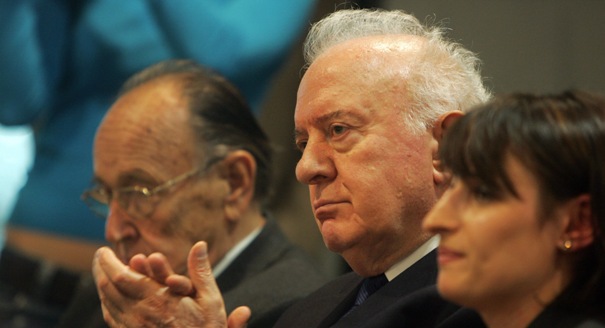
As Petro Poroshenko embarks on a long steep journey as leader of Ukraine, he would do well to study Eduard Shevardnadze's statecraft in Georgia, with both his great successes and the later disappointments.
August 16 marked 40 days since the death of former Georgian leader Eduard Shevardnadze, a traditional moment to bid farewell to the departed.
The many obituaries of Shevardnadze were justly full of praise for his achievements as Mikhail Gorbachev's foreign minister. Several of them were less charitable about his 11 years as leader of independent Georgia. Having been unable to pay homage that day to a man I knew and respected, I offer a much more positive view of Shevardnadze's rule, which also has many lessons for today's Ukraine.
Certainly, the last three or four years of Shevardnadze's time as president of Georgia were miserable. Corruption was rampant and powerful oligarchs were more powerful than the government. The paradox is that Georgia's state weakness was to a large degree the price Shevardnadze paid for success in saving the country from collapse.
There was no state at all. On the same day in June 1992 that Shevardnadze made a peace deal over South Ossetia, Gamsakhurdia supporters briefly seized the television station in Tbilisi and the Georgian interior minister was evicted from his office in Abkhazia. Soon afterwards, Shevardnadze failed to prevent war from breaking out in Abkhazia, waged by many of the same Georgian militias who had had lost a role because of the truce in South Ossetia.
Over several years, Shevardnadze pulled off a remarkable political feat. He slowly disarmed and neutralized Georgia's warlords and played them against each other. He allowed democracy to prosper. And he crafted a distinct foreign policy, courting the West, while keeping on as good terms as he could with Russia. His maneuvering and diplomacy eventually secured the two main foundations that guaranteed Georgian independence: the Baku-Tbilisi-Ceyhan oil pipeline and the agreement to withdraw Russian military bases from Georgian soil.
But to keep the country together, Shevardnadze made Faustian deals with regional bosses, like Aslan Abashidze, turning a blind eye to their corruption and local agendas. His Georgia was more or less democratic, with powerful friends abroad—but also weak, with barely a central government. Huge amounts of energy were devoted to managing crises with Russia.
Does that sounds familiar? Ukraine's new leader Petro Poroshenko faces many of the same challenges.
Like Shevardnadze, Poroshenko appears to be a pragmatist who seems prepared to try anything if it keeps his country together. He looks to be in a hurry to end the armed pro-Russian rebellion in Donetsk and Lugansk, both through fighting and talking, in order to get on with the bigger job of trying to forge national unity and rescue Ukraine's economy.
In the process, he has cut, in the words of the BBC's David Stern, "a devil's bargain" with all kinds of unsavory militias who are prepared to do the Ukrainian government's dirty work for it. One of those militias, the notorious Right Sector, threatened "a march on Kiev" in terms that Shevardnadze of the 1990s would have recognized.
Poroshenko must also rely on oligarchs, men like Rinat Akhmetov and Igor Kolomoisky to stabilize his country, while knowing that they want to carve out as much regional and economic power as they can from the current mess.
A big challenge will come from Kolomoisky, governor of Dnepropetrovsk. One of Ukraine's most seasoned political power-brokers and reputedly the country's fourth wealthiest man, he formed his own militia, the Dnieper Battalion, to fight in the east.
Today's allies can be tomorrow's threat. As he embarks on a long steep journey as leader of Ukraine, Poroshenko would do well to study Shevardnadze's statecraft in Georgia, with both his great successes and the later disappointments.

Senior Fellow, Carnegie Europe
Thomas de Waal is a senior fellow at Carnegie Europe, specializing in Eastern Europe and the Caucasus.
Recent Work
Thomas de Waal
Thomas de Waal
Carnegie does not take institutional positions on public policy issues; the views represented herein are those of the author(s) and do not necessarily reflect the views of Carnegie, its staff, or its trustees.

By failing to address Palestinian representation, the current process is bound to lead to just another temporary arrangement.

Nathan J. Brown
In an interview, Sergei Melkonian discusses Armenia’s and Azerbaijan’s careful balancing act among the United States, Israel, and Iran.

Armenak Tokmajyan

Just look at Iraq in 1991.

Marwan Muasher

A coalition of states is seeking to avert a U.S. attack, and Israel is in the forefront of their mind.

Michael Young

Baku may allow radical nationalists to publicly discuss “reunification” with Azeri Iranians, but the president and key officials prefer not to comment publicly on the protests in Iran.

Bashir Kitachaev