

In The Media
Mario Abou Zeid
{
  "authors": [
    "Mario Abou Zeid"
  ],
  "type": "legacyinthemedia",
  "centerAffiliationAll": "dc",
  "centers": [
    "Carnegie Endowment for International Peace",
    "Malcolm H. Kerr Carnegie Middle East Center"
  ],
  "collections": [],
  "englishNewsletterAll": "menaTransitions",
  "nonEnglishNewsletterAll": "",
  "primaryCenter": "Malcolm H. Kerr Carnegie Middle East Center",
  "programAffiliation": "MEP",
  "programs": [
    "Middle East"
  ],
  "projects": [],
  "regions": [
    "Gulf",
    "Levant",
    "Syria",
    "Iraq",
    "North America",
    "United States",
    "Middle East"
  ],
  "topics": [
    "Political Reform",
    "Security",
    "Military",
    "Foreign Policy",
    "Religion"
  ]
}
Source: Getty
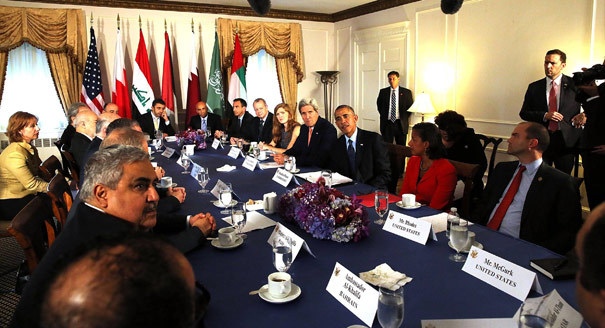
It remains to be seen what role Arab countries will play in combined international efforts to defeat the Islamic State.
Source: ABC Radio National’s RN Drive
Speaking on ABC Radio National's RN Drive, Carnegie’s Mario Abou Zeid said that the United States is attempting to integrate an Islamic State alliance and limit its funding and support for efforts to hunt down Islamic State leadership and fighters. However, Abou Zeid pointed out that in order to defeat the jihadist group, a three-pronged approach must be looked at, one that includes not only a military strategy, but also a strategy for religious and cultural reform.
Abou Zeid warned that the sectarian dimension of the conflict cannot be ignored. If, for example, any Shiite force were to join the alliance against the Islamic State, it would give the jihadist group the justification to present itself as a victim of regional Shiite expansion, and thus, enable the group to recruit more fighters and gain power in the region’s Sunni communities.
This interview was originally broadcast on ABC Radio National’s RN Drive.

Former Research Analyst, Middle East Center
Abou Zeid was a research analyst at the Carnegie Middle East Center, where his work focuses on political developments in Lebanon, Syria, Iraq, and Iran.
Recent Work
Mario Abou Zeid
Mario Abou Zeid
Carnegie does not take institutional positions on public policy issues; the views represented herein are those of the author(s) and do not necessarily reflect the views of Carnegie, its staff, or its trustees.

Israel is encroaching on the country’s territory, while the Lebanese look askance at one another.

Issam Kayssi
The party’s domestic and regional roles have changed, so Lebanon should devise a disarmament strategy that encompasses this.

Michael Young

In an interview, Marc Lynch discusses his new book decrying the post-1990 U.S.-dominated order in the Middle East.
Michael Young

Because perpetual conflict enhances control, offers economic benefits, and allows leaders to ignore popular preferences.

Angie Omar
In Basra, an ethnoracial minority wages a constant struggle to assert itself in the face of marginalization.

Zeinab Shuker