

Article
Frederic Grare
{
  "authors": [
    "Frederic Grare"
  ],
  "type": "other",
  "centerAffiliationAll": "dc",
  "centers": [
    "Carnegie Endowment for International Peace"
  ],
  "collections": [],
  "englishNewsletterAll": "ctw",
  "nonEnglishNewsletterAll": "",
  "primaryCenter": "Carnegie Endowment for International Peace",
  "programAffiliation": "SAP",
  "programs": [
    "South Asia"
  ],
  "projects": [],
  "regions": [
    "South Asia",
    "Afghanistan",
    "Western Europe",
    "France"
  ],
  "topics": [
    "Security",
    "Military",
    "Foreign Policy"
  ]
}
Source: Getty
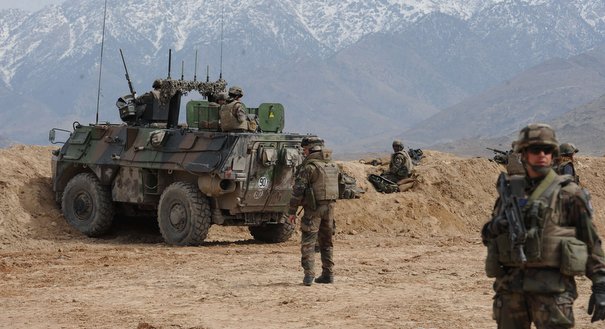
The existence of a French civil-military cooperation in Afghanistan and the forms it took were the direct and indirect consequences of political decisions that placed French forces under U.S. command and consequently increased the pressure on the former to operate like their U.S. counterparts.
Source: Book chapter from Reconstructing Afghanistan
French forces were present in Afghanistan as early of the US post 9/11 intervention. Similarly, a number of civilian operation were started or restarted immediately after the fall of the Taliban regime. There was, however, no civilian-military cooperation per se. Although they were officially both contributing to the larger objective of state building and reconstruction, civilian and military acted autonomously. The main sectors of concentration of civilian agencies, whether they were branches of the French state or NGOs funded by the French government, were education and health. No formal mechanism of inter- agency cooperation existed.
It is not until the nomination of the first special envoy for Afghanistan and Pakistan, Pierre Lellouche, in February 2009, that the concept of civil-military operation became operational. Unlike many of its allies and partners, France had so far refused to consider the possibility of establishing a Provincial Reconstruction Team (PRT) but although the word remained anathema, it would two years later establish a structure the organizing principles and directions of which were somehow comparable to those of a PRT. In this regard, one of the most striking characteristics is that the French started the debate on civil-military cooperation, and therefore on giving some degree of control to the military over civilian action, at a time when a parallel but opposite debate was starting on the civilianization of the PRTs.
Moreover, the concept of civil-military relations was itself problematic. Not only was the idea itself welcomed differently by the various actors, but it meant different thing to different people. For the military it was essentially (although with some nuances) an instrument to convince local populations to accept the presence of military forces and to cooperate. Development agencies had of course exclusively development in mind. In between, a structure, the so-called AfPak cell, an inter-agency body created specifically to coordinate the work of the various French official bodies involved in Afghanistan, helped define mid terms projects aimed at providing the overall French action in Afghanistan, the required consistency.Why and how the present French civil-military set up was established in Afghanistan constitutes the object of the present chapter. It argues that international politics, more than any specific concerns for the Afghans, have been the driver for the changes in the form of involvement chosen. This assertion needs however to be qualified: the argument is not that developmental or humanitarian concerns, and therefore population, were irrelevant in French decisions. They were indeed at the main (and for a long time the sole) justification for the French intervention in Afghanistan in all official discourses. It simply means that the existence of a French civil-military cooperation in Afghanistan and the forms it took, were the direct and indirect consequences of political decisions as reflected by the shift from a quasi exclusive Kabul focus to Kapisa and Surobi, placing French forces under US command and consequently increasing the pressure on the former to operate like their US counterparts. This shift was motivated primarily by transatlantic considerations, not local requirements.
Although they did not really express it explicitly, the civilian side was aware that accepting the principle of a military-cooperation in Afghanistan also meant accepting the subordination of part of their development and humanitarian agenda to military objectives and practices. The issue was institutional (the leadership of the effort in Afghanistan), and theoretical (the link between development and security in geographically defined areas). Both had very practical implications. The final dispensation was a compromise in which the role and the modalities of action of the civilian team based in Nijrab was negotiated between the two sides.
It raised as many problems as it solved. Stabilizing a geographically defined area could make tactical sense but was not de facto relevant from a strategic perspective. It inevitably generated inequalities between various parts of the districts under French responsibility. What was at stake was not only the theoretical question of the correlation between the levels of investment and conflictuality in any given area, but the incentive it created for the less troubled area to change their behaviour. It also inevitably raised questions regarding the ownership of the reconstruction and development process, in particular, in the absence of reliable local and national institutions.
At the time of writing, the fact that France has allocated part of its civilian assistance to the conflict zone under French responsibility civil-military cooperation has allowed the French military to keep their operational autonomy in the areas under their responsibility. The result was more debatable however regarding the sustainability of their (real) achievements. This , very early on, questioned the very possibility of a successful exit strategy, i.e. a withdrawal at the end of which the Afghans of Kapisa and Surobi would be able to insure their own security in its various dimensions.
This is the introduction to a chapter in the book Reconstructing Afghanistan.

Former Nonresident Senior Fellow, South Asia Program
Frédéric Grare was a nonresident senior fellow at the Carnegie Endowment for International Peace, where his research focuses on Indo-Pacific dynamics, the search for a security architecture, and South Asia Security issues.
Recent Work
Frederic Grare
Frederic Grare
Carnegie does not take institutional positions on public policy issues; the views represented herein are those of the author(s) and do not necessarily reflect the views of Carnegie, its staff, or its trustees.

Just look at Iraq in 1991.

Marwan Muasher

A coalition of states is seeking to avert a U.S. attack, and Israel is in the forefront of their mind.

Michael Young

Baku may allow radical nationalists to publicly discuss “reunification” with Azeri Iranians, but the president and key officials prefer not to comment publicly on the protests in Iran.

Bashir Kitachaev
The country’s leadership is increasingly uneasy about multiple challenges from the Levant to the South Caucasus.

Armenak Tokmajyan
The countries of the region have engaged in sustained competition that has tested their capacities and limitations, while resisting domination by rivals. Can a more stable order emerge from this maelstrom, and what would it require?

Hamza Meddeb, Mohamed Ali Adraoui