

Paper
James L. Schoff, Douglas E. Rake, Joshua Levy
{
  "authors": [
    "James L. Schoff"
  ],
  "type": "legacyinthemedia",
  "centerAffiliationAll": "dc",
  "centers": [
    "Carnegie Endowment for International Peace"
  ],
  "collections": [],
  "englishNewsletterAll": "asia",
  "nonEnglishNewsletterAll": "",
  "primaryCenter": "Carnegie Endowment for International Peace",
  "programAffiliation": "AP",
  "programs": [
    "Asia"
  ],
  "projects": [],
  "regions": [
    "East Asia",
    "Japan"
  ],
  "topics": [
    "Security",
    "Foreign Policy"
  ]
}
Source: Getty
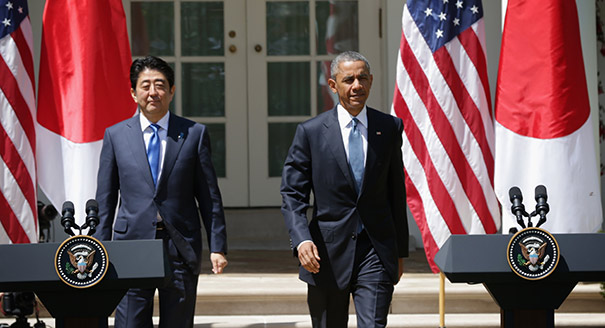
The main goal of Prime Minister Shinzo Abe’s visit to the United States was was to lay the foundation for greater alliance cooperation going forward.
Source: Diplomat
Speaking to the Diplomat, Carnegie’s James L. Schoff explained that the major highlight of Prime Minister Shinzo Abe’s visit to the United States was the new defense guidelines between the United States and Japan, announced at the earlier “2+2” meeting, even though these guidelines did not directly involve the prime minister’s visit. These guidelines bring fundamental changes, he explained, such as greater integration for noncombat operations and the establishment of mechanisms to deepen alliance coordination. He said that the goal of Abe’s actual visit and his speech to Congress was to lay the foundation for greater alliance cooperation going forward and that this was accomplished.
Schoff also discussed Abe’s speech to Congress, which was considered by some to be a preview for remarks he will make in the fall of this year commemorating the end of the war. Schoff said that Abe chose to focus on the U.S.-Japan relationship in his talks and addressed an American audience.Turning back to the guidlines, Schoff explained that they were a product of three separate scenarios: the Japanese government shifting from DPJ to LDP control and the Japanese public’s subsequent simultaneous disenchantment with DPJ policies and sufficient acceptance of the LDP’s platform, the continued existence of North Korean nuclear weapons along with China’s increased military spending and disagreement with Japan over territory issues, and worry in the Asia-Pacific over U.S. staying power in the region. The guidelines enable greater integration: both the United States and Japan should be able to come to each other’s aid and engage in mutual asset protection, which would result in a more balanced relationship between the two countries. He said that this potential closeness was a psychological deterrence in-and-of-itself, and Japan now has more responsibility for its own defense.
The guidelines should also be of use for encouraging future of trilateral cooperation, Schoff added. He said that more planning between Japan and the United States should make it easier to plan with other countries, such as Australia and South Korea. Schoff said that cooperation would be easier with Australia than South Korea, because the United States already has an information sharing agreement in place with Australia. He added that while Japan may not necessarily take more actions to engage more in multilateral and minilateral cooperation, it can definitely engage in more planning.

Former Senior Fellow, Asia Program
James L. Schoff was a senior fellow in the Carnegie Asia Program. His research focuses on U.S.-Japan relations and regional engagement, Japanese technology innovation, and regional trade and security dynamics.
Recent Work
James L. Schoff, Douglas E. Rake, Joshua Levy
James L. Schoff
Carnegie does not take institutional positions on public policy issues; the views represented herein are those of the author(s) and do not necessarily reflect the views of Carnegie, its staff, or its trustees.

In an interview, Ian Lustick and Eli Clifton discuss their new book on why a prominent ally has so much influence in America.

Michael Young

By failing to address Palestinian representation, the current process is bound to lead to just another temporary arrangement.

Nathan J. Brown

Just look at Iraq in 1991.

Marwan Muasher

A coalition of states is seeking to avert a U.S. attack, and Israel is in the forefront of their mind.
Michael Young

Baku may allow radical nationalists to publicly discuss “reunification” with Azeri Iranians, but the president and key officials prefer not to comment publicly on the protests in Iran.

Bashir Kitachaev