

Article
Thomas de Waal
{
  "authors": [
    "Thomas de Waal"
  ],
  "type": "commentary",
  "centerAffiliationAll": "",
  "centers": [
    "Carnegie Endowment for International Peace",
    "Carnegie Europe",
    "Carnegie Russia Eurasia Center"
  ],
  "collections": [],
  "englishNewsletterAll": "",
  "nonEnglishNewsletterAll": "",
  "primaryCenter": "Carnegie Europe",
  "programAffiliation": "",
  "programs": [],
  "projects": [
    "Eurasia in Transition"
  ],
  "regions": [
    "Caucasus",
    "Georgia",
    "Eastern Europe",
    "Ukraine"
  ],
  "topics": [
    "Political Reform"
  ]
}
Source: Getty
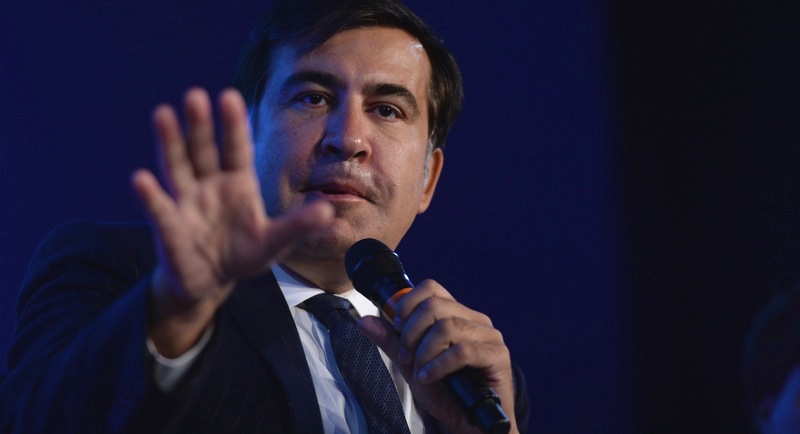
The sensational appointment of Mikheil Saakashvili to run Odessa will shake up both Ukraine and Georgia.
Mikheil Saakashvili—known to most of the world as “Misha”—will not slip quietly into history.
The sensational news that he has been appointed governor of Odessa province will have rippling effects across Ukraine, Georgia and in the breakaway territory of Transnistria.
Saakashvili has been an adviser to the Ukrainian government for the past year but mainly in a back-seat role. Now he is suddenly back in the limelight in charge of Ukraine’s biggest port and a region of 2.4 million people.
Poroshenko’s gamble will be that history can repeat itself and a foreign-born appointee can put his stamp on Odessa. The analogy is Duke of Richelieu, the charismatic young exiled French aristocrat named by Tsar Alexander I to be Odessa’s gradonachal’nik (or city chief) who launched the city on its golden years of economic boom. Richelieu’s statue, clad in a Roman toga, stands at the top of the famous Potemkin Steps.
Saakashvili certainly promises something completely different. He has already started purging the bureaucracy. But the challenge is even bigger than the one he faced in his own country in 2004. In Georgia he began with a clean slate and a big electoral mandate. Moreover, he was more the front-man selling the anti-corruption reforms implemented by others. In Odessa he must start from scratch in a foreign country.
Then there is the international context. The drama titled “Saakashvili vs Russia” is a decade old now and shows no signs of ending. The former Georgian president has used his time in Kiev to launch new broadsides against Russia and the Russian media is still trying to baitits bête noire. On Russia’s Channel 1, Mikhail Delyagin told viewers that Ukraine’s “supplies of political bums and prostitutes has been nearly exhausted. They have to import new ones.”
Odessa is largely Russian-speaking and still has close cultural and economic ties to Russia. Saakashvili’s divisive history with Russia will be problematic in a city that is still dealing with violence of May 2 last year when dozens of pro-Russian activists died in a fire in the center of town.
Commentators are also speculating on what this will mean for Transnistria, the pro-Russian enclave de facto separate from Moldova and 100km to the north of Odessa.
Bordering only Moldova and Ukraine, Transnistria has been squeezed over the last year. On May 21 the parliament in Kiev revoked the permission of the Russian military to transit Ukrainian territory to get there. Almost all the territory’s imports, both legal and illegal, come via Odessa. Transnistrian officials now say they are under a “blockade” and have appealed to Moscow for help.
In February Saakashvili went on the record to assert that Russia wanted to punch a land corridor from Odessa to Transnistria so as to destroy Ukraine. Any prospect of an operation to squeeze Transnistria will bring back bad memories of South Ossetia in 2004 when what began as a Georgian-government anti-smuggling operation led to a summer of bloodshed, setting the stage for the subsequent conflict of 2008.
In Georgia itself there is fevered discussion of the news. There is humorous commentary on Saakashvili’s declaration that “There is no other city on the Black Sea, which can compete with its potential with this wonderful city,” with Georgians asking, “What about Batumi?” in reference to the ex-president’s previous pet project.
The most intriguing twist is that the former president, who is facing a criminal indictment in Georgia, must renounce his Georgian citizenship to take the job. He told the BBC “a Georgian passport basically means guaranteed imprisonment in Georgia”
Georgia of 2015 is still enduring the very personal political feud between Saakashvili and Bidzina Ivanishvili that began in 2011. Possibly, Saakashvili’s change of job could be the stimulus members of his United National Movement (UNM) party need to push him out as party leader. Only last week four UNM parliamentarians left the party, saying it needed a fresh start.
The UNM has a solid but small base of support and Saakashvili’s divisive legacy is the major reason it cannot attract new supporters. If the party can get itself a new less controversial leader, the news that is shaking Odessa may have a calming effect on Georgia.

Senior Fellow, Carnegie Europe
Thomas de Waal is a senior fellow at Carnegie Europe, specializing in Eastern Europe and the Caucasus.
Recent Work
Thomas de Waal
Thomas de Waal
Carnegie does not take institutional positions on public policy issues; the views represented herein are those of the author(s) and do not necessarily reflect the views of Carnegie, its staff, or its trustees.
In an interview, Sergei Melkonian discusses Armenia’s and Azerbaijan’s careful balancing act among the United States, Israel, and Iran.

Armenak Tokmajyan
The country’s leadership is increasingly uneasy about multiple challenges from the Levant to the South Caucasus.
Armenak Tokmajyan
A humanitarian crisis in Lebanon deepens, and Syrian refugees face a perilous choice: remain in a war-torn environment or return to Syria where they risk encountering significant dangers and discrimination. There are significant challenges and risks to their search for safety in Syria.
Haid Haid
In Syria’s border regions, changes in demographics, economics, and security mean that an inter-Syrian peace process will require consensus among main regional powers that Syria must remain united, that no one side can be victorious, and that perennial instability threatens the region.
Kheder Khaddour, Armenak Tokmajyan
For many in the society, the post-Ben Ali years were mainly about successive economic crises and political instability.
Jasmine Khelil