

Article
C. Raja Mohan, Darshana M. Baruah
{
  "authors": [
    "C. Raja Mohan"
  ],
  "type": "legacyinthemedia",
  "centerAffiliationAll": "dc",
  "centers": [
    "Carnegie Endowment for International Peace",
    "Carnegie India"
  ],
  "collections": [],
  "englishNewsletterAll": "ctw",
  "nonEnglishNewsletterAll": "",
  "primaryCenter": "Carnegie India",
  "programAffiliation": "SAP",
  "programs": [
    "South Asia"
  ],
  "projects": [],
  "regions": [
    "South Asia",
    "Pakistan",
    "India"
  ],
  "topics": [
    "Foreign Policy",
    "Security"
  ]
}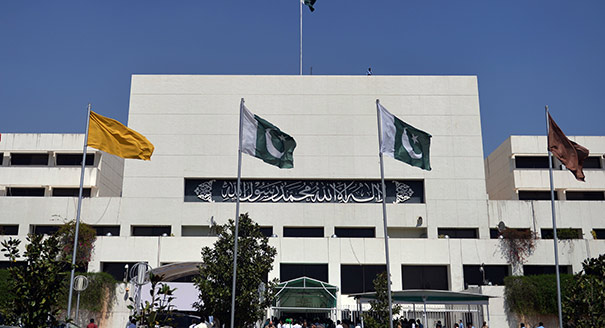
Source: Getty
India and Pakistan cannot afford to stay away from each other for too long. But they cannot stay with each other either.
Source: Indian Express
Few other activities in the world generate as much excitement and deliver as few results as the India-Pakistan dialogue. The acrimony surrounding the planned meeting between the two national security advisors in New Delhi this week confirms the proposition.
The temperature would have turned red hot had Sartaj Aziz, Pakistan’s NSA, chosen to come across the border, grandstand before the inflammable Indian media with provocative statements on Kashmir, and trash Delhi’s dossier on cross-border terrorism and make his own charges against India. Delhi, of course, was planning to put Aziz on the mat with all the evidence it had on Pakistan’s sponsorship of terrorism in India. In other words, it could have been a lot worse.For those looking for an upside, Delhi has hinted that the latest fiasco may not necessarily mean a prolonged break in the dialogue. As the external affairs minister, Sushma Swaraj, put it on Saturday, there are no full-stops in Indian diplomacy towards Pakistan. Pakistan too may not be averse to letting other meetings, such as between the security forces, agreed upon by the two prime ministers at Ufa last month, take place.
Put simply, India and Pakistan can’t stay away from each other or with each other for too long. That has been the story of unending conflict and diplomacy between India and Pakistan for nearly five decades. During 1947 to 1965, the two sides successfully addressed the many problems that arose out of the partition of the subcontinent, including Indus water-sharing. The borders between the two countries remained open despite the continuing tussle over Kashmir, and the markets were connected.
But after the 1965 and 1971 wars, the borders were shut down. They became increasingly militarised and the markets got disconnected. At the political level, it became difficult to get even small things done between the two countries. And over time, it has become very hard to keep the talks going on a regular basis.
A decisive war or a structural change in the balance of power, the history of world politics suggests, might lead to sustainable peace settlements. But India’s definitive victory over Pakistan in 1971 did not lead to durable peace on the subcontinent. India’s role in helping Bangladesh liberate itself from Pakistan only set the stage for a more complex dynamic in the region that saw Rawalpindi acquire nuclear weapons and unleash a sub-conventional war against India. If the balance of power changed in India’s favour in 1971, the nuclearisation of Pakistan by the late 1980s ended Delhi’s presumed advantage.
Since then, we have had a stalemate. Pakistan has shown the capacity to destabilise Kashmir and foment terror across India. But it has not been able to change the territorial status quo in Kashmir. Delhi, on the other hand, has not been able to find an effective answer to Rawalpindi’s proxy war. Nor has India been able to compel Pakistan to normalise bilateral relations through the expansion of economic cooperation and a settlement around the status quo in Kashmir. Neither side knows how to break this stalemate.
There is no consensus within India or Pakistan on either the terms of engagement or on the give-and-take that must be part of any serious effort to find a new political compact between the neighbours.
The divide in Pakistan between the civilian leaders and the army on how to deal with India is widely noted as a stumbling block to the peace process. But the internal cracks in India, too, are widening.
When in government, both the Congress and the BJP have engaged Pakistan against great odds but refused to cut the other slack when in opposition. The kind of consultation and understanding that was visible in the early 1990s between then PM P.V. Narasimha Rao and Atal Bihari Vajpayee as the leader of opposition has been elusive. Stephen Cohen, a leading American scholar of South Asia, has often wondered if the current Indo-Pak conflict might eventually be known as the “hundred years’ war”. Sixty-eight years after Partition and given the weekend’s political spat, that prospect seems scarily real.
Not so fast. For all its bleak history, diplomacy between India and Pakistan has also seen moments of hope. Delhi and Islamabad seemed close to agreements on the Siachen and Sir Creek disputes during 2005-06. The back channel between then PM Manmohan Singh and General Pervez Musharraf had produced a framework agreement on Kashmir in 2007 after two years of negotiations. In 2012, Pakistan seemed on the verge of normalising trade relations with India. There were extended periods when cross-border terrorism from Pakistan seemed to ebb.
For all the problems with Pakistan, our diplomacy must be animated by hope leavened with the fact that change is inevitable. As the world of India and Pakistan changes, there will always be opportunities to break the current stalemate.
This article was originally published in the Indian Express.
Former Nonresident Senior Fellow, Carnegie India
A leading analyst of India’s foreign policy, Mohan is also an expert on South Asian security, great-power relations in Asia, and arms control.
Recent Work

C. Raja Mohan, Darshana M. Baruah


Alexander Gabuev, Paul Haenle, C. Raja Mohan, …
Carnegie does not take institutional positions on public policy issues; the views represented herein are those of the author(s) and do not necessarily reflect the views of Carnegie, its staff, or its trustees.

Just look at Iraq in 1991.

Marwan Muasher

A coalition of states is seeking to avert a U.S. attack, and Israel is in the forefront of their mind.

Michael Young

Baku may allow radical nationalists to publicly discuss “reunification” with Azeri Iranians, but the president and key officials prefer not to comment publicly on the protests in Iran.

Bashir Kitachaev
The country’s leadership is increasingly uneasy about multiple challenges from the Levant to the South Caucasus.

Armenak Tokmajyan
The countries of the region have engaged in sustained competition that has tested their capacities and limitations, while resisting domination by rivals. Can a more stable order emerge from this maelstrom, and what would it require?

Hamza Meddeb, Mohamed Ali Adraoui