

Commentary
The Zaidi government’s objective to collect weapons is constrained by regional conflict, but it can take certain measures at home.
Ali Al-Mawlawi
{
  "authors": [
    "Nikolay Kozhanov"
  ],
  "type": "legacyinthemedia",
  "centerAffiliationAll": "",
  "centers": [
    "Carnegie Endowment for International Peace",
    "Malcolm H. Kerr Carnegie Middle East Center",
    "Carnegie Russia Eurasia Center"
  ],
  "collections": [],
  "englishNewsletterAll": "",
  "nonEnglishNewsletterAll": "",
  "primaryCenter": "Carnegie Russia Eurasia Center",
  "programAffiliation": "",
  "programs": [],
  "projects": [
    "Eurasia in Transition"
  ],
  "regions": [
    "Levant",
    "North America",
    "United States",
    "Middle East",
    "Syria",
    "Russia"
  ],
  "topics": [
    "Political Reform",
    "Security",
    "Military",
    "Foreign Policy"
  ]
}
Source: Getty
Moscow does not want to escalate confrontation with the West over Syria beyond the current level without what it sees as good reason. In general, Russia’s behavior in the Middle East has been largely defensive, with only isolated and mostly inept attempts to inflict harm on the West.
Source: BBC
US Secretary of Defence Ashton Carter and Russia's Defence Minister Sergei Shoigu have held their first talks to discuss the conflict in Syria.
The phone call between the two men which took place on Friday, with Russian state media saying it proved the two sides had common ground, while the Pentagon said the ministers discussed how the US and Russia could avoid accidentally clashing on the ground.
Russia's reported increased military presence in Syria has raised concerns in the US for some time.
First and foremost are what the leadership perceives as security concerns. The Kremlin argues that the fall of Syrian President Bashar al-Assad would bring radical Islamists to power in Syria and that this in turn would lead to further destabilisation in the Middle East and consequently affect Russia's Muslim regions.
Russia points to Western-backed changes of government in Iraq and Libya, which have led to violence and instability affecting the region as a whole. Moscow is also concerned about the possible return to Russia of the 2,000 or more Russian-speakers currently fighting against Assad's forces.Russia's economic and military interests also play a role. Ambitions to extend the reach of the Russian navy mean Moscow needs to safeguard the supply point in Tartus, while Russian energy companies are interested in the possible oil and gas reserves along Syria's coastline.
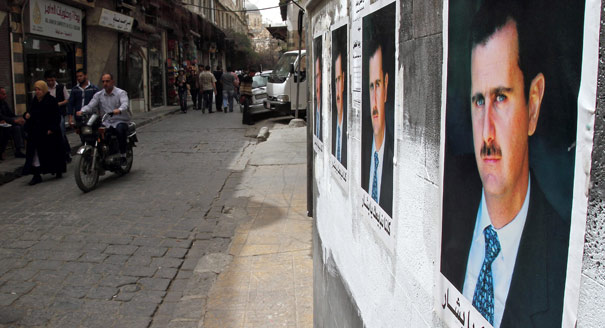
For these reasons, Moscow's "master plan" is to ensure the survival of the Assad regime, and recent reports of its decision to increase military support to Damascus should therefore not have come as a surprise to the West.
The Kremlin is not unwavering in its loyalty to President Assad. On the contrary, his inflexibility irritates the Kremlin and has created mistrust on several occasions prior to the current conflict, including in the early 2000s, when the Syrian government refused to extradite Chechen rebels.
Russian contacts with the Syrian opposition demonstrate that Moscow is keeping its options open. But the Russian government would probably show more flexibility if the opposition offered to preserve some of Russia's political and economic influence in a post-Assad Syria, and to prevent an influx of jihadist groups from Syria to Russia's Muslim regions.
In June 2015, while confirming Moscow's support for Damascus, President Putin stated that the Kremlin was "ready to work with the president [Assad] to ensure political transformation, so that all Syrians have access to the instruments of power".
In this vein, the Kremlin has adopted a two-track approach. On the one hand it is intensifying dialogue with the international community on options for the national reconciliation process in Syria. Meanwhile, it is increasing the volume and quality of military supplies to the Syrian regime to ensure it survives long enough for the Kremlin to achieve a diplomatic breakthrough commensurate with its interests.
Russia's reaction would be likely to be overwhelmingly negative. In 2013, when the US and its partners were considering options for military intervention, Foreign Minister Sergei Lavrov and Defence Minister Shoigu said Moscow would adopt an asymmetric response to any attack on Assad, to make the West "learn its lesson".
The increased supplies of arms and weapons systems provided by Moscow will make any military operation against Damascus more challenging. Despite the presence of Russian military advisers and other troops, any direct military confrontation between Russia and Western forces in Syria is unlikely though.
This telephone call, initiated by the Russian side, shows that Moscow does not want to escalate confrontation with the West over Syria beyond the current level without what it sees as good reason.
Currently, the Russian authorities are doing their best to clarify their position and partly allay Western concerns. As part of possible trust-building measures they even offered to launch direct negotiations with the US on how to deal with the so-called Islamic State (IS).
The confrontation between Russia and the West over Ukraine has contributed to Moscow's heightened engagement in the Middle East. The Kremlin believes that good relations with states in the region can help Russia avoid international isolation and compensate for the negative effect of US and EU sanctions.
If necessary, the Kremlin can also use its leverage with other states in the region, such as Iran and Egypt, to put additional pressure on Western countries.
For example, in March 2014, in the wake of the Ukrainian crisis, Russia announced it was reconsidering its participation in the negotiations between Iran and the P5+1 (the five permanent members of the UN Security Council - China, France, Russia, the UK and the US - plus Germany). This was enough to keep Washington concerned about this possibility for the rest of 2014.
Russia's presence in the Middle East should not be seen as a direct threat to US and EU interests in the region. There are a number of areas where Russian and US/EU interests are closely aligned, for example, protecting the nuclear non-proliferation regime in the Middle East, stabilising Iraq and countering the spread of jihadism.
So far, Moscow's behaviour has been largely defensive, with only isolated and mostly inept attempts to inflict harm on the West.
The Russian authorities have rarely tried to use the Middle Eastern card against the West. In April 2015, Mr Putin lifted the ban on the export of S-300 missile complexes to Iran.
However, this gesture was only for show. The number of S-300s promised to Iran is not enough to radically change the military balance in the region. Therefore Russia's decision to sell them should be seen more as a message to the West that Moscow can be an important independent player in the Middle East.
In reality, the Kremlin has limited capacity to act in the Middle East, but it uses what it has effectively. In most cases, Moscow focuses on safeguarding its economic interests and trying to keep its links with Middle Eastern states unrestricted.
Nikolay Kozhanov
Former nonresident scholar, Foreign and Security Policy Program, Moscow Center
Kozhanov is a former nonresident scholar at the Carnegie Moscow Center and a contributing expert to the Moscow-based Institute of the Middle East.
Carnegie does not take institutional positions on public policy issues; the views represented herein are those of the author(s) and do not necessarily reflect the views of Carnegie, its staff, or its trustees.
The Zaidi government’s objective to collect weapons is constrained by regional conflict, but it can take certain measures at home.
Ali Al-Mawlawi

Huawei pushed hard to enter the Egyptian data centers market, until the Americans made a better offer.

Angie Omar

Middle Eastern states should welcome an accelerated U.S. disengagement from their region.

Michael Young

In an interview, former ambassador Charles Freeman assesses the Trump administration’s war against Iran.
Michael Young

The accord represents a pivotal moment in the region to avert a security vacuum in the Gulf.


Azeema Cheema, Mohanad Hage Ali