

Paper
Douglas H. Paal
{
  "authors": [
    "Douglas H. Paal"
  ],
  "type": "legacyinthemedia",
  "centerAffiliationAll": "dc",
  "centers": [
    "Carnegie Endowment for International Peace",
    "Carnegie China"
  ],
  "collections": [],
  "englishNewsletterAll": "asia",
  "nonEnglishNewsletterAll": "",
  "primaryCenter": "Carnegie China",
  "programAffiliation": "AP",
  "programs": [
    "Asia"
  ],
  "projects": [],
  "regions": [
    "North America",
    "United States",
    "East Asia",
    "China",
    "Taiwan"
  ],
  "topics": [
    "Political Reform",
    "Economy",
    "Foreign Policy"
  ]
}
Source: Getty
The elections in Taiwan have the potential to lead to strains between the United States, Chinese mainland, and Taiwan for the first time in over seven years.
Source: China Daily
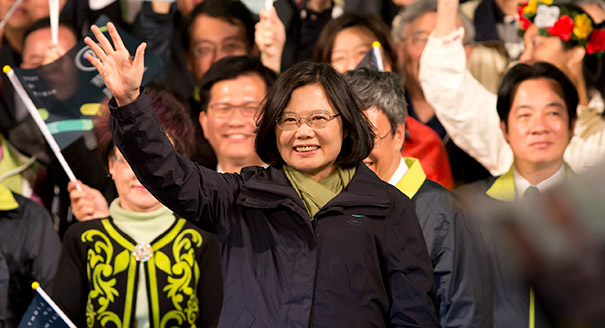
Tsai Ing-wen, candidate of the Democratic Progressive Party, won Taiwan's leadership election on Saturday. The elections in Taiwan have the potential to lead to strains between the United States, Chinese mainland, and Taiwan for the first time in over seven years.
Parallel interests in all three leaderships do not fundamentally clash, leaving space for careful and creative management of the Taiwan political transition. But there is enough suspicion and mistrust across the Taiwan Strait that a vicious circle of action and reaction cannot be ruled out and probably should be subject to active policy prevention.It is important at the outset to note that the policy objectives of all three sides in some way call for the maintenance of peace and stability across the Taiwan Strait. For the U.S. government, this should form the core of its private and public messaging as events unfold. Steadiness will be required as both the Chinese mainland and Taiwan will persuade Washington to help each to restrain or mollify the other. If the U.S. does not grasp and establish its own principled position from the outset, it risks entrapment by events. That position starts with the formal and almost ritual adherence to the three Sino-U.S. communiques and the Taiwan Relations Act (TRA), but it may have to adapt quickly to changing circumstances.
The Chinese mainland will look for public indications that Tsai has taken seriously the mainland's repeated warnings that the basis for continued cross-Strait cooperation lies in an acknowledgement of the concept of One China, however formulated.
It is at this juncture that U.S .policymakers will need to kick in. It is in the U.S. interest that Tsai continue the moderate, even conservative and reassuring approach to cross-Strait affairs that she adopted before the election. Her posture this time toward cross-Strait relations is markedly more constructive in terms of maintaining the status quo than her ambiguous stance in 2012, and this deserves to be recognized.
Tsai's revised posture won her American acquiescence to her candidacy after a visit to Washington in 2015. That was something she failed to achieve in her 2012 unsuccessful bid for the leadership. Washington seemed persuaded, temporarily at least, that she had developed safe hands to manage cross-Strait policy.
Some in the U.S. and other circles, including in Japan and Taiwan, argue that Washington should seize the change in Taiwan to raise the level of official dealings in U.S.-Taiwan relations, embed Taiwan in the "rebalance" to Asia, and promote closer security cooperation among Japan, the United States, and Taiwan.
That is an option, but in light of the increasingly interdependent agendas of the United States and Chinese mainland, and the extreme sensitivity of issues involving sovereignty for the Chinese, pursuing such an option would be fraught with costs difficult to predict or control. For the Barack Obama administration, on its way out and in search of a positive legacy, this seems an unlikely choice.
The Chinese mainland will naturally have its own levers to try to influence Tsai's government. The mainland will have four months to signal publicly or communicate privately warnings or inducements to shape Tsai's cross-Strait policy choices.
There are hints that Tsai's team is preparing to manage any such setbacks. They may seek U.S. criticism of the moves. The best public U.S. response is probably to revert to a desire to see peace and stability maintained in the region and to repeat the mantra of the communiqués and the TRA.
The Taiwan election has already caught the attention of some of those running to succeed Obama. But on the whole, the Chinese mainland and Taiwan are relatively subordinate to the Middle East, the Iran nuclear agreement, Russia-Eastern Europe relations, and other hot button issues in this U.S. election. The Chinese mainland would be smart to remind itself of that fact and contain its instincts appropriately with respect to managing the transition with Taiwan.

Distinguished Fellow, Asia Program
Paal previously served as vice chairman of JPMorgan Chase International and as unofficial U.S. representative to Taiwan as director of the American Institute in Taiwan.
Recent Work
Douglas H. Paal


Douglas H. Paal, Tong Zhao, Chen Qi, …
Carnegie does not take institutional positions on public policy issues; the views represented herein are those of the author(s) and do not necessarily reflect the views of Carnegie, its staff, or its trustees.

In an interview, Rozina Ali discusses her new book on the rise and manifestations of Islamophobia in the United States.

Michael Young

In an interview, Ian Lustick and Eli Clifton discuss their new book on why a prominent ally has so much influence in America.
Michael Young

As the U.S. stumbles in its war with Iran, we are likely to see an acceleration of its disengagement from the region.
Michael Young

Middle Eastern states should welcome an accelerated U.S. disengagement from their region.
Michael Young

In an interview, former ambassador Charles Freeman assesses the Trump administration’s war against Iran.
Michael Young