

Commentary
As the U.S. stumbles in its war with Iran, we are likely to see an acceleration of its disengagement from the region.
Michael Young
{
  "authors": [
    "Nikolay Kozhanov"
  ],
  "type": "legacyinthemedia",
  "centerAffiliationAll": "",
  "centers": [
    "Carnegie Endowment for International Peace",
    "Carnegie Russia Eurasia Center"
  ],
  "collections": [],
  "englishNewsletterAll": "",
  "nonEnglishNewsletterAll": "",
  "primaryCenter": "Carnegie Russia Eurasia Center",
  "programAffiliation": "",
  "programs": [],
  "projects": [],
  "regions": [
    "Middle East",
    "Russia"
  ],
  "topics": [
    "Foreign Policy"
  ]
}
Source: Getty
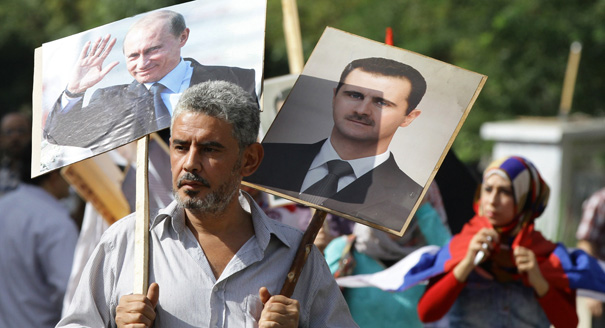
By intensifying its current activities in the Middle East, the Kremlin is pursuing three goals: economic, political, and security.
Source: Cipher Brief
Since 2012, there has been a period of diplomatic activity by the Kremlin in the Middle East which is unprecedented since the fall of the USSR. Existing records of diplomatic and political contacts show an increased exchange of multilevel delegations between Russia and Middle Eastern countries. Moscow is attempting to cultivate deeper involvement in regional issues and to establish contacts with those forces in the region which the Kremlin considers as legitimate. If before 2012 the Kremlin’s diplomacy in the Middle East could be characterized as inconsistent and shaped by the opportunism of the Russian authorities, the growing confrontation with the West became the factor which impelled Moscow to intensify its activities in the Middle East. All in all, by intensifying its current activities in the region, the Kremlin is pursuing the following three goals:
This article was originally published on The Cipher Brief website.

Nikolay Kozhanov
Former nonresident scholar, Foreign and Security Policy Program, Moscow Center
Kozhanov is a former nonresident scholar at the Carnegie Moscow Center and a contributing expert to the Moscow-based Institute of the Middle East.
Carnegie does not take institutional positions on public policy issues; the views represented herein are those of the author(s) and do not necessarily reflect the views of Carnegie, its staff, or its trustees.

As the U.S. stumbles in its war with Iran, we are likely to see an acceleration of its disengagement from the region.

Michael Young

Huawei pushed hard to enter the Egyptian data centers market, until the Americans made a better offer.

Angie Omar

The accord represents a pivotal moment in the region to avert a security vacuum in the Gulf.


Azeema Cheema, Mohanad Hage Ali

In an interview, Jason Burke discusses his sweeping account of the “revolutionists” who so shaped the 1970s and early 1980s.
Michael Young

By failing to address Palestinian representation, the current process is bound to lead to just another temporary arrangement.

Nathan J. Brown