

Article
C. Raja Mohan, Darshana M. Baruah
{
  "authors": [
    "C. Raja Mohan"
  ],
  "type": "legacyinthemedia",
  "centerAffiliationAll": "dc",
  "centers": [
    "Carnegie Endowment for International Peace",
    "Carnegie India"
  ],
  "collections": [],
  "englishNewsletterAll": "ctw",
  "nonEnglishNewsletterAll": "",
  "primaryCenter": "Carnegie India",
  "programAffiliation": "SAP",
  "programs": [
    "South Asia"
  ],
  "projects": [],
  "regions": [
    "South Asia",
    "India",
    "Middle East"
  ],
  "topics": [
    "Foreign Policy"
  ]
}
Source: Getty
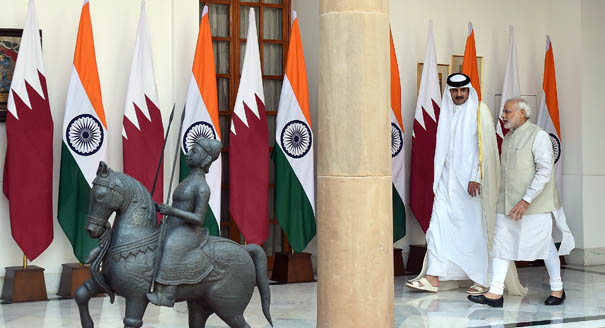
India needed to drop its posturing and step up political and security engagement in the Gulf.
Source: Indian Express
Prime Minister Narendra Modi’s just concluded visit to Saudi Arabia and the expansive agenda for bilateral security cooperation that he unveiled there mark an important inflection point in India’s engagement with the Middle East. Modi’s visit is rightly seen as the continuation of recent high-level exchanges, including late King Abdullah’s Republic Day visit to India in 2006 and then PM Manmohan Singh’s return trip to Riyadh in 2010. These exchanges helped end the prolonged alienation between the two countries.
Vastly changed circumstances in the Middle East since 2010 and Modi’s willingness to seize the emerging possibilities in the Gulf have lent new urgency and energy to the bilateral ties between New Delhi and Riyadh. The political aftermath of the Arab Spring has profoundly altered the security environment for the Gulf Arabs in general and the Saudis in particular. The rise of extremist Sunni Islam in the form of the Islamic State has threatened the conservative Arab monarchies as never before.The Saudis are also deeply troubled by what they perceive as America’s abandonment of its traditional partners either in the name of democratisation, as in Egypt, and the embrace of their adversary, Iran, in the name of political realism. Discarding the traditional caution, the Saudis have chosen to take charge of their own destiny and are spending much treasure to limit Iran’s influence, from Lebanon to Yemen and from Basra to Damascus.
To make matters worse, the steep fall in oil revenues has begun to squeeze the Saudi economy. For the first time in decades, Saudi Arabia is compelled to look at changing its national business model and diversification of its strategic partnerships. As it looks for new friends and partners, India has begun to figure prominently in the Saudi calculus.
Meanwhile, Delhi under Modi is taking a fresh look at the region. The PM came to power flaunting a special fondness for Benjamin Netanyahu. If the UPA government viewed the Middle East through the prism of domestic politics, the NDA was in danger of making the same mistake. Modi, however, was quick to see that for India, there is a lot more to the Middle East than Israel. Modi figured that India’s imagined binaries — West versus Muslims and Israel versus Arabs have long ceased to be the defining political themes in the Middle East. The PM had no difficulty seeing that the growing tension between Saudi Arabia and Iran has begun to overwhelm the traditional divides in the region.
The regional concern today is not about the abuse of American power but the prospect of US retrenchment from the Middle East. US President Barack Obama has not hidden his belief that it is no longer worth America’s while to expend blood and treasure in the region. He is quite happy to let the Middle East find its own internal balance and sort out its enduring contradictions. On this, Obama is not alone in America. Others like Donald Trump, the frontrunner for the Republican presidential nomination, are demanding that American allies must do more to secure the region.
Modi has instinctively sensed that this is a moment of opportunity for India to end its strategic diffidence in the region. For the last four decades and more, Delhi was interested only in oil, diaspora and remittances from its growing number of expatriate workers. In its determination to keep out of the conflicts in the Middle East, Delhi had apparently lost all capacity to empathise with the region’s real concerns. Delhi had also lazily branded key countries like Saudi Arabia and Turkey as pro-Pakistan, and did little to explore India’s own bilateral opportunities with them.
No one in the region is under the illusion that India can solve the multiple problems facing the Middle East. But all of them want India to go beyond the empty posturing of the past, shed some of its mercantilism and step up political and security engagement.
That precisely is what Modi is doing now. If the visit to the UAE last year sensitised Modi to the possibilities for economic, political and security cooperation in the Gulf, the two-day trip to Saudi Arabia has only confirmed it. India’s new approach to the region, under Modi, is fashioned around three axes. The first is to leverage the Gulf riches to accelerate India’s economic growth. The second is to tap into the huge potential for strengthening counter-terror cooperation, Delhi’s most important national security preoccupation. The third is to explore the prospects for deepening defence cooperation with the Gulf states.
When the subject of defence cooperation was first broached during the UPA rule nearly a decade ago, Delhi was hesitant in embracing the idea. In being more enthusiastic about defence cooperation, Modi is merely returning India to its historic role as a provider of security in the Gulf. To be sure, there is entrenched resistance in Delhi against an activist course in the Gulf that would involve balancing competing interests, making strategic choices and projecting power. But that is what leadership is about, and Modi has cast the die.
This article was originally published in the Indian Express.
Former Nonresident Senior Fellow, Carnegie India
A leading analyst of India’s foreign policy, Mohan is also an expert on South Asian security, great-power relations in Asia, and arms control.
Recent Work

C. Raja Mohan, Darshana M. Baruah


Alexander Gabuev, Paul Haenle, C. Raja Mohan, …
Carnegie does not take institutional positions on public policy issues; the views represented herein are those of the author(s) and do not necessarily reflect the views of Carnegie, its staff, or its trustees.

Just look at Iraq in 1991.

Marwan Muasher
As Iran defends its interests in the region and its regime’s survival, it may push Hezbollah into the abyss.

Michael Young
Without structural reform, the organization, which is racked by internal rivalries, risks sliding into irrelevance.
Hesham Alghannam

A coalition of states is seeking to avert a U.S. attack, and Israel is in the forefront of their mind.
Michael Young
Fifteen years after the Arab uprisings, a new generation is mobilizing behind an inclusive growth model, and has the technical savvy to lead an economic transformation that works for all.
Jihad Azour