

Paper
Renée DiResta, Rachel Kleinfeld, Margot Treadwell
{
  "authors": [
    "Rachel Kleinfeld"
  ],
  "type": "legacyinthemedia",
  "centerAffiliationAll": "dc",
  "centers": [
    "Carnegie Endowment for International Peace"
  ],
  "collections": [],
  "englishNewsletterAll": "democracy",
  "nonEnglishNewsletterAll": "",
  "primaryCenter": "Carnegie Endowment for International Peace",
  "programAffiliation": "DCG",
  "programs": [
    "Democracy, Conflict, and Governance"
  ],
  "projects": [],
  "regions": [
    "North America",
    "South America"
  ],
  "topics": [
    "Democracy",
    "Security",
    "Foreign Policy"
  ]
}
Source: Getty
Only when democracy became real after the new constitution could Colombians retake their state, reverse the corruption, and elect independent candidates who, in turn, paved the way for U.S. security assistance to make a difference.
Source: Hill
The world's longest running war has come to an end. After a half century of fighting, Colombia has made peace with the FARC, who once controlled a swath of Colombian territory as large as Switzerland. The U.S.-backed Plan Colombia played a crucial role in this success. But the true story is not the one we usually recount — and the gap between the truth and the tale is leading us down the wrong road in the Middle East and in scores of other countries fighting violence today.
Once upon a time, Washington tells itself, Colombia was nearly a failed state, its security services and government eaten away by massive drug violence, guerrilla warfare, and corruption. Then the U.S. offered massive aid under Plan Colombia to reform the military, law enforcement, and courts. The money turbo-charged President Álvaro Uribe when he came to power intent on fighting the FARC. With U.S. equipment and intelligence married to Colombian willpower, that fight so decimated the guerrillas' power that Uribe's successor, President Juan Manuel Santos, could force them to the negotiating table.
This story is partially true, and it serves as a template for Plan Merida in Mexico, CARSI in Central America, and the other 124 fragile states the U.S. now helps with security sector assistance. Build up the military and police, find a government willing to fight, throw some funds at the courts to appease the left — then reap success.
But the partial truth is dangerous. You see, the U.S. launched a program in Colombia back in the 1960s to fight a much smaller group of left-wing rebels. It was very similar to Plan Colombia. And it backfired. Instead of ending a minor insurgency, the fighting brought disparate rebels together into the original FARC. Military force, absent a legitimate government, put the insurgency on steroids.Boy, was that a lesson we needed in Iraq in the years before the Islamic State in Iraq and Syria (ISIS) took advantage of the situation.
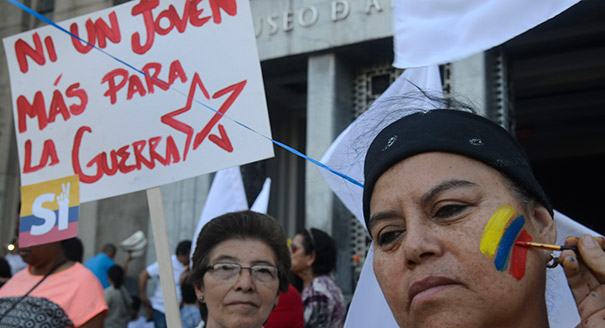
The real story of Colombia’s peace starts in 1991, when Colombia was the murder capital of the world. That's when Colombians, disgusted by the murder of three presidential candidates, bombings in shopping malls and an inept and brutal state response, took to the streets demanding a new Constitution. Backed by the biggest newspaper in the country, the referendum passed.
Colombians knew what Americans did not: that the root of the country's violence lay not in drugs or guerrillas, but in rotten politics. The country's two main parties had come together after fighting a mid-century civil war and made a deal: Regardless of who won elections, they would divvy up ministries and share chances for corruption and patronage power. Most of the country would have no voice, and the military and police would be kept too weak to launch a coup. Landlords would be allowed to protect themselves with private armies — the poor were out of luck.
Multiple RAND Corp. reports show that in fragile states with noninclusive governments, security sector assistance fails. And that's what happened in Colombia. It was this dirty deal that let left-wing intellectuals give sotto-voice support to guerrillas who seemed the only standard-bearers for the poor, and allowed the respectable right to support paramilitaries (often funded by drug cartels) who painted themselves as traditional landlord armies. It was this dirty deal let drug kingpin Pablo Escobar paint himself as a hero to the poor, apocryphally claiming that his first murder was one of those hated landlords. Only when democracy became real after the new Constitution could Colombians retake their state, reverse the corruption, and elect independent candidates — like Uribe — who paved the way for U.S. security assistance to make a difference.
What does the real story behind Colombia's peace mean for other countries? The U.S. now provides security sector assistance to 124 fragile states. We screen individual units for human rights, but pay little attention to the governance of the countries we aid. In some cases, this throws good money away. In others, it could abet the enemy. In Iraq, the U.S. spent years training and equipping the military, despite knowing that the political order was so rotten that the government was supporting Shiite militias and breaking promises to share power with Sunnis. The Sunni turn toward ISIS — or some other insurgent group — could have been predicted. When it came, ISIS made off with over $1 billion worth of U.S. equipment. In Libya, terrorist-affiliated militias stole sensitive hardware such as night-vision goggles. In Mali, years of training didn't stop a coup that was then exploited by al Qaeda.
It's time the U.S. used a new rule of thumb for security sector assistance, paying as much attention to the governance of the country as the technical prowess of the troops we train. The U.S. contributed to a great success in Colombia — and we could do the same elsewhere. But to have such success stories, we must start with truer tales.
Senior Fellow, Democracy, Conflict, and Governance Program
Rachel Kleinfeld is a senior fellow in Carnegie’s Democracy, Conflict, and Governance Program, where she focuses on issues of rule of law, security, and governance in democracies experiencing polarization, violence, and other governance problems.
Recent Work
Renée DiResta, Rachel Kleinfeld, Margot Treadwell
Political Violence Researchers, Rachel Kleinfeld, ed., Dalya Berkowitz, ed.
Carnegie does not take institutional positions on public policy issues; the views represented herein are those of the author(s) and do not necessarily reflect the views of Carnegie, its staff, or its trustees.

In an interview, Ian Lustick and Eli Clifton discuss their new book on why a prominent ally has so much influence in America.

Michael Young

By failing to address Palestinian representation, the current process is bound to lead to just another temporary arrangement.

Nathan J. Brown

Just look at Iraq in 1991.

Marwan Muasher

A coalition of states is seeking to avert a U.S. attack, and Israel is in the forefront of their mind.
Michael Young

Baku may allow radical nationalists to publicly discuss “reunification” with Azeri Iranians, but the president and key officials prefer not to comment publicly on the protests in Iran.

Bashir Kitachaev