

Commentary
Alexander Gabuev
{
  "authors": [
    "Alexander Gabuev"
  ],
  "type": "legacyinthemedia",
  "centerAffiliationAll": "",
  "centers": [
    "Carnegie Endowment for International Peace",
    "Carnegie Russia Eurasia Center"
  ],
  "collections": [],
  "englishNewsletterAll": "",
  "nonEnglishNewsletterAll": "",
  "primaryCenter": "Carnegie Endowment for International Peace",
  "programAffiliation": "",
  "programs": [],
  "projects": [],
  "regions": [
    "East Asia",
    "China",
    "Russia"
  ],
  "topics": [
    "Foreign Policy"
  ]
}
Source: Getty
In the last two years the warm friendship between Russian President Vladimir Putin and Chinese President Xi Jinping is perhaps the only reason why large deals are still being made.
Source: Kommersant
At the end of June Vladimir Putin will visit China. The visit coincides with the second anniversary of Russia's “swing towards the East,” which was symbolized by the Shanghai talks and the “deal of the century” for the Power of Siberia pipeline.
However, over the last two years there is still no answer to the question of whether Russia has been able to build a new model of relations with China.
A recent Kommersant article first described the sides' grandiose intentions and then explained why they are destined to remain only on paper.This was the case with the idea of giving the Chinese access to large oil and gas deposits (they did not agree on the prices), substitute Western money with Chinese money (which was more expensive and more difficult to obtain) and build a highway from China to Europe as a part of the Silk Road project (there has not been any news on it for a year). Another example will be mentioned below.
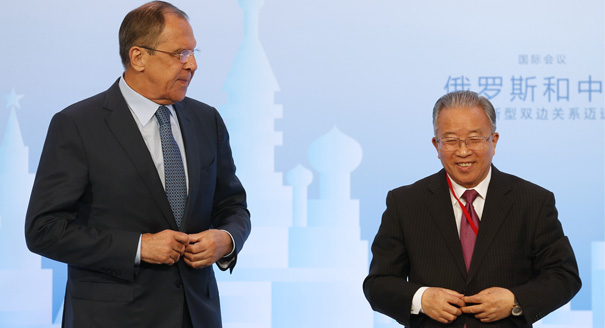
Disillusionment has already seeped into the public space when it comes to Russia-China trade ties. During the Russia-China conference organized by the Russian International Affairs Council, policy experts along with Russian Foreign Minister Sergei Lavrov spoke about an unending friendship.
But in the business sessions Viktor Vekselberg called the level of cooperation in innovation “catastrophic,” while China's former ambassador to Russia Li Fenglin complained that “Gazprom is trying to play hide and seek with China” and “is rather difficult.”
Behind the scenes the participants complained that the excessive desire to be friends only created new problems. For example, the companies are forced to run around and present their projects to three intergovernmental commissions, whose authorities are not always defined.
The bottom line, according to the Chinese, is that in the last two years the most effective cooperation mechanism has been the personal relationship between Russian President Vladimir Putin and Chinese President Xi Jinping. The warm friendship is perhaps the only reason why large deals are still being made.
It is this friendship that is responsible for the success of Yamal LNG attracting a new Chinese shareholder. This camaraderie paved the way for a $12 billion loan for the project from Chinese state banks (with very advantageous interest rates for Russia).
The relations between the leaders also explain the successful sale of a stake in Sibur to Sinopec, and the agreement to provide credit for Moscow-Kazan high-speed railway without state guarantees.
“The Chinese president sees that China cannot help all of Russia's economy, but is willing to help precisely those projects that are important for President Putin,” Chinese experts say.
In such conditions, expectations for large deals to be made during Putin's June visit are modest. Chinese banks have enormous resources, but they are not limitless, and they can finance only those projects that belong to the leaders' closest business friends and companies. While investing in Russia, Chinese companies seek profitability, which is hard to come by in times of crises.
The translation of this article was published in the Russia Beyond the Headlines.

Director, Carnegie Russia Eurasia Center
Alexander Gabuev is director of the Carnegie Russia Eurasia Center. Gabuev’s research is focused on Russian foreign policy with particular focus on the impact of the war in Ukraine and the Sino-Russia relationship. Since joining Carnegie in 2015, Gabuev has contributed commentary and analysis to a wide range of publications, including the Financial Times, the New York Times, the Wall Street Journal, and the Economist.
Recent Work
Alexander Gabuev
Alexander Gabuev
Carnegie does not take institutional positions on public policy issues; the views represented herein are those of the author(s) and do not necessarily reflect the views of Carnegie, its staff, or its trustees.

Huawei pushed hard to enter the Egyptian data centers market, until the Americans made a better offer.

Angie Omar

By failing to address Palestinian representation, the current process is bound to lead to just another temporary arrangement.

Nathan J. Brown

Just look at Iraq in 1991.

Marwan Muasher

A coalition of states is seeking to avert a U.S. attack, and Israel is in the forefront of their mind.

Michael Young

Baku may allow radical nationalists to publicly discuss “reunification” with Azeri Iranians, but the president and key officials prefer not to comment publicly on the protests in Iran.

Bashir Kitachaev