

Commentary
Dmitri Trenin
{
  "authors": [
    "Dmitri Trenin"
  ],
  "type": "legacyinthemedia",
  "centerAffiliationAll": "",
  "centers": [
    "Carnegie Endowment for International Peace",
    "Carnegie China",
    "Carnegie Russia Eurasia Center"
  ],
  "collections": [
    "China’s Foreign Relations",
    "China and the Developing World"
  ],
  "englishNewsletterAll": "",
  "nonEnglishNewsletterAll": "",
  "primaryCenter": "Carnegie Russia Eurasia Center",
  "programAffiliation": "",
  "programs": [],
  "projects": [],
  "regions": [
    "South Asia",
    "India",
    "East Asia",
    "China",
    "Russia"
  ],
  "topics": [
    "Foreign Policy"
  ]
}
Source: Getty
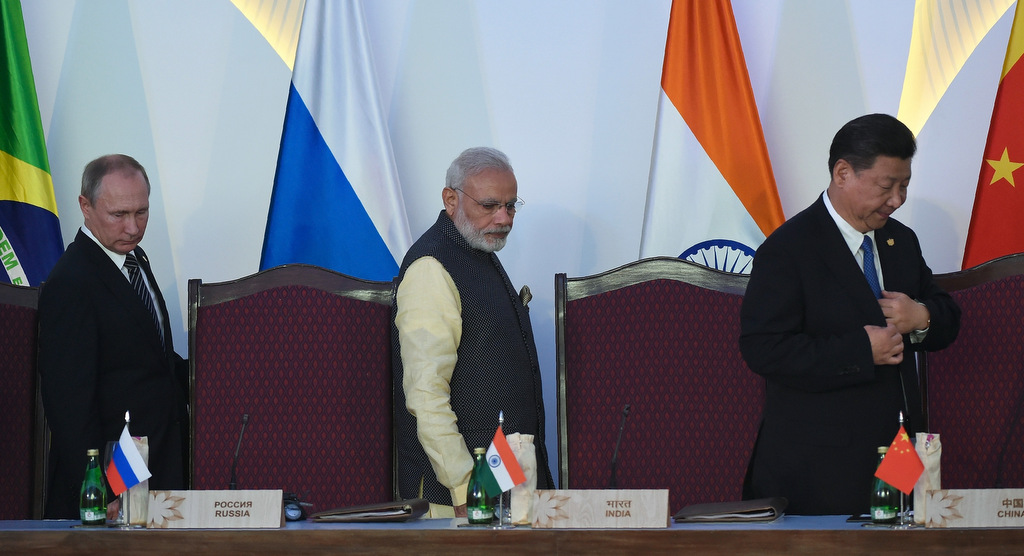
Rather than forging an alliance against the third corner of the triangle, China and Russia should join forces in building a new regional system at the time when the global order is in transition.
Source: Global Times
At the Munich Security Conference last week, China's Foreign Minister Wang Yi gave a speech that seemed to encompass the whole world. Mike Pence, the US vice president, vowed to hold Russia accountable for its actions in Ukraine, and Russia's top diplomat Sergei Lavrov announced the start of a "post-West" era in global politics. Wang extolled the importance of the Sino-US relationship, the most important bilateral relationship in the world, and then immediately praised Beijing's strategic partnership with Moscow.
At the beginning of the 21st Century, the world's geopolitical landscape includes three unequal powers whose actions impact the global system in decisive ways. The United States is the center of the system; China is the main challenger to the US dominance; and Russia, much smaller than either of the two, actively seeking to replace the current hegemony of one power with some sort of an oligarchy.
A triangle, however, is not merely a geometric notion; it can be a political tool. Forty-five years ago, the United States successfully practiced the art of triangular diplomacy to achieve a rapprochement with China against the Soviet Union. As explained by Henry Kissinger, the architect of that policy for president Richard Nixon, the Washington-Moscow-Beijing triangle favored the United States because it had better relations with both the USSR and China than the other two had between them.
After more than a decade, the Soviet Union embarked on a policy of perestroika, which ended with its own disintegration. Moscow's relations with both Beijing and Washington dramatically improved, but Russia's importance shrank dramatically too. As China simultaneously began its meteoric rise, and America enjoyed the kind of hegemony that no power in history had ever achieved, talk of a Sino-US duopoly started, in which countries would align with either of the two powers.
However, Russia's breakout in 2014 of the post-Cold War system in Europe; its politico-military comeback to the Middle East; and its very active global information warfare strategy have revealed the weaknesses in the US-dominated order. What is more astounding, however, is the revelation about the true state of the United States and its elites as in the 2016 presidential elections. The shock of Donald Trump's victory makes one recall the phrase used by the Soviet party leader Yuri Andropov in 1982. In it, Andropov, who had been head of the KGB for 15 years, admitted that "we do not know the country where we live." This is precisely the case for those Americans who, for three decades or more, had neglected fundamental changes happening in their country.
Trump's win is just the tip of the iceberg. Beneath it, there is open warfare within the deeply divided US ruling elite, and, even more fundamentally, a cleft society engaged in culture wars. Trump's opponents' attempts to undercut the president would make the United States an unpredictable country, domestically and internationally. This can still be managed. Real trouble will start if and when the US becomes politically unstable, which may happen if the current trends continue unabated.
America's internal divisions, much more than Russia's activism, will shape the global system in the long run. At first glance, these trends favor China. To use Kissinger's formula, China has now climbed onto the top of the triangle.
Beijing is seeking to advance within the current global system, rather than trying to break it. It is studiously avoiding a showdown with Washington and prefers to make its way forward incrementally. Above all, it seeks to expand its knowledge and understanding of other regions, gain diplomatic experience, and improve military capabilities.
Russia is China's major partner in Eurasia. Over the past quarter-century, the two countries have managed to create a new type of major power relationship. This relationship is based on a formula: China and Russia will never go against each other, but they do not have to follow each other. The formula combines reassurance with flexibility.
The challenge before Beijing and Moscow now is to use the basis of their bilateral partnership to construct a regional order based on new principles. Eurasia cannot come under dominance of a single power. A lasting order can, thus, only be multilateral, with the major powers leading the way, but taking all other countries' interests into consideration. Harmony in place of balance; diversity in place of homogeneity; and consensus in place of one-country leadership could serve as the pillars of the order built around the platform of the Shanghai Cooperation Organization (SCO).
The expected enlargement of the SCO this year through inclusion of India and Pakistan is a major challenge to the SCO. Unless dealt with creatively and proactively, it can make the organization less, not more, relevant. Here, Sino-Russian relations can be a model for other major power relations in the region.
China, India and Russia can build a core group to lead the order-building process. The United States, its global role notwithstanding, is not part of the regional order. Rather than forging an alliance against the third corner of the triangle, China and Russia should join forces in building a new regional system at the time when the global order is in transition.
Former Director, Carnegie Moscow Center
Trenin was director of the Carnegie Moscow Center from 2008 to early 2022.
Recent Work
Dmitri Trenin
Dmitri Trenin
Carnegie does not take institutional positions on public policy issues; the views represented herein are those of the author(s) and do not necessarily reflect the views of Carnegie, its staff, or its trustees.

In an interview, Ian Lustick and Eli Clifton discuss their new book on why a prominent ally has so much influence in America.

Michael Young

By failing to address Palestinian representation, the current process is bound to lead to just another temporary arrangement.

Nathan J. Brown

Just look at Iraq in 1991.

Marwan Muasher

A coalition of states is seeking to avert a U.S. attack, and Israel is in the forefront of their mind.
Michael Young

Baku may allow radical nationalists to publicly discuss “reunification” with Azeri Iranians, but the president and key officials prefer not to comment publicly on the protests in Iran.

Bashir Kitachaev