

Paper
Constantino Xavier
{
  "authors": [
    "Constantino Xavier"
  ],
  "type": "other",
  "centerAffiliationAll": "dc",
  "centers": [
    "Carnegie Endowment for International Peace",
    "Carnegie India"
  ],
  "collections": [],
  "englishNewsletterAll": "ctw",
  "nonEnglishNewsletterAll": "",
  "primaryCenter": "Carnegie India",
  "programAffiliation": "SAP",
  "programs": [
    "South Asia"
  ],
  "projects": [],
  "regions": [
    "South Asia",
    "India"
  ],
  "topics": [
    "Foreign Policy",
    "Security"
  ]
}
Source: Getty
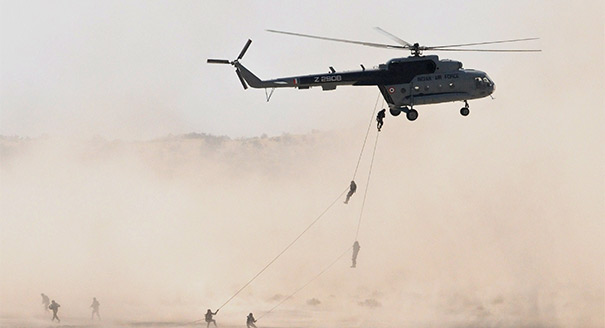
To ensure the safety of Indians abroad, the Indian armed forces will have to develop specific doctrines, procedures and capabilities to deploy expeditionary forces in coordination with civilian authorities.
Source: Force
Over the last few decades, the Indian government conducted dozens of emergency operations to protect and evacuate its distressed citizens abroad. When the lives and assets of overseas Indians are threatened due to war, natural calamities or discriminatory policies, New Delhi is expected to act swiftly and decisively.
As the Indian Diaspora grows in size, dispersion and complexity, and areas of major concentration like the Gulf region witness large-scale destabilisation, the government will have to expand its capacity and expertise to execute such missions. Most importantly, these missions cannot remain an almost exclusively civilian prerogative. While the ministry of external affairs (MEA) will continue to play a lead role, the Indian military must be roped in as a key stakeholder.
To ensure the safety of Indians abroad, the Indian armed forces will have to develop specific doctrines, procedures and capabilities to deploy expeditionary forces in coordination with civilian authorities. Especially in hostile and conflict environments, the Indian military will have to be prepared to use lethal power, including Special Forces, to protect and extricate emigrants....
Former Fellow, Carnegie India
Constantino Xavier was a fellow at Carnegie India, based in New Delhi. His research focus is on India’s foreign policy, with emphasis on relations with its neighboring countries and South Asian regional security.
Recent Work
Constantino Xavier
Constantino Xavier
Carnegie does not take institutional positions on public policy issues; the views represented herein are those of the author(s) and do not necessarily reflect the views of Carnegie, its staff, or its trustees.

By failing to address Palestinian representation, the current process is bound to lead to just another temporary arrangement.

Nathan J. Brown

Just look at Iraq in 1991.

Marwan Muasher

A coalition of states is seeking to avert a U.S. attack, and Israel is in the forefront of their mind.

Michael Young

Baku may allow radical nationalists to publicly discuss “reunification” with Azeri Iranians, but the president and key officials prefer not to comment publicly on the protests in Iran.

Bashir Kitachaev
The country’s leadership is increasingly uneasy about multiple challenges from the Levant to the South Caucasus.

Armenak Tokmajyan