

Q&A
- +1
Amr Hamzawy, Andrew Leber, Eric Lob, …
{
  "authors": [
    "Marwan Muasher"
  ],
  "type": "legacyinthemedia",
  "centerAffiliationAll": "dc",
  "centers": [
    "Carnegie Endowment for International Peace",
    "Malcolm H. Kerr Carnegie Middle East Center"
  ],
  "collections": [],
  "englishNewsletterAll": "menaTransitions",
  "nonEnglishNewsletterAll": "",
  "primaryCenter": "Malcolm H. Kerr Carnegie Middle East Center",
  "programAffiliation": "MEP",
  "programs": [
    "Middle East"
  ],
  "projects": [
    "Arab Horizons"
  ],
  "regions": [
    "Middle East",
    "Israel",
    "Palestine",
    "Levant"
  ],
  "topics": [
    "Political Reform",
    "Democracy",
    "Security"
  ]
}
Source: Getty
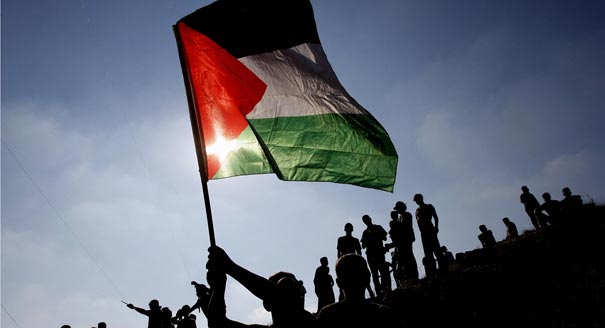
The Palestinian national movement is at a crossroads and may need a redefined vision and strategy for the months and years ahead.
Source: Project Syndicate
AMMAN – In the 50 years that have elapsed since the 1967 Arab-Israeli War, the prospects of a “final status” agreement to end the conflict have never looked bleaker. Decades of failed negotiations have left Palestinians with sharply diminished expectations of ever having a state of their own, as well as a deep lack of faith in their leadership and institutions.
While a two-state solution has long been the objective for a negotiated settlement, it is time to acknowledge that, two decades after the failure of the Oslo Accords, the current pathway to statehood is blocked. A course correction is long overdue.
The Israeli government is not interested in changing the status quo; its strategy of continued settlement expansion carries minimal diplomatic, economic, and security costs. Israel is not being pressured to negotiate in good faith, and it sees no benefit to making concessions, especially as most of the world remains silent on the Palestinians’ plight.
Meanwhile, the political legitimacy of the Palestinian leadership has long been declining, and many Palestinians doubt that it can articulate a national strategy and deliver an agreement with Israel in any form.
Until now, efforts to resolve the conflict have been confined to the contours of the Oslo model, according to which the route to Palestinian self-determination traverses bilateral agreement on borders, settlements, territory, and the right of return. But this narrow paradigm has left all sides exasperated and no closer to a solution. Rather than starting with the statehood question, perhaps it’s time to end with it.
By putting the core issue of Palestinian rights front and center, the Palestinian leadership would be acknowledging a shift that is already occurring within Palestinian society. Young people and civil-society groups are increasingly focused on how to secure individual rights, and regard their civil liberties as a precursor to, rather than the result of, statehood. In fact, two thirds of Palestinians believe that the two-state solution is no longer feasible. While past decades have centered on the establishment of a state as the pathway to collective freedom, this approach has yielded little more than years of lost hope and political stagnation.
Reordering the political agenda would position Palestinians’ civil and human rights as the highest priority, and leave for later discussions the structure and form of the state itself. Such an approach has been exemplified in local non-violent resistance movements, as well as the Boycott, Divestment, Sanctions (BDS) movement to pressure Israel at the international level.
While this shift from the Oslo paradigm could inject new energy into finding a solution, it is almost certain to have a major impact on Palestinian nationalism, which is itself at an impasse, divided between those who hold firm to the tenets of the Oslo framework, and those who focus more on greater legal protections and universal freedoms. The rift has only widened with every round of failed negotiations. Palestinian identity – which has long been defined by a narrative centered on independence – hangs in the balance.
The trajectory of the Palestinian national movement is examined in a forthcoming report by the Carnegie Endowment for International Peace, entitled “Revitalizing Palestinian Nationalism: Options Versus Realities.” The report assesses Palestinian nationalism in the current political climate, and offers proposals for rejuvenating the project. Its conclusions are based on a survey of 58 Palestinian experts, who not only explore the barriers to Palestinian statehood, but also offer perspectives on the future course of a national strategy.
Two questions are at the center of “Revitalizing Palestinian Nationalism.” First, can an idea that was originally centered on statehood be redefined with a rights-based focus? And, second, can the principles of a Palestinian state come to replace the form of such a state?
How Palestinians, Israelis, and the international community answer these questions will shape the future of the struggle. But they cannot be avoided, given the changes occurring within the Palestinian national movement itself. While the current situation on the ground stagnates – amid continued settlement expansion, extensive Israeli military control, and anemic Palestinian institutions – an emerging generation of Palestinians is determined to take the stage.
Palestinian nationalism will survive; it is a core element of Palestinian identity. But whether the Palestinian national project will proceed with a redefined vision and strategy, or remain bogged down by old ideas, is the key question that must be addressed in the months and years ahead.

Vice President for Studies
Marwan Muasher is vice president for studies at Carnegie, where he oversees research in Washington and Beirut on the Middle East. Muasher served as foreign minister (2002–2004) and deputy prime minister (2004–2005) of Jordan, and his career has spanned the areas of diplomacy, development, civil society, and communications.
Recent Work



Amr Hamzawy, Andrew Leber, Eric Lob, …
Marwan Muasher
Carnegie does not take institutional positions on public policy issues; the views represented herein are those of the author(s) and do not necessarily reflect the views of Carnegie, its staff, or its trustees.
As the U.S.-led Coalition withdraws, the Kurds’ reliance on Baghdad, and on themselves, will only increase.
Wladimir van Wilgenburg

In an interview, Ian Lustick and Eli Clifton discuss their new book on why a prominent ally has so much influence in America.

Michael Young

As the U.S. stumbles in its war with Iran, we are likely to see an acceleration of its disengagement from the region.
Michael Young
The Zaidi government’s objective to collect weapons is constrained by regional conflict, but it can take certain measures at home.
Ali Al-Mawlawi

It is improbable that Israel’s forthcoming elections will alter much in terms of how the country thinks about security.

Nathan J. Brown