

Commentary
Alexander Gabuev
{
  "authors": [
    "Alexander Gabuev"
  ],
  "type": "legacyinthemedia",
  "centerAffiliationAll": "",
  "centers": [
    "Carnegie Endowment for International Peace",
    "Carnegie China",
    "Carnegie Russia Eurasia Center"
  ],
  "collections": [],
  "englishNewsletterAll": "",
  "nonEnglishNewsletterAll": "",
  "primaryCenter": "Carnegie Endowment for International Peace",
  "programAffiliation": "",
  "programs": [],
  "projects": [],
  "regions": [
    "North America",
    "United States",
    "East Asia",
    "China",
    "Russia"
  ],
  "topics": [
    "Foreign Policy"
  ]
}
Source: Getty
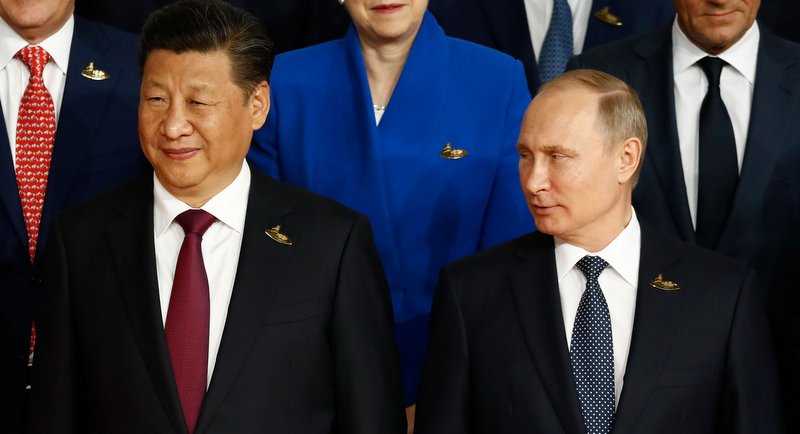
Mr Putin and Mr Xi have found an unlikely ally in Mr Trump. The latter’s clumsy approach to foreign policy and fractious relations with long-time allies leave the west poorly equipped to push back.
Source: Financial Times
When Chinese president Xi Jinping landed in Moscow on the eve of the G20 summit for two days of talks with his Russian counterpart Vladimir Putin, the world paid little or no attention. Compare that with the breathless coverage of Donald Trump’s meeting with the Russian leader days later.
Cooler heads in the Kremlin, however, recognise that the meeting between Messrs Putin and Xi was where the real action was. Beijing and Moscow are stealthily scaling up their co-operation in areas that are likely to pose challenges to western interests and policies.
The dominant view in the west is that the “bromance” between Mr Putin and Mr Xi masks an awkward relationship, in which mutual trust is conspicuously absent. But this obscures a more complex picture. The truth is that Russian and Chinese national interests tend to coincide precisely in areas where they oppose those of the west.
Take the North Korean nuclear issue. Mr Trump wants Mr Xi and Mr Putin to put more pressure on Pyongyang. But China and Russia see North Korean efforts to acquire a nuclear-capable inter-continental ballistic missile as an unwelcome yet inevitable development caused by the regime’s desire to have an insurance against possible hostile moves by the US and its allies. Mr Putin and Mr Xi share Kim Jong Un’s paranoia about the western penchant for supporting regime change in authoritarian polities.
Hawks in the Russian and Chinese national security establishments are united in their belief that Washington is using the North Korean nuclear problem as a pretext to put more military pressure on both countries by deploying the Thaad missile defence system. Both see a nuclear-armed Mr Kim as a far lesser threat than a growing American military presence at their doorstep. Mr Putin and Mr Xi spent much time in Moscow discussing those issues and are presenting a united front to block US moves on North Korea.
Elsewhere, Mr Trump triggered an avalanche of criticism by hyping the idea of creating a joint cyber defence unit with Moscow, before disowning it. In fact, Russia and the US have been sparring for years in the cyber domain and disagree strongly about global governance of the internet. By contrast, Moscow and Beijing have consistently converged on these issues. The joint statement issued after Mr Xi’s visit to Moscow promotes an approach to global internet governance that puts sovereignty of national domains above the principle of freedom of information.
On the domestic front, both governments are happy to share best practice on limiting dissent online. Beijing has reverse-engineered draconian Russian law on non-governmental organisations, while the Kremlin’s experts are busy studying China’s “Great Firewall”.
There are more examples where Chinese and Russian agendas may not directly align, but are close enough for the two powers to help each other. Beijing opposed the annexation of Crimea, but has quietly supplied Russia with an electricity cable that undermined Kiev’s energy blockade of the peninsula. Similarly, Moscow has not taken a public stance on territorial disputes in the South China Sea, but, shortly after the war in Ukraine, resumed sales of military equipment that will boost China’s capabilities in the disputed waters.
Co-operation between China and Russia might be transactional, but it has geo-strategic consequences. At times, Mr Putin and Mr Xi have found an unlikely ally in Mr Trump. The latter’s clumsy approach to foreign policy and fractious relations with long-time allies leave the west poorly equipped to push back. Nor should we expect that an increasingly isolated US administration will have the political capital to manage conflict and competition between great powers in the post-cold war era.

Director, Carnegie Russia Eurasia Center
Alexander Gabuev is director of the Carnegie Russia Eurasia Center. Gabuev’s research is focused on Russian foreign policy with particular focus on the impact of the war in Ukraine and the Sino-Russia relationship. Since joining Carnegie in 2015, Gabuev has contributed commentary and analysis to a wide range of publications, including the Financial Times, the New York Times, the Wall Street Journal, and the Economist.
Recent Work
Alexander Gabuev
Alexander Gabuev
Carnegie does not take institutional positions on public policy issues; the views represented herein are those of the author(s) and do not necessarily reflect the views of Carnegie, its staff, or its trustees.

In an interview, Ian Lustick and Eli Clifton discuss their new book on why a prominent ally has so much influence in America.

Michael Young

As the U.S. stumbles in its war with Iran, we are likely to see an acceleration of its disengagement from the region.
Michael Young

Huawei pushed hard to enter the Egyptian data centers market, until the Americans made a better offer.

Angie Omar

Middle Eastern states should welcome an accelerated U.S. disengagement from their region.
Michael Young

In an interview, former ambassador Charles Freeman assesses the Trump administration’s war against Iran.
Michael Young