

Article
C. Raja Mohan, Darshana M. Baruah
{
  "authors": [
    "C. Raja Mohan"
  ],
  "type": "legacyinthemedia",
  "centerAffiliationAll": "dc",
  "centers": [
    "Carnegie Endowment for International Peace",
    "Carnegie India"
  ],
  "collections": [],
  "englishNewsletterAll": "ctw",
  "nonEnglishNewsletterAll": "",
  "primaryCenter": "Carnegie India",
  "programAffiliation": "SAP",
  "programs": [
    "South Asia"
  ],
  "projects": [],
  "regions": [
    "South Asia",
    "India",
    "Russia"
  ],
  "topics": [
    "Foreign Policy"
  ]
}
Source: Getty
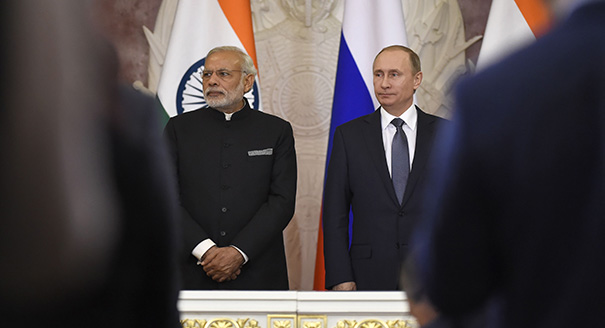
New Delhi and Moscow must move toward a practical relationship that focuses on give and take wherever possible.
Source: Indian Express
Since the end of the Cold War, the West and especially America viewed Russia with unbelievable condescension. Nearly three decades after the fall of the Berlin Wall, America and Europe are now calling Russia a political and military threat. This transformation of the Western perceptions of Russia, which congealed in 2017, have everything do with President Vladimir Putin. He has surprised the West by putting Russia right back at the centre of great power politics.
Through his eight-year tenure, US president Barack Obama dismissed Russia as a “regional power”. When the Republican presidential candidates Senator John McCain (2008) and Governor Mitt Romney (2012) talked of Russia as a security threat, the Democratic Party’s foreign policy establishment rolled on the floor laughing.
In an ironic twist, Donald Trump, who won the White House on a Republican ticket, thinks it is necessary and possible to get along with Putin’s Russia. Washington’s permanent establishment has little interest in that proposition. It accuses Putin of interfering in the presidential election and tilting it in Trump’s favour. Few would have expected in 2016 that Russia would be at the front and centre of America’s internal disputations in 2017.
Washington’s foreign policy community is replacing unreasonable disdain for Russia with irrational hostility. Meanwhile, the Europeans are struggling to come to terms with Russia’s annexation of Crimea, continuing intervention in eastern Ukraine and political meddling elsewhere on Russia’s periphery. Putin’s military modernisation, a robust nuclear doctrine and a penchant for coercive diplomacy are giving sleepless nights to Russia’s European neighbours.
Beyond Europe, Russia has joined China in reshaping the geopolitics of Eurasia. It has re-emerged as a critical player in the Middle East. Note its successful military intervention to shore up the regime of Bashar al Assad. In partnership with Beijing, Moscow also created regional institutions like the SCO, challenging Western primacy in international institutions. If the West thought Russia was inconsequential, Moscow has demonstrated the capability to disrupt Western plans with an asymmetric strategy.
When the Soviet Union broke up in 1991, Delhi was among the few capitals that mourned. India’s foreign policy community prayed for the miracle of Russian resurrection. Delhi did its best to keep the relationship with Russia going. It resolved outstanding financial issues, renegotiated the peace and friendship treaty and went along with many of Russia’s global initiatives. Having long wished for Moscow’s return to the centre stage, Delhi’s discomfort with an assertive Russia became increasingly visible in 2017. Russia’s tightening embrace of China and its flirting with the Taliban and the Pakistan army are generating unease. Instead of lamenting, Delhi must reimagine India’s relations with Russia in 2018 and beyond on the basis of clear-eyed realism. Three elements must constitute this pragmatic engagement.
First, having long-wished and campaigned for a multipolar world, Delhi must learn to live with it. A world of many powers is far more unstable than the Cold War duopoly and the unipolar moment. Realignment, dealignment and multi-alignment are the features of the contemporary world. India, on its part, has sought to hold onto Russia while rapidly expanding its ties with the US. Russia, which drew closer to India in the 1960s to counter China, now hangs on to a tenuous trilateralism with Delhi and Beijing. But here is the inescapable reality: India is trying to balance China by turning to America and Japan. Russia is trying to balance the West by aligning with China. India can’t expect a veto over Russia’s China policy, nor it can cede one to Moscow on India’s ties with the US. India’s bilateral ties with Russia must necessarily be defined by these boundary conditions in the near term.
The second is to appreciate Russia’s long-term strategy towards the West. While Russia appears to revel in tweaking America’s nose, a permanent fight with the US and Europe is not Putin’s end-goal. Defiance can be exhilarating for a while, but it is of no long-term solace for Putin to find Russia isolated from the West. What Putin wants is an honourable accommodation with the West that Russians feel was denied after the collapse of the Soviet Union. Although Putin has drawn Russia closer to China, he has no desire to play a permanent second fiddle. Moscow, which helped Mao’s Beijing in the 1950s and fought with it in the 1960s and 1970s, has no illusions about a rising China. In a world of changing distribution of power, Russia is aware that it can’t reinvent a duopoly with America. Putin wants to make Russia a “swing state” in the global balance of power marked by the rise of China and the uncertain evolution of America.
Third, if Russia is conscious of its limitations, Delhi’s strategic community seems hesitant to acknowledge India’s strengths. Consider the fact that India’s GDP today, at $2.4 trillion, is nearly twice that of Russia. Many in Delhi’s foreign policy establishment, who grew up thinking of Russia as a warm blanket in a cold and uncertain world, are unprepared for a relationship that is more in tune with the changed circumstances in which India is emerging as a power in its own right.
Russia’s relative weight may have diminished, but it has a long tradition of great power diplomacy. It has military capabilities and the political will to use force that together can shape global and regional balances. As middle powers, there is much that Delhi and Moscow can do with each other.
In the new circumstances, Delhi and Moscow must move towards a practical relationship that focuses on give and take wherever possible. The two sides must also carefully manage the inevitable differences that arise. For the foreign policy conservatives in Delhi, this sounds “transactional”. But in the dynamic world that confronts India and Russia, “transactional” is any day better than “sentimental”.
This article was originally published in the Indian Express.
Former Nonresident Senior Fellow, Carnegie India
A leading analyst of India’s foreign policy, Mohan is also an expert on South Asian security, great-power relations in Asia, and arms control.
Recent Work

C. Raja Mohan, Darshana M. Baruah


Alexander Gabuev, Paul Haenle, C. Raja Mohan, …
Carnegie does not take institutional positions on public policy issues; the views represented herein are those of the author(s) and do not necessarily reflect the views of Carnegie, its staff, or its trustees.

By failing to address Palestinian representation, the current process is bound to lead to just another temporary arrangement.

Nathan J. Brown

Just look at Iraq in 1991.

Marwan Muasher

A coalition of states is seeking to avert a U.S. attack, and Israel is in the forefront of their mind.

Michael Young

Baku may allow radical nationalists to publicly discuss “reunification” with Azeri Iranians, but the president and key officials prefer not to comment publicly on the protests in Iran.

Bashir Kitachaev
The country’s leadership is increasingly uneasy about multiple challenges from the Levant to the South Caucasus.

Armenak Tokmajyan