

Commentary
Dmitri Trenin
{
  "authors": [
    "Dmitri Trenin"
  ],
  "type": "legacyinthemedia",
  "centerAffiliationAll": "",
  "centers": [
    "Carnegie Endowment for International Peace",
    "Carnegie Russia Eurasia Center"
  ],
  "collections": [],
  "englishNewsletterAll": "",
  "nonEnglishNewsletterAll": "",
  "primaryCenter": "Carnegie Russia Eurasia Center",
  "programAffiliation": "",
  "programs": [],
  "projects": [],
  "regions": [
    "East Asia",
    "China",
    "Russia"
  ],
  "topics": [
    "Foreign Policy"
  ]
}
Source: Getty
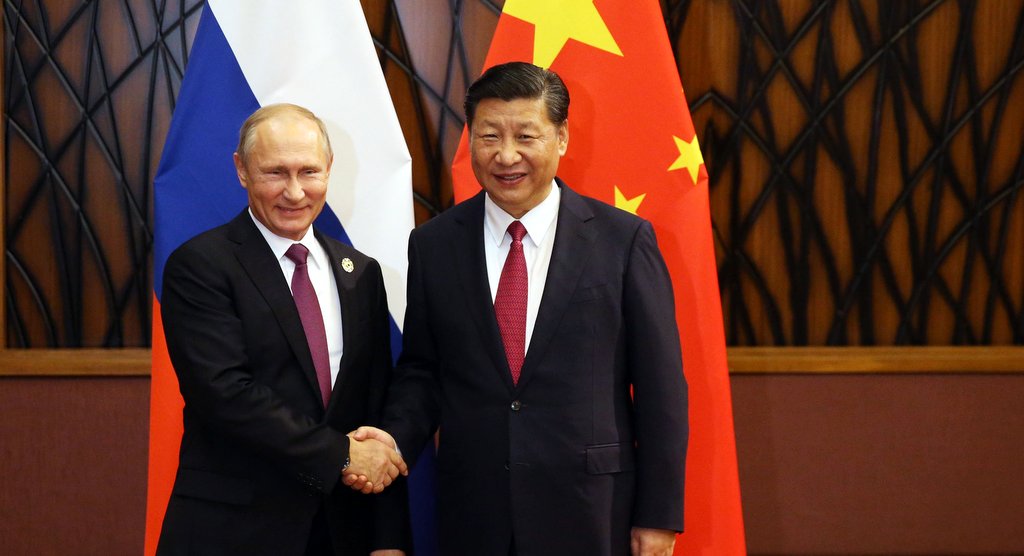
China and Russia have been cooperating closely over the past three decades. But since the Ukraine crisis, the process has become more dynamic. Moscow and Beijing are now coordinating their policies on a wider range of issues.
Source: China Daily
Both China and Russia have re-elected their presidents, and the two countries, China led by President Xi Jinping and Russia by Vladimir Putin, seem to be on track to reinforce their bilateral ties.
Global major power relations took a new turn at the end of 2017, especially after the United States officially designated China as a strategic rival. This, of course, was anything but a declaration of a new “Cold War”, but it certainly exhibited a palpable change in attitude. The earlier careful balance between engagement and hedging in the US’ China policy has been disrupted. Tensions, that have always been there, are becoming more pronounced.
This pales in comparison with the sharp tailspin in US-Russia relations since 2014. Perhaps it is safe to say Washington-Moscow might get worse. With several rounds of sanctions, accusations of election meddling, and rising military tensions, not least in Syria, the US-Russian agenda has de facto shrunk to just one item: war avoidance. This state of affairs is likely to persist for years — if we are lucky, of course.
For Washington, both China and Russia are power rivals of the US. In a stark and stunning departure from previous US foreign policy practices, Washington is now seeking to simultaneously contain Beijing and Moscow. But by pressuring both at the same time, the US is drawing China and Russia closer together. This may be due to Washington’s self-confidence and its disdain for old-fashioned “Kissingerian” geopolitics, but it may also be due to the simple lack of strategic thinking in Washington.
China and Russia have been cooperating closely over the past three decades. But since the Ukraine crisis, the process has become more dynamic. Moscow and Beijing are now coordinating their policies on a wider range of issues; Chinese companies have been given access to Russia’s energy resources in exchange for investments in Russia’s energy sector; Russia has agreed to sell China more sophisticated weapons systems; and the two countries’ navies have held exercises in the Atlantic basin as well as the Pacific.
Still, barring a simultaneous US attack against both, which is unlikely, Russia and China will not form a military bloc. In general, permanent peacetime alliances which were the hallmark of the second half of the 20th century are not a salient feature of the much more fluid 21st century, except as a system supporting a single power’s global leadership, as in the case of the US. China and Russia, each of which is a great power, perceive no need for an outside protector, and seek no hegemony over each other. They need reassurance, but also flexibility. The current formula of their relationship — “never against each other, but not necessarily always with each other” — suits them well.
Yet Russia’s economy is five times smaller and population 10 times smaller than China’s, and its economic growth rate anemic. US and European sanctions have sharply reduced Russia’s access to Western credits, investment and technology, and Russia has come to rely more on China. In these circumstances, there is little in the realm of foreign policy that Moscow needs as badly as a realistic strategy of economic interaction with Beijing that would help Russia’s development while avoiding over-dependence on its neighbor. A Russia that feels comfortable about its relationship with China is also in Beijing’s best interest.
Even as the US global leadership is waning, and competition among countries increases, national leadership is becoming more important, and the lack of it is turning into a significant disadvantage. Weak leadership within Europe — at the country and European Union levels — has contributed much to the EU’s current woes. Weak leadership in the US has led to a near-paralysis of the American political system. In Russia, twice in the history of past century, weak leadership led to state collapse.
The next decade will be crucial for the fate of all major powers. Will the US political class regain its self-confidence to fix the broken political system and improve America’s competitiveness in a world where US dominance will continue to shrink? Will the EU consolidate and turn into a single strategic player, or will it fragment even more? How will China manage the shift from the export-driven to a domestic consumption-based model, even as it proceeds to reshape the world order? Can Russia handle a political transition and modernize its economy while resisting the growing pressure of the US? These are just some of the questions where the quality of national leadership is a decisive issue.
Former Director, Carnegie Moscow Center
Trenin was director of the Carnegie Moscow Center from 2008 to early 2022.
Recent Work
Dmitri Trenin
Dmitri Trenin
Carnegie does not take institutional positions on public policy issues; the views represented herein are those of the author(s) and do not necessarily reflect the views of Carnegie, its staff, or its trustees.

Just look at Iraq in 1991.

Marwan Muasher

A coalition of states is seeking to avert a U.S. attack, and Israel is in the forefront of their mind.

Michael Young

Baku may allow radical nationalists to publicly discuss “reunification” with Azeri Iranians, but the president and key officials prefer not to comment publicly on the protests in Iran.

Bashir Kitachaev

The country’s leadership is increasingly uneasy about multiple challenges from the Levant to the South Caucasus.

Armenak Tokmajyan
The countries of the region have engaged in sustained competition that has tested their capacities and limitations, while resisting domination by rivals. Can a more stable order emerge from this maelstrom, and what would it require?


Hamza Meddeb, Mohamed Ali Adraoui