

Article
C. Raja Mohan, Darshana M. Baruah
{
  "authors": [
    "C. Raja Mohan"
  ],
  "type": "legacyinthemedia",
  "centerAffiliationAll": "",
  "centers": [
    "Carnegie Endowment for International Peace",
    "Carnegie India"
  ],
  "collections": [],
  "englishNewsletterAll": "",
  "nonEnglishNewsletterAll": "",
  "primaryCenter": "Carnegie India",
  "programAffiliation": "",
  "programs": [],
  "projects": [],
  "regions": [
    "South Asia",
    "Pakistan",
    "India"
  ],
  "topics": [
    "Foreign Policy"
  ]
}
Source: Getty
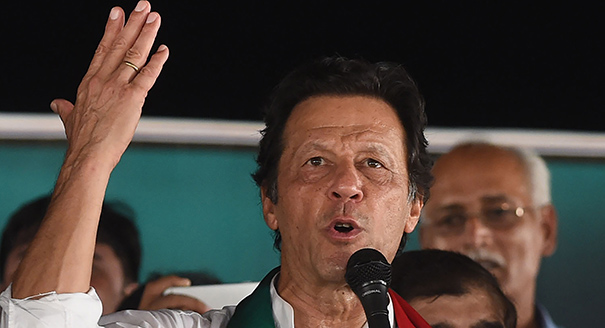
Rather than debate India’s future with Pakistan's Prime Minister-designate Imran Khan in terms of “loves me, loves me not,” Delhi should focus on strengthening its position in Afghanistan, which once again is poised to shape Pakistan’s relations with India.
Source: Indian Express
It is quite natural that India’s current debate on Imran Khan and his ascendancy to the top of Pakistan’s political heap is focused on the consequences of his rise to bilateral relations. But Delhi has no reason to believe that India is at the top of the new Pakistan leader’s foreign policy agenda. That spot goes to Afghanistan, which holds Pakistan’s centre of gravity and defines Islamabad’s relations with the rest of the world, including Delhi.
As it turns out, there is a new and unexpected dynamism in the international diplomacy on Afghanistan. Although the overlapping Ramzan ceasefires in June initiated by Kabul and the Taliban held only for three days, they raised hopes for a productive peace process in Afghanistan. Imran’s arrival on the scene might just add another dimension to the unfolding diplomatic drama that puts the Taliban back at the centrestage. Imran acquired the moniker, “Taliban Khan”, on the basis of his repeated calls for engaging the Islamist insurgents in both Afghanistan and Pakistan and his vigorous criticism of the US war on terror and Islamabad’s support for it.
If Imran has earned a bad name for himself by siding with the Taliban, he might now find himself quite valuable to Pakistan’s major interlocutors who are so eager to reconcile with the Taliban. If talking to the Taliban was a taboo until recently, it is now seen by many as the only way forward to peace in Afghanistan. The Afghan president Ashraf Ghani has been anxious to begin talks with the Taliban. However, the Taliban leadership sees the current government in Kabul as illegitimate and refused to engage with it. Ghani has been unwilling to take “no” for an answer and has repeatedly affirmed his readiness to sit down with the Taliban any place any time.
Ghani was among the first international leaders to congratulate Imran Khan on his electoral success and urge him to strengthen the peace process with the Taliban. Ghani hopes Imran will make an early visit to Kabul.
Meanwhile, senior US officials have reportedly sat down with the Taliban leaders in Qatar for direct talks last week. Until now, Washington had refused to talk with the Taliban and insisted that the insurgent group must negotiate with Kabul instead. US officials say they are not abandoning Washington’s long-stated position that the peace talks must be “Afghan-led and Afghan-owned”. They clarify that their talks in Qatar were preliminary in nature and focused on creating conditions for direct talks between Kabul and the Taliban.
Until now, the Taliban had insisted that it would only talk to the US and its priority is about getting the “foreign occupation forces” out of Afghanistan. While the US is unlikely to get out of Afghanistan immediately, it is apparently considering scaling down of its military operations in the country and limiting them to the defence of cities.
While this might let the Taliban and other insurgent groups consolidate their hold in many rural areas, there is a growing sense in Washington that the US military effort must be closely tied to the peace process with the Taliban. There should be no doubt that President Donald Trump’s basic instinct was to pull out of Afghanistan but he was persuaded to give Pentagon one more shot at it. A breakthrough in the talks with the Taliban might help Trump get America out of its longest war ever in Afghanistan.
The US is not the only one interested in dealing with the Taliban. Russia and Iran, which in the past supported the Afghan coalition against the Taliban, now have active channels of contact with the group. Post-reform China, traditionally wary of getting involved in civil wars of other countries, is now gingerly stepping forward to promote reconciliation in Afghanistan.
One of the main objectives of the Trump Administration’s Afghan policy announced nearly a year ago was to bring the Taliban to the negotiating table. As part of that effort, the US stepped up the attacks on the Taliban and ramped up the pressure on Pakistan to deliver the insurgents to the talks.
Pakistan, quite clearly, has had some role in getting the Taliban to accept the Ramzan ceasefire and now talk to the Americans. The current international interest in negotiating political compromises with the Taliban is certainly a major triumph for the Pakistan army. After all, it has long insisted that there is no alternative to engaging the Taliban.
If —a very big “if” indeed — Pakistan can nudge the Taliban towards a reasonable political accommodation with Washington and Kabul, Rawalpindi’s international stock would dramatically rise. So will the personal prestige of Imran Khan, who is now the political face of Pakistan. That in turn might significantly alter the way the Pakistan army views the context of the relationship with Delhi and define the boundary conditions for Imran’s India policy.
For nearly four decades, it is the turmoil in Afghanistan that has driven Pakistan’s internal and external policies. It has provided Pakistan extraordinary strategic gains and imposed huge political costs. Rawalpindi’s room for strategic manouevre with Delhi has grown or shrunk along with its political fortunes in Afghanistan.
Rather than debate India’s future with Imran in terms of “loves me, loves me not,” Delhi should focus on strengthening its position Afghanistan, which once again is poised to shape Pakistan’s relations with India.
This article was originally published in the Indian Express.
Former Nonresident Senior Fellow, Carnegie India
A leading analyst of India’s foreign policy, Mohan is also an expert on South Asian security, great-power relations in Asia, and arms control.
Recent Work

C. Raja Mohan, Darshana M. Baruah


Alexander Gabuev, Paul Haenle, C. Raja Mohan, …
Carnegie does not take institutional positions on public policy issues; the views represented herein are those of the author(s) and do not necessarily reflect the views of Carnegie, its staff, or its trustees.

By failing to address Palestinian representation, the current process is bound to lead to just another temporary arrangement.

Nathan J. Brown

Just look at Iraq in 1991.

Marwan Muasher

A coalition of states is seeking to avert a U.S. attack, and Israel is in the forefront of their mind.

Michael Young

Baku may allow radical nationalists to publicly discuss “reunification” with Azeri Iranians, but the president and key officials prefer not to comment publicly on the protests in Iran.

Bashir Kitachaev
The country’s leadership is increasingly uneasy about multiple challenges from the Levant to the South Caucasus.

Armenak Tokmajyan