

Commentary
Peter Kellner
{
  "authors": [
    "Peter Kellner"
  ],
  "type": "commentary",
  "centerAffiliationAll": "",
  "centers": [
    "Carnegie Endowment for International Peace",
    "Carnegie Europe"
  ],
  "collections": [
    "Brexit and UK Politics"
  ],
  "englishNewsletterAll": "",
  "nonEnglishNewsletterAll": "",
  "primaryCenter": "Carnegie Europe",
  "programAffiliation": "",
  "programs": [],
  "projects": [],
  "regions": [
    "Europe",
    "Western Europe",
    "United Kingdom"
  ],
  "topics": [
    "EU",
    "Political Reform",
    "Foreign Policy"
  ]
}
Source: Getty
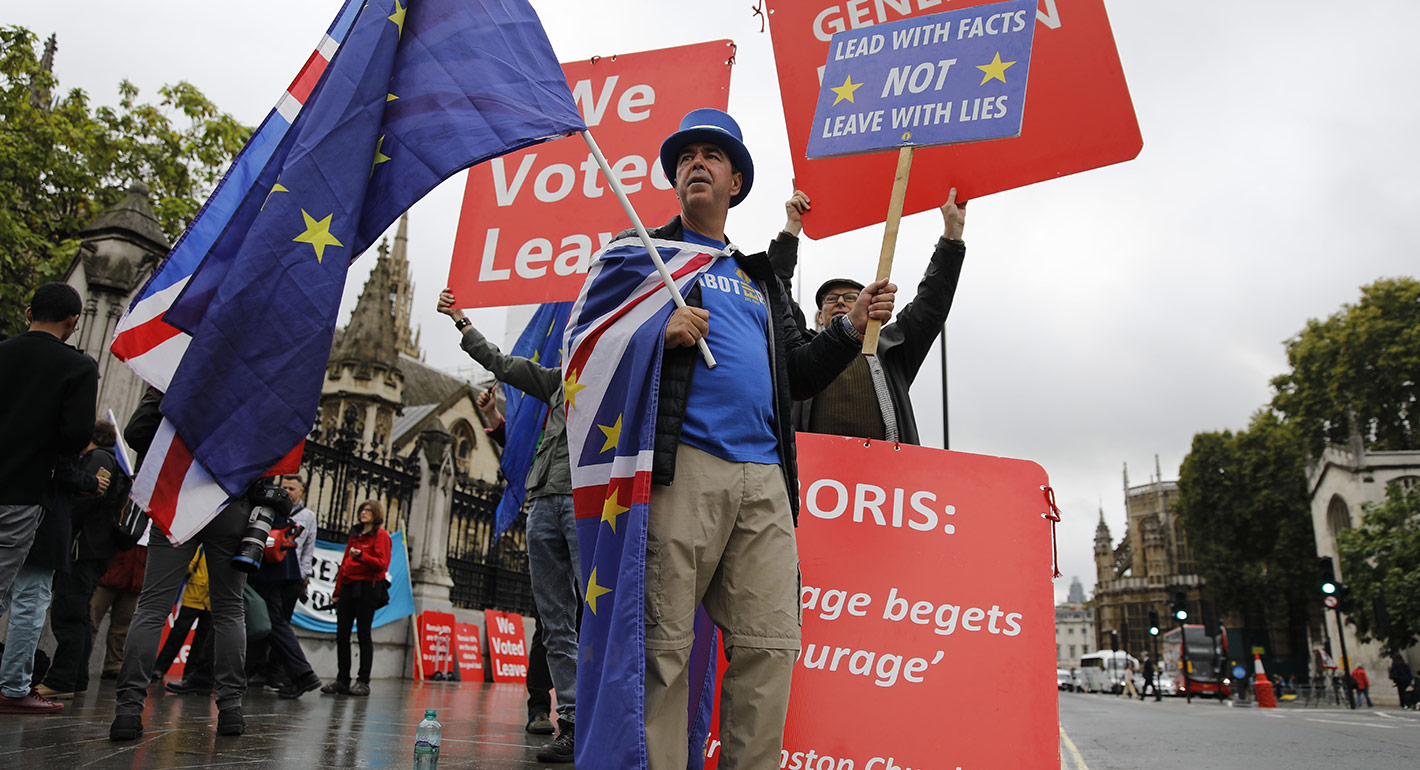
British leader Boris Johnson’s plans were thrown into disarray when the UK’s Supreme Court ruled that his recent suspension of Parliament was unlawful. What does this mean for Brexit?
Sometimes the long-term impact of an action is easier to predict than its short-term consequences. This week’s ruling of the UK’s Supreme Court falls squarely into this category. It is truly historic. In centuries to come, 2019 is likely to be remembered as one of those critical dates in the slow evolution of Britain’s constitution, along with 1215 (when King John was forced to sign the Magna Carta) and 1832 (when Parliament passed the Great Reform Act, a milestone on the road to our modern democracy).
In essence, what the Supreme Court decided—with the agreement of all eleven judges: a unanimity that was as much a surprise as their ruling itself—is that the UK does, after all, have a real constitution that its prime minister has a legal obligation to obey.
To regard that as a profound innovation will seem odd to people in most democracies. Wherever there is a written constitution, it is ultimately up to judges to interpret its meaning. But that has not been Britain’s way. Remember John Adams’s definition of the infant United States’ system: “a government of laws and not of men”. He was contrasting his country’s approach with Britain’s unwritten constitution, in which the limits of what governments could do were set by general codes, conventions and customs that had evolved down the centuries, rather than by clear words approved by Parliament and set down on parchment.
The particular issue that came to a head this week was whether British prime minister Boris Johnson had the right to suspend (“prorogue” in the archaic language of these things) Parliament for five weeks as the drama of Brexit came to a head. (Technically, the Queen signed the document suspending parliament; but she did so on Johnson’s advice; and as everyone agrees that the monarch these days must do as the prime minister “advises”, she had no choice.)
Johnson knew that a five-week suspension would be controversial. Normally they last no more than a week, ahead of a new parliamentary session. There have been longer suspensions in the past, but not at such moments of great national drama. Johnson reckoned that Britain’s unwritten constitution contained no time limit, and he was therefore legally safe. If he was to immerse himself in hot water, it would be a political problem, to be settled in due course by MPs, not a legal problem to be resolved by judges.
What the Supreme Court has said, in effect, is that some constitutional conventions matter so much that they have the status of firm laws. In this instance, the Court decided that a suspension of Parliament for as long as five weeks at such an important moment was unlawful “because it had the effect of frustrating or preventing the ability of parliament to carry out its constitutional functions without reasonable justification.” Suddenly, an undefined, small-c convention that Johnson thought he could legally interpret as he chose, became a big-L Law that he had broken. All future governments will have to take special care whenever they seek to redefine conventions in their own interest.
More immediately, the Court’s ruling means that Parliament reconvenes on September 25. Then what? This is where my crystal ball becomes cloudy. Johnson no longer commands a majority in the House of Commons; but neither is there – yet – any alternative Prime Minister who could assemble a different majority. The leader of the main opposition Labour Party, Jeremy Corbyn, argues that he is the obvious alternative national leader. But he has fewer parliamentary supporters than Johnson.
There has been talk of a short-term elder statesman taking over, such as Kenneth Clarke, the seventy-nine-year-old ex-minister and strong pro-European. He was a Conservative for thirty-nine years until he was one of twenty-one Conservative MPs who had the party whip withdrawn three weeks ago (meaning that, effectively, they were thrown out of the party) for opposing the Government’s plans for Brexit. But so far Corbyn has rejected the idea, and as Labour’s leader he effectively wields a veto.
With Parliament deadlocked, one obvious way forward would be a general election. If Johnson had had his way, an election campaign would now be underway; but twice MPs have refused to give him the election he wanted. Even if MPs were to change their mind now, an election could not now take place until mid-November, two weeks after the UK is due to leave the European Union.
Meanwhile, Parliament—again against Johnson’s wishes—has passed a law instructing him to seek an extension to the UK’s membership of the EU beyond October 31, unless he can negotiate a new deal with the EU that Britain’s Parliament endorses. At the moment, it is uncertain whether Johnson can negotiate a deal, and even if he does, he may fail to persuade a majority of MPs to back it. One possibility is that he can secure a parliamentary majority, but only if it is approved in a confirmatory referendum next spring.
My best guess—and it is no more than a guess—is that the British public will have to give their verdict in the next few months; though nobody can be sure whether they shall be asked to cast votes in a general election, or a referendum, or one then the other. Nor can anyone be certain what the outcome of either democratic event would be. Britain’s judges have dramatically clarified the law in the current crisis; Britain’s MPs and voters have yet to clarify its politics.

Peter Kellner
Former Nonresident Scholar, Carnegie Europe
Kellner was a nonresident scholar at Carnegie Europe, where his research focused on Brexit, populism, and electoral democracy.
Recent Work
Peter Kellner
Peter Kellner
Carnegie does not take institutional positions on public policy issues; the views represented herein are those of the author(s) and do not necessarily reflect the views of Carnegie, its staff, or its trustees.

Just look at Iraq in 1991.

Marwan Muasher

A coalition of states is seeking to avert a U.S. attack, and Israel is in the forefront of their mind.

Michael Young

Baku may allow radical nationalists to publicly discuss “reunification” with Azeri Iranians, but the president and key officials prefer not to comment publicly on the protests in Iran.

Bashir Kitachaev
The country’s leadership is increasingly uneasy about multiple challenges from the Levant to the South Caucasus.

Armenak Tokmajyan
The countries of the region have engaged in sustained competition that has tested their capacities and limitations, while resisting domination by rivals. Can a more stable order emerge from this maelstrom, and what would it require?


Hamza Meddeb, Mohamed Ali Adraoui