

Article
Dalia Ghanem
{
  "authors": [
    "Dalia Ghanem"
  ],
  "type": "other",
  "centerAffiliationAll": "dc",
  "centers": [
    "Carnegie Endowment for International Peace",
    "Malcolm H. Kerr Carnegie Middle East Center"
  ],
  "collections": [
    "Civil-Military Relations in Arab States"
  ],
  "englishNewsletterAll": "menaTransitions",
  "nonEnglishNewsletterAll": "",
  "primaryCenter": "Malcolm H. Kerr Carnegie Middle East Center",
  "programAffiliation": "MEP",
  "programs": [
    "Middle East"
  ],
  "projects": [],
  "regions": [
    "Middle East",
    "North Africa"
  ],
  "topics": [
    "Political Reform"
  ]
}
Source: Getty
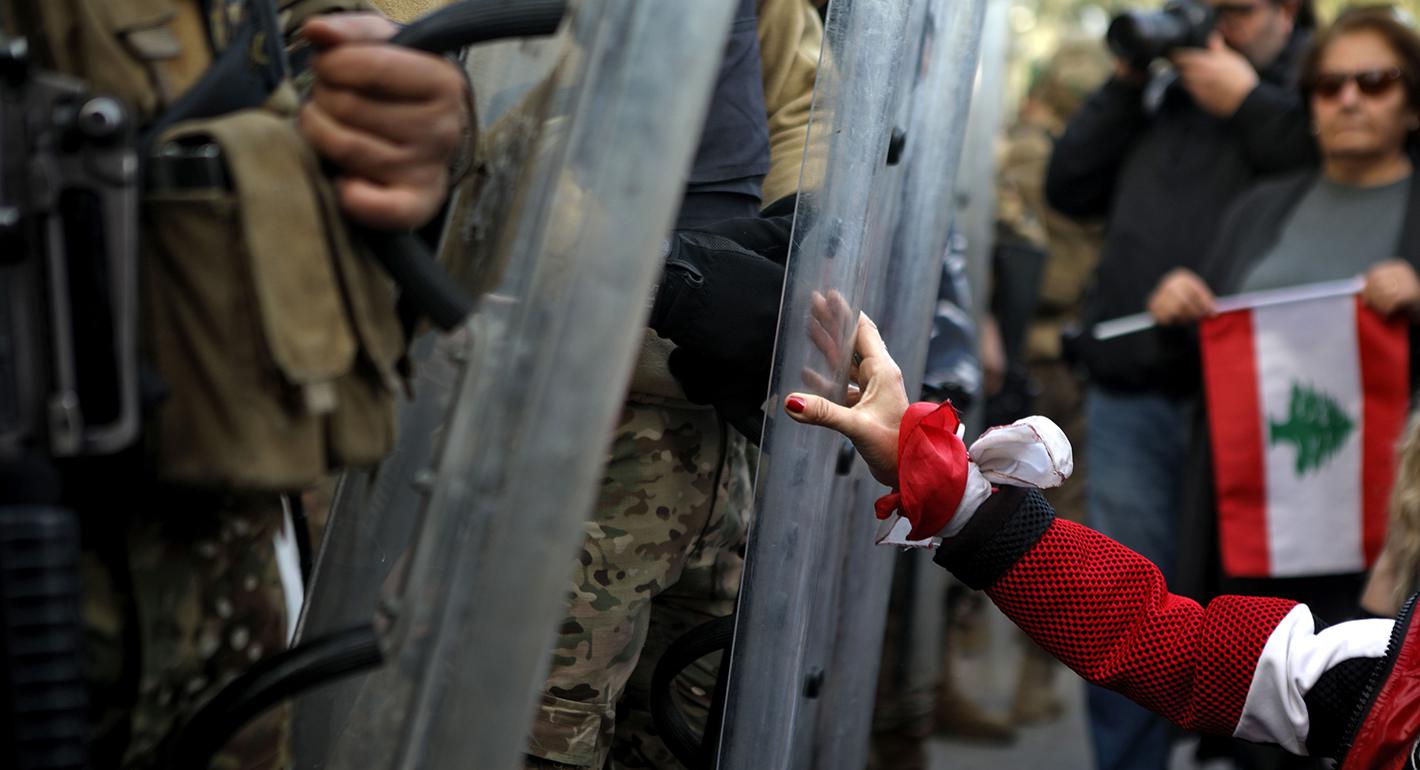
The armies’ responses to the protests in Arab countries, in 2011 and 2019, towards their respective regimes varied from one country to another.
Source: Konrad Adenauer Stiftung
In 2019, protests swept through the Middle East and North Africa (MENA) region, leading many experts and journalists to talk about the “second wave of the Arab spring.” From Algeria to Lebanon, passing through Sudan, Egypt, and Iraq, citizens took to the streets, like in 2011, to ask for more significant political reforms, democracy, social justice, and regime change. Similarly, regional military apparatuses played a decisive political role during the 2019 upheavals, just as they did eight years earlier. The armies’ responses to the protests and their behavior towards their respective regimes varied from one country to another. In Iraq and Egypt, the military harshly cracked down on protesters. In Egypt, more than 2,300 people were arrested over the first two weeks of the protests. In Iraq, thousands of people were arrested and tortured, while no less than 600 individuals were killed by the live ammunition and “smoker” grenades that security forces used against them.
On the other hand, in Algeria, the military refrained from using violence against protestors, while militaries in Sudan and Lebanon were more ambiguous, sometimes protecting demonstrators and sometimes attacking them. In both Algeria and Sudan, demonstrators called on the military to intervene and force their respective leaders to step down. Eventually, Presidents Abdelaziz Bouteflika and Omar AlBashir, who had spent twenty and thirty years in office, respectively, were forced by the military to abdicate. In each country, the military played a crucial role by pressuring the political class, and by sacking many top officials and putting them on trial. Such was the case for Saïd Bouteflika, the brother of deposed President Bouteflika, and Al-Bashir, both of whom landed in court. As for Lebanon, where protests erupted against the sectarian post-war political order, the military used significant violence when protecting key government institutions while also tolerating the protesters to maintain civil peace and allow for the political leadership to find a suitable political solution.
This article was originally published by Konrad Adenauer Stiftung.
Former Senior Resident Scholar, Malcolm H. Kerr Carnegie Middle East Center
Dalia Ghanem was a senior resident scholar at the Malcolm H. Kerr Carnegie Middle East Center in Beirut, where her research focuses on Algeria’s political, economic, social, and security developments. Her research also examines political violence, radicalization, civil-military relationships, transborder dynamics, and gender.
Recent Work
Dalia Ghanem


Frances Z. Brown, Judy Dempsey, Dalia Ghanem, …
Carnegie does not take institutional positions on public policy issues; the views represented herein are those of the author(s) and do not necessarily reflect the views of Carnegie, its staff, or its trustees.
In Egypt’s dense cities, the disappearance of foliage has health implications and punishes daily commuters.

Angie Omar

Huawei pushed hard to enter the Egyptian data centers market, until the Americans made a better offer.
Angie Omar

The accord represents a pivotal moment in the region to avert a security vacuum in the Gulf.


Azeema Cheema, Mohanad Hage Ali

In an interview, Jason Burke discusses his sweeping account of the “revolutionists” who so shaped the 1970s and early 1980s.

Michael Young

The armed forces champion a form of capitalism that is generating revenue, but its reliance on rent faces diminishing returns, leaving the country with massive sunk costs and deferred returns, deepening dependency on external borrowing.

Yezid Sayigh