• Research
  • Diwan
  • About
  • Experts
Carnegie Middle East logoCarnegie lettermark logo
LebanonIran
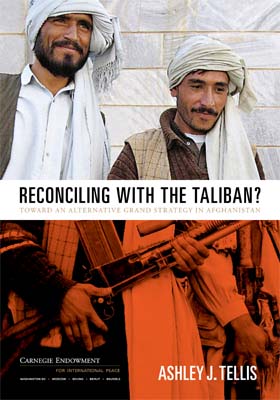
Reconciling With the Taliban?: Toward an Alternative Grand Strategy in Afghanistan
Report

Reconciling With the Taliban?: Toward an Alternative Grand Strategy in Afghanistan

Negotiating with the Taliban is the worst possible approach the U.S. could adopt in its effort to stabilize Afghanistan. Instead, the U.S. must signal long-term commitment to rebuilding the nation.

Link Copied
By Ashley J. Tellis
Published on Apr 13, 2009

Additional Links

Full Text

Negotiating with the Taliban—who are convinced military victory is within sight—is the worst possible approach to stabilizing Afghanistan, and one that would fail. Ashley J. Tellis warns that U.S. signals of impatience and a desire for an early exit could motivate insurgents to maintain a hard line and outlast the international coalition. Though costly, a long-term commitment to building an effective Afghan state is the only way to achieve victory and defend U.S. national security objectives.

Key Conclusions:

  • Negotiation with the Taliban is premature and unnecessary. Afghan stability can be achieved through a concerted modification of current military and political strategy—sustaining commitment from Washington, returning to successful counterinsurgency operations, and improving Afghan governance.
     
  • A lasting peace in Afghanistan and defeat of the Taliban can only come from a political-military victory that diminishes the rewards for continued resistance. The Taliban’s leadership does not want conciliation. Initiating unwanted negotiations could exacerbate ethnic fissures in Afghanistan, signal weakness or defeat in Washington and Kabul, and ultimately renew civil war.
     
  • The United States must reaffirm the goal of building a democratic and stable Afghan state. Counterterrorism and state-building are not mutually exclusive. Washington cannot fight al-Qaeda and its allies in Afghanistan and Pakistan without supporting the creation of an effective and responsive regime in Kabul.
     
  • Although counterterrorism cooperation by Pakistan is desirable for U.S. success in Afghanistan, American goals in Afghanistan can be—and if necessary must be—attained without Islamabad’s assistance.
     
  • Portending coalition defeat in the “graveyard of empires” is an inadequate analogy. Neither the British nor Soviet experience mimics the current situation. Military superiority aside, the U.S. presence in Kabul is seen less as occupation than support for the Afghan people, much to its advantage. The Afghan public, by a margin of 82 percent to 4 percent, oppose the Taliban and desperately seek success from Western military forces.
     
  • President Obama’s recently announced “Af-Pak” strategy is courageous and responsible, but still incomplete. The administration needs to commit to building a democratic Afghan state, persevering in Afghanistan over the long term, deploying additional U.S. resources and troops, correct command and control deficiencies, and enlarging the size of Afghanistan’s national security forces, among other things.  


Tellis explains:


“Mullah Omar and the Taliban leadership have decisively rejected any reconciliation with the government of Afghanistan. And the tribal chiefs, village elders, and street fighters, who either
support the insurgency or are sitting on the sidelines currently but are susceptible to being reconciled in principle, certainly will not take any steps in that direction so long as the Karzai regime, and its Western supporters, are not seen to be winning in their long-running battle against the Taliban. The coalition, therefore, is confronted by an inescapable paradox: any meaningful accommodation with those reconcilable segments of the rebellion will only come at the tail end of political-military success in Afghanistan and not as a precursor to it; yet, if such success is attained, reconciliation will become possible but, ironically, when it is least necessary.”

About the Author

Ashley J. Tellis

Former Senior Fellow

Ashley J. Tellis was a senior fellow at the Carnegie Endowment for International Peace.

    Recent Work

  • Paper
    Multipolar Dreams, Bipolar Realities: India’s Great Power Future

      Ashley J. Tellis

  • Commentary
    India Sees Opportunity in Trump’s Global Turbulence. That Could Backfire.

      Ashley J. Tellis

Ashley J. Tellis
Former Senior Fellow
South AsiaAfghanistanForeign Policy

Carnegie does not take institutional positions on public policy issues; the views represented herein are those of the author(s) and do not necessarily reflect the views of Carnegie, its staff, or its trustees.

More Work from Malcolm H. Kerr Carnegie Middle East Center

  • people watching smoke rising at sunrise from rooftops
    Commentary
    Emissary
    Bombing Campaigns Do Not Bring About Democracy. Nor Does Regime Change Without a Plan.

    Just look at Iraq in 1991.

      Marwan Muasher

  • Commentary
    Diwan
    Iran and the New Geopolitical Moment

    A coalition of states is seeking to avert a U.S. attack, and Israel is in the forefront of their mind.

      Michael Young

  • Commentary
    Carnegie Politika
    Baku Proceeds With Caution as Ethnic Azeris Join Protests in Neighboring Iran

    Baku may allow radical nationalists to publicly discuss “reunification” with Azeri Iranians, but the president and key officials prefer not to comment publicly on the protests in Iran.

      Bashir Kitachaev

  • Commentary
    Diwan
    Iran’s Woes Aren’t Only Domestic

    The country’s leadership is increasingly uneasy about multiple challenges from the Levant to the South Caucasus.

      Armenak Tokmajyan

  • A municipal employee raises the US flag among those of other nations in Sharm el-Sheikh, as the Egyptian Red Sea resort town gets ready to receive international leaders, following a Gaza ceasefire agreement, on October 11, 2025.
    Article
    The Tragedy of Middle Eastern Politics

    The countries of the region have engaged in sustained competition that has tested their capacities and limitations, while resisting domination by rivals. Can a more stable order emerge from this maelstrom, and what would it require?

      • Mohamed Ali Adraoui

      Hamza Meddeb, Mohamed Ali Adraoui

Get more news and analysis from
Malcolm H. Kerr Carnegie Middle East Center
Carnegie Middle East logo, white
  • Research
  • Diwan
  • About
  • Experts
  • Projects
  • Events
  • Contact
  • Careers
  • Privacy
  • For Media
Get more news and analysis from
Malcolm H. Kerr Carnegie Middle East Center
© 2026 Carnegie Endowment for International Peace. All rights reserved.