• Research
  • Diwan
  • About
  • Experts
Carnegie Middle East logoCarnegie lettermark logo
LebanonIran
Egypt’s Unobserved Elections

Source: Getty

Article

Egypt’s Unobserved Elections

Even though the Obama administration was unable to persuade President Mubarak to accept international election monitors, it is important to continue showing U.S. support for political reform and human rights in Egypt.

Link Copied
By Michele Dunne and Amr Hamzawy
Published on Nov 23, 2010

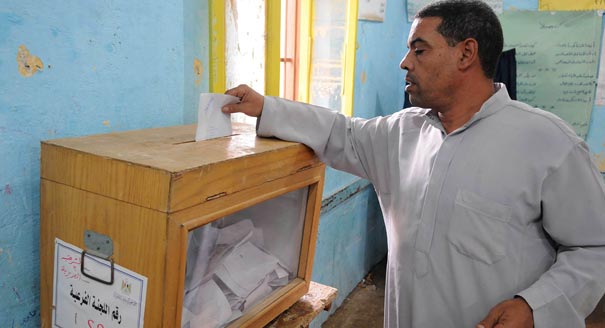
As Egypt heads toward elections for the lower house of parliament on November 28 and the presidency in 2011, Cairo’s officials have got their story straight and they are sticking to it: this proud nation needs no international observation of its elections, which will proceed according to well-established laws and constitutional precepts.  There is just one problem with this story, which is the history of past elections in the country: rigged and often violent.  In fact, Egyptians’ sense of trust in formal politics (never great) has deteriorated to the extent that several opposition parties will boycott and those that will participate are suffering from internal rifts because many of their members do not want to legitimize the existing system.

Assuming there will be no international observers to provide a window into the elections, how can Egyptians and outsiders tell how fair they were in the end?  One of the most important signals will be whether the Higher Electoral Commission extends credentials to the 14,000 or so Egyptian civil society activists seeking to monitor the elections. They have undergone rigorous training since a much more modest monitoring effort in 2005 and now are pressing for full access to the voting and counting processes.  In the  June 2010 elections for the small upper house of parliament, the electoral commission gave credentials to only a small percentage of civil society monitors at the eleventh hour (a major impediment in a country as large as Egypt) and then failed to instruct poll workers to let monitors in.  Whether that was incompetence or deliberate obstruction, the media spotlight on the November 28 elections is too bright for the electoral commission to get away with that again.

Violence has also been a major factor in previous Egyptian elections and could be this time as well.  The Ministry of Interior has in the past surrounded certain polling places—where a prominent pro-government candidate faced a strong opposition competitor— with security cordons, leading to violence as voters attempted to get in.  Thugs working for the security services or hired by specific candidates have intimidated and physically (including sexually) assaulted voters, monitors, and journalists while police looked the other way.  Will the orders be any different this year?

New measures specifically targeting Egypt’s largest opposition group, the Muslim Brotherhood, also raise doubts about how fair and competitive the elections will be.   The Brotherhood, a banned organization, may run candidates only as independents but in 2005 they campaigned openly, using the slogan “Islam is the solution,” and contested almost one-third of the parliamentary seats. Now the Egyptian government has outlawed the slogan, police authorities are systematically rounding up supporters of the movement, and the electoral commission has denied registration to one-quarter of the Brotherhood’s proposed candidates.

The government meanwhile has registered all of the hopefuls of co-opted or weak secular opposition parties, while newer and more independent secular parties (such as the liberal Ghad and Democratic Front parties) are boycotting. This faces the ruling National Democratic Party (NDP) with a dilemma: it needs to win at least two-thirds of the parliament, but it also wants to create the image of real competition.  With the Brotherhood on the run and more credible secular parties boycotting, a strong electoral showing by captive or weakened parties such as the Tagammu and the Wafd would be a sure sign of electoral meddling.

Media coverage is emerging as another major issue in light of recent measures by the government, like requiring satellite television channels to get official clearance before reporting live from anywhere in Egypt. The government also has stipulated that cell phone providers get a similar clearance before sending aggregate text messages to their users, a technique that has been increasingly used by the opposition to mobilize supporters and reach out to the public. And in spite of the diversity of the media landscape in Egypt, with its mix of public and private ownership, initial reports by Egyptian NGOs following media coverage and reporting in the lead-up to the elections have indicated a clear bias towards the ruling party and its candidates.
 
Perhaps the most interesting thing to look for on November 28 will be the U.S. reaction to Egypt’s elections. Washington tried unsuccessfully to persuade President Mubarak to accept international election monitors and to lift the state of emergency under which Egypt has been ruled for three decades.  The administration should keep in mind that showing U.S. support for political reform and human rights in Egypt has value even if Mubarak—aged 82 and ailing—continues to stonewall.  The Egyptian public follows every utterance from Washington, trying to determine where Obama stands.  And Mubarak’s successor, perhaps yet to be determined, is on the scene and undoubtedly also listening to every word, trying to gauge whether external actors support Egyptian citizens’ demands for democratic change and to what extent he will need to accommodate them.
 

About the Authors

Michele Dunne

Former Nonresident Scholar, Middle East Program

Michele Dunne was a nonresident scholar in Carnegie’s Middle East Program, where her research focuses on political and economic change in Arab countries, particularly Egypt, as well as U.S. policy in the Middle East.

Amr Hamzawy

Director, Middle East Program

Amr Hamzawy is a senior fellow and the director of the Carnegie Middle East Program. His research and writings focus on governance in the Middle East and North Africa, social vulnerability, and the different roles of governments and civil societies in the region.

Authors

Michele Dunne
Former Nonresident Scholar, Middle East Program
Michele Dunne
Amr Hamzawy
Director, Middle East Program
Amr Hamzawy
North AfricaEgyptMiddle EastPolitical Reform

Carnegie does not take institutional positions on public policy issues; the views represented herein are those of the author(s) and do not necessarily reflect the views of Carnegie, its staff, or its trustees.

More Work from Malcolm H. Kerr Carnegie Middle East Center

  • people watching smoke rising at sunrise from rooftops
    Commentary
    Emissary
    Bombing Campaigns Do Not Bring About Democracy. Nor Does Regime Change Without a Plan.

    Just look at Iraq in 1991.

      Marwan Muasher

  • Commentary
    Diwan
    Axis of Resistance or Suicide?

    As Iran defends its interests in the region and its regime’s survival, it may push Hezbollah into the abyss.

      Michael Young

  • Commentary
    Diwan
    When Football Is More Than Football

    The recent African Cup of Nations tournament in Morocco touched on issues that largely transcended the sport.

      Issam Kayssi, Yasmine Zarhloule

  • GCC foreign minister meeting in Kuwait City on June 2, 2025
    Article
    Can the Gulf Cooperation Council Transcend Its Divisions?

    Without structural reform, the organization, which is racked by internal rivalries, risks sliding into irrelevance.

      Hesham Alghannam

  • Commentary
    The Middle East’s Promising Gen Z

    Fifteen years after the Arab uprisings, a new generation is mobilizing behind an inclusive growth model, and has the technical savvy to lead an economic transformation that works for all.

      Jihad Azour

Get more news and analysis from
Malcolm H. Kerr Carnegie Middle East Center
Carnegie Middle East logo, white
  • Research
  • Diwan
  • About
  • Experts
  • Projects
  • Events
  • Contact
  • Careers
  • Privacy
  • For Media
Get more news and analysis from
Malcolm H. Kerr Carnegie Middle East Center
© 2026 Carnegie Endowment for International Peace. All rights reserved.