

Commentary
In an interview, Ian Lustick and Eli Clifton discuss their new book on why a prominent ally has so much influence in America.
Michael Young
{
  "authors": [
    "Ulrich Speck"
  ],
  "type": "legacyinthemedia",
  "centerAffiliationAll": "dc",
  "centers": [
    "Carnegie Endowment for International Peace",
    "Carnegie Europe"
  ],
  "collections": [
    "Europe’s Eastern Neighborhood"
  ],
  "englishNewsletterAll": "ctw",
  "nonEnglishNewsletterAll": "",
  "primaryCenter": "Carnegie Europe",
  "programAffiliation": "EP",
  "programs": [
    "Europe"
  ],
  "projects": [],
  "regions": [
    "Russia",
    "Europe",
    "Eastern Europe",
    "Ukraine",
    "Iran"
  ],
  "topics": [
    "Foreign Policy"
  ]
}
Source: Getty
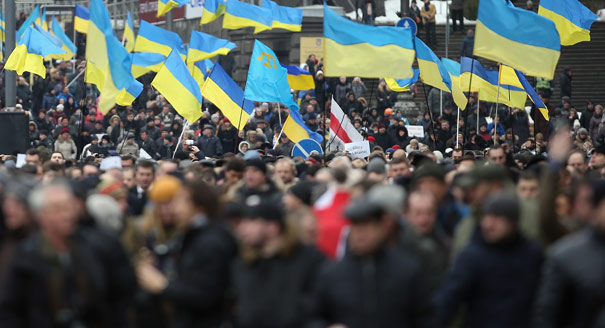
Ukraine’s best hope for peace is to wind down the war with Russia and to use the breathing space for much-needed reform.
Source: CNN
Russian President Vladimir Putin has insisted that the Minsk II ceasefire agreement from February 12 is the road to "a final settlement" of the conflict in Ukraine -- and although the truce is shaky, Ukraine and the West have a strong interest in seeing it hold.
The West is not going to enter into a proxy war with Russia -- and Ukraine's best hope is to wind down the war and to use the breathing space for much-needed reform.Minsk II confirms the military gains Russia has made in Ukraine and gives Moscow plenty of leverage over Kiev. But compared to war, it is the lesser evil.
In fact, the agreement could be turned to Ukraine's advantage, providing the country with the breathing space it urgently needs to enact political and economic changes. A stronger Ukrainian state -- more functional, less corrupt, and better able to deliver to its citizens -- would be much more capable to resist Russian aggression.
It is Ukraine's weakness that has allowed Russia to invade the country in the east. A weak sense of national solidarity and togetherness there, as well as insufficient supervision of the border, allowed unofficial and official Russian troops to enter into the Donbass region. And a badly-trained, badly-equipped and badly-organized army wasn't able to push back.
Ulrich Speck
Former Visiting Scholar, Carnegie Europe
Speck was a visiting scholar at Carnegie Europe in Brussels, where his research focuses on the European Union’s foreign policy and Europe’s strategic role in a changing global environment.
Carnegie does not take institutional positions on public policy issues; the views represented herein are those of the author(s) and do not necessarily reflect the views of Carnegie, its staff, or its trustees.

In an interview, Ian Lustick and Eli Clifton discuss their new book on why a prominent ally has so much influence in America.

Michael Young

Germany, India, and other middle powers can’t build frontier AI alone, and they risk being cut off if they depend on the United States or China. The way through is to build the capacity for a frontier sprint while hoping never to use it.
Anton Leicht, Sam Winter-Levy

Sergei Kiriyenko used Russia’s parliamentary vote to further hone his strategy of corporate mobilization that is designed to maximize votes for United Russia.

Andrey Pertsev

Before the next wave of EU enlargement takes place, the union needs to grapple with thorny questions of how power is distributed among its members.


Emil Sondaj Hansen, Ditte Brasso Sørensen

The real test may come after the leaders leave the room.



Sheena Chestnut Greitens, Oriana Skylar Mastro, Yukon Huang, …