

Commentary
Thomas de Waal
{
  "authors": [
    "Thomas de Waal"
  ],
  "type": "commentary",
  "centerAffiliationAll": "",
  "centers": [
    "Carnegie Endowment for International Peace",
    "Carnegie Europe"
  ],
  "collections": [
    "Transatlantic Cooperation"
  ],
  "englishNewsletterAll": "",
  "nonEnglishNewsletterAll": "",
  "primaryCenter": "Carnegie Europe",
  "programAffiliation": "",
  "programs": [],
  "projects": [],
  "regions": [
    "Russia",
    "Europe",
    "North America",
    "United States",
    "Western Europe"
  ],
  "topics": [
    "Foreign Policy",
    "Security"
  ]
}
Source: Getty
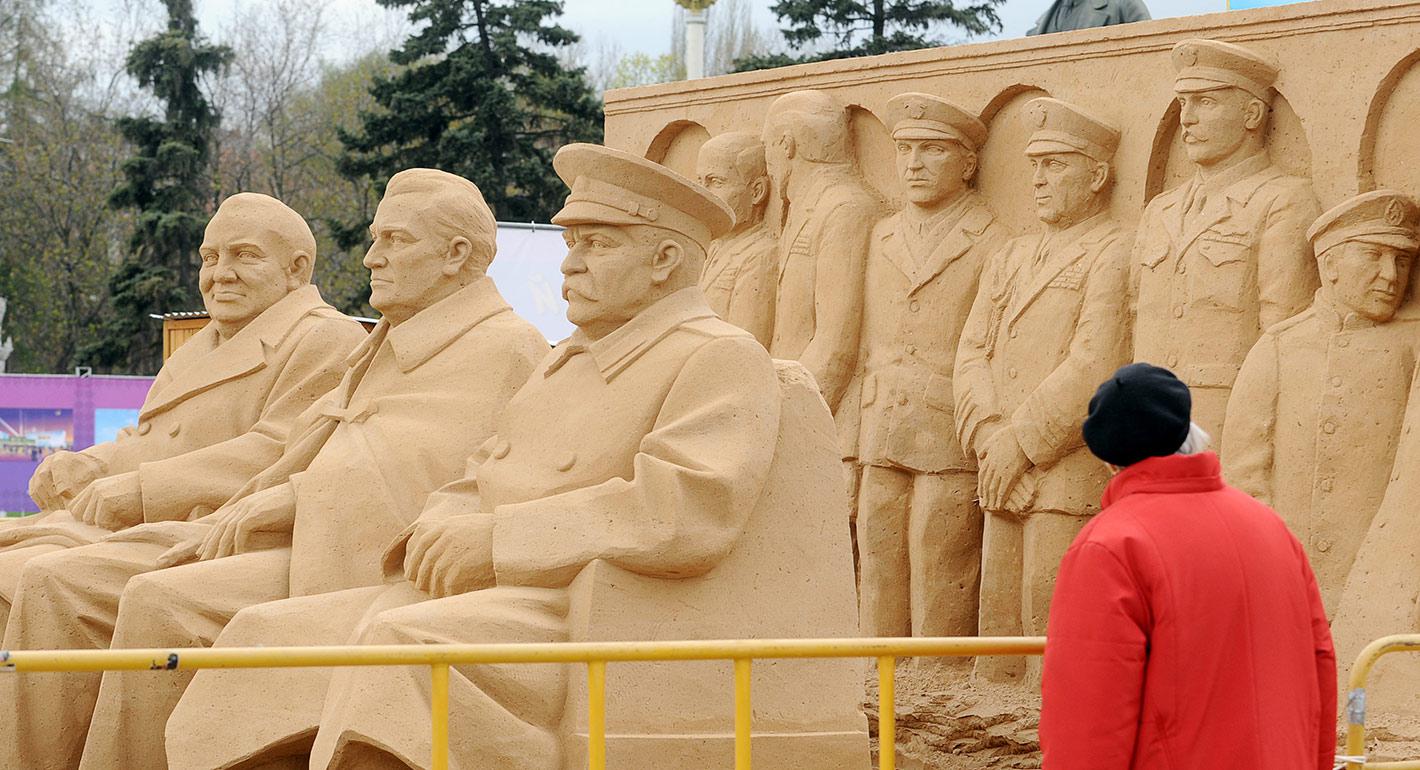
In February 1945, the leaders of the United States, the Soviet Union, and the UK hammered out the fate of postwar Europe in a bombed-out resort on the Black Sea. Seventy-five years later, how have their decisions held up?

It is one of the defining pictures of the twentieth century. Winston Churchill, Franklin D. Roosevelt, and Joseph Stalin sit smiling on dining room chairs on the terrace of the Livadia Palace, outside Yalta, Crimea, a carpet under their feet. Military men stand behind them.
The Yalta conference, which took place seventy-five years ago this week, had the aura of Greek tragedy about it. Like gods on Mount Olympus, three leaders made decisions that affected the lives of millions. They met in former imperial palaces on the beautiful Black Sea coast of Crimea, which was still ruined from war and German occupation. Churchill called it “the Riviera of Hades.”
Over lavish dinners, the Big Three decided on the future of post-Nazi Germany, the new borders of Eastern Europe, the fate of cities such as Lviv/Lwow and Koningsberg/Kaliningrad, and the shape of the new “world organization,” as they then called it: the United Nations.
The next generations made “Yalta” a catch-all word for the betrayal of Eastern Europe and accused Churchill and Roosevelt of letting Stalin write the script. In a speech in Riga in May 2005, former U.S. president George W. Bush compared Yalta to the sell-out of Czechoslovakia at Munich in 1938 and the Molotov-Ribbentrop pact of 1939.
Certainly, Poland in particular got a very nasty deal. Stalin wanted it to be the Soviet Union’s western buffer zone, with a compliant Communist government. Churchill lamely put forward the claims of the prewar Polish government now in exile in London—on whose behalf Britain after all had gone to war in 1939—but Stalin got his way.
But much else happened at Yalta besides. Recently, historians have put much more nuance on the story. In his definitive book of 2010, Yalta: The Price of Peace, the Harvard historian Serhii Plokhy draws on the archives of all three participating states and applies some correctives to the Yalta myths. Could Churchill and Roosevelt have done better? Yes, they could, concludes Plokhy. They did not coordinate at times and each had their eccentricities. But, he also notes their diplomatic wins as well as defeats.
Churchill and Roosevelt were also at a disadvantage. Yalta was above all a wartime summit, whose first agenda item was the final defeat of Germany. Stalin deliberately chose Crimea as a location so that his guests would witness the destruction the Germans had left behind there—and it duly made an impact on them. As Leo Tolstoy knew, having learned about war as a soldier fighting in nearby Sevastopol, war is not really won by “great men,” but by millions of ordinary ones. The Red Army’s extraordinary sacrifice and success had handed Stalin all the cards, in Poland and elsewhere.
Moreover, the new European order was divided but also surprisingly stable. Its new borders were not contested, allowing the postwar states to put their energies into reconstruction and cooperation. It would be seventy years before a European power next seized the territory of another by force—ironically, when Russia annexed Crimea.
The record also shows that Stalin was a master manipulator, but not the big strategic diplomat that he thought he was. For example, Stalin had originally demanded the complete dismemberment of Germany into mini-states and for it to pay ruinous reparations, as it had done in 1919. Had he got his way, the powerful Germany that has been the engine of postwar Europe would not have materialized. But in the end, Stalin backed down.
France’s wartime leader, Charles de Gaulle, was offended that he was not invited to Yalta. But France also got a very good deal, thanks to Churchill’s doggedness. Stalin conceded that that France be named the “fourth liberating power” in the postwar settlement, giving the French a key role in shaping postwar Europe, and Germany in particular.
Finally, there was the United Nations, Roosevelt’s number one priority. The U.S. president said, “[The Yalta conference] ought to spell the end of the system of unilateral action, the exclusive alliances, the spheres of influence, the balances of power, and all the other expedients that have been tried for centuries—and have always failed.” Perhaps because Stalin underestimated the importance of the UN, he also let the Americans decide its basic structure.
In 2020, it is curious and poignant to read how a Francophile British prime minister advanced the interests of Western Europe and France in particular. And to be reminded that in 1945 the biggest champion of multilateralism and the United Nations was the president of the United States. Yalta was not just a feast of the big powers. It was a moment for some smaller ones as well.

Senior Fellow, Carnegie Europe
Thomas de Waal is a senior fellow at Carnegie Europe, specializing in Eastern Europe and the Caucasus.
Recent Work
Thomas de Waal
Thomas de Waal
Carnegie does not take institutional positions on public policy issues; the views represented herein are those of the author(s) and do not necessarily reflect the views of Carnegie, its staff, or its trustees.

For every ruble allocated to social policy, health, and education in 2027, double that amount is earmarked for the army, the police, and the security services.

Alexandra Prokopenko

The acknowledgment has sparked fears of a new arms race with China and Russia.

Chris O’Meara
Smaller powers cannot go it alone, but Canadian history shows that integration with the United States will not always be benign.
Paul Samson

The European Commissioner for Trade is headed to China. But after President Xi’s bridge-building visit to Washington, can a more isolated EU overcome Beijing’s stranglehold on critical raw materials? Who will blink first?

Rym Momtaz, ed.

The summit may be remembered as a fatal blunder, when Washington, Beijing, and the AI industry collectively chose ceremony over action.

Jeffrey Prescott