Moscow desperately needs to stop Ukraine’s counteroffensive. Russian troops are losing their combat effectiveness, barely hanging on to the territory they control, and increasingly being forced to “retreat to more advantageous positions.” It is critical for the Kremlin to avoid obvious military losses: another high-profile failure could result in large-scale destabilization.
The only solution is to stop or suspend hostilities on all fronts. Russia does not have the reserves or resources to change the situation on the battlefield: the partial mobilization is not sufficient to withstand the Ukrainian counteroffensive, and major losses could tear apart the Russian armed forces.
The key point of Russian President Vladimir Putin’s September 30 speech was therefore his call upon Kyiv to immediately cease all hostilities and return to the negotiating table, but taking “new territorial realities” into account.
The warning that Moscow is prepared “to defend Russian land by all available means,” massive bombardments of Ukrainian cities, and the allusion to the use of nuclear weapons are intended to motivate Kyiv and, in Putin’s words, its “true masters in the West” to cease fire and resume negotiations on Russia’s terms.
Moscow wants to return to the negotiations as they were before falling apart in mid-April. On March 29 in Istanbul, Russia and Ukraine had coordinated the key parameters for a peace deal. These included a neutral and nonnuclear status for Ukraine (this has technically been the case since 1994) in exchange for certain security guarantees from “a group of leading powers,” including Russia—and potentially even Belarus. The security guarantees did not extend to Crimea or the self-proclaimed Donbas republics, whose ultimate status was to be decided at a future point. In other words, Kyiv was agreeing to de facto new borders for Ukraine.
The parameters also had military components: a prohibition on foreign military bases in Ukraine, Russia’s right to veto military exercises with third countries on Ukrainian territory, and restrictions on the size of the Ukrainian armed forces and the types of weaponry used (including a ban on long-range ballistic and cruise missiles).
As advantageous as the Istanbul formula was for Russia, it would have required Russian troops to retreat to the positions they held on February 23. This was not acceptable to Putin, whose goals were more ambitious than merely keeping Ukraine from joining NATO. Moscow therefore called on Ukrainian President Volodymyr Zelensky to accept the new “territorial realities,” and dismissed demands that Russia pull back its troops. The “new realities” were apparently contained in the Russian draft of the settlement submitted to Kyiv in mid-April.
Meanwhile, Ukraine has also hardened its stance, likely following consultations with its Western partners, which may have made clear to Zelensky that Russia’s role as one of the security guarantors gave Moscow new opportunities to restrict Ukraine’s sovereignty, turning it into a “mandate territory” of the guarantor states. Kyiv rejected Russia and Belarus as guarantors of Ukrainian security and objected to Moscow’s right to veto military exercises involving third parties in Ukraine.
The package of recommendations on security guarantees for Ukraine published by the working group headed by Andriy Yermak and Anders Fogh Rasmussen in September no longer included such excesses. Russia was not listed among guarantor states, and the section on limiting Ukraine’s military potential was replaced with a plan for its large-scale expansion.
The biggest challenge to resuming negotiations today is the territorial question, which could take decades to resolve. Keeping the newly annexed territories part of Russia is now almost the only way to prove that “all goals of the special military operation have been achieved,” which makes negotiations unfeasible for Russia. But continuing military action that might result in losing the acquired territory is also unfeasible.
If Zelensky does not want to stop his counteroffensive and resume talks, then the Kremlin believes it must convince his Western partners to force him. The Kremlin must persuade U.S. President Joe Biden’s administration of the threat of a nuclear conflict between Russia and the United States that will affect the continental United States, and not just Europe or Ukraine.
The Kremlin hopes that the nuclear threat will compel Washington to step in and “freeze” the conflict with Russia’s current territorial gains, though there does not appear to be unanimity among the Russian leadership on whether the conflict should be frozen temporarily, until Russia can regain its strength, or forever.
Moscow has also changed its rhetoric on U.S. military assistance to Ukraine. This is now being referred to as “direct participation in hostilities,” and the Kremlin is warning that it could lead to an inevitable military conflict between the United States and Russia—though all the actions of the Biden administration have been aimed at avoiding such a conflict, and supplying weapons and intelligence was common practice even during the Cold War.
The Kremlin is also sending Washington other signals that it is serious. In particular, the Diplomatic Academy of the Foreign Ministry organized a conference to mark the sixtieth anniversary of the Cuban Missile Crisis, focusing on lessons learned from the crisis, such as “respecting other countries’ red lines” and resolving conflicts through secret channels.
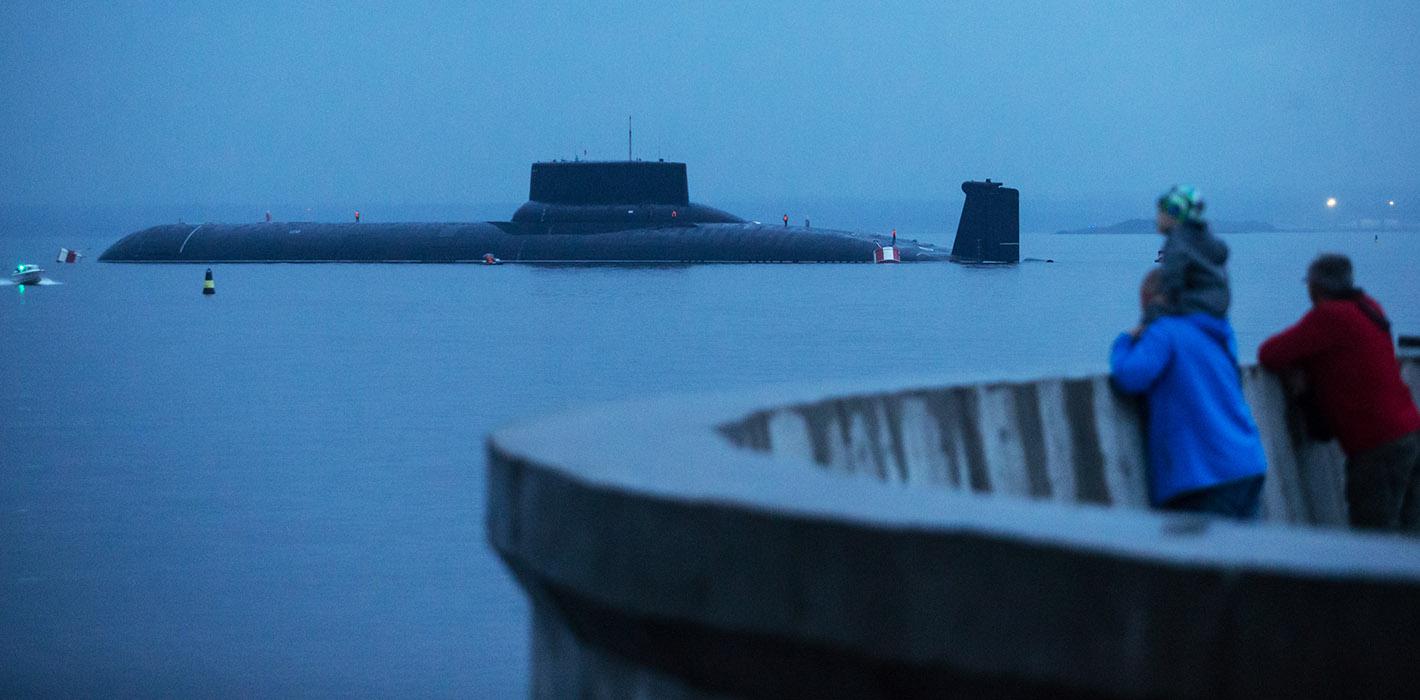
Simultaneously, Moscow is taking actions that can be interpreted by the United States as boosting the readiness of its nuclear forces: releasing footage of a train carrying the equipment of a Defense Ministry directorate responsible for Russia’s nuclear arsenal; announcing military exercises using Iskander missile systems in Kaliningrad; preparing to test a Burevestnik nuclear-powered cruise missile in Novaya Zemlya; closing air space to test-launch a Sarmat intercontinental ballistic missile from Plesetsk to Kamchatka; and surfacing the Belgorod nuclear submarine, carrying Poseidon nuclear torpedoes, in neutral waters, where it is sure to be seen.
All of the above are routine exercises, albeit grouped more closely together. Even if the Defense Ministry begins shuttling trains with nuclear warheads back and forth, this is common practice for both Russia and the United States, and might raise the nuclear threat level, but will not faze Biden. Moscow could take a page from the Cuban Missile Crisis playbook and keep escalating the combat readiness of the Strategic Nuclear Forces to its maximum, with bombers armed with nuclear cruise missiles on full alert or even up in the air, and submarines deployed to patrol zones. However, it would be easy to get carried away and make a fatal mistake.
For now, Moscow is not making any extraordinary steps, and the Pentagon is not taking the bait. This means that Washington is not motivated to rush in and stop Kyiv on the battlefield.
Despite the frenzied television coverage, it is unlikely that Moscow is serious about using nuclear weapons. A showcase detonation of a nuclear warhead over Novaya Zemlya, the Black Sea, or the Chernobyl exclusion zone will not scare off Kyiv. What it will do is destroy any remnants of Russia’s reputation as a signatory of the Comprehensive Nuclear-Test-Ban Treaty and deprive Moscow of Turkey, India, and China’s amicable neutrality.
In contrast to the Cuban Missile Crisis, Moscow and Washington are not currently in a direct nuclear standoff. Artificially creating this standoff would be a difficult and dubious undertaking, because for now the United States is fully capable of ignoring Russia’s signals and avoiding a nuclear conflict. Ukraine is not Cuba.
Russia needs to take some action, however, because strategic procrastination is growing more and more costly. Of the lessons learned from the Cuban Missile Crisis, the most obvious is the need to create and maintain back channels for dialogue.
Biden’s national security advisor, Jake Sullivan, recently said that the U.S. administration has communicated its concerns and warnings about any use of nuclear weapons to the Kremlin “directly, privately, and at very high levels.” He may have been referring to his phone calls with Putin’s foreign policy advisor, Yury Ushakov. Yet even that kind of communication is not sufficient. Moscow and Washington need a permanent channel for secret diplomacy to discuss the undiscussable.
In May 2022, the Biden administration informed the Kremlin through an intermediary that it was prepared to create such a back channel. CIA Director William Burns was expected to oversee these communications from the U.S. side. At the time, however, Moscow was not interested.
One key aspect of the Cuban Missile Crisis was that Moscow and Washington initially created a back channel along intelligence lines. Robert Kennedy (then Attorney General and younger brother of President John F. Kennedy) first communicated with Alexander Feklisov, the KGB station chief in Washington. Soviet Ambassador Anatoly Dobrynin only joined the dialogue after the KGB confirmed that Robert Kennedy’s information was accurate and that he was speaking on behalf of the U.S. president. Repeating this back-channel diplomacy feat would be constructive, but following all the diplomatic ousters, there are no good candidates for it left in Moscow and Washington.