

Commentary
Andrei Kolesnikov
{
  "authors": [
    "Andrei Kolesnikov"
  ],
  "type": "commentary",
  "blog": "Carnegie Politika",
  "centerAffiliationAll": "dc",
  "centers": [
    "Carnegie Endowment for International Peace",
    "Carnegie Russia Eurasia Center"
  ],
  "collections": [],
  "englishNewsletterAll": "ctw",
  "nonEnglishNewsletterAll": "",
  "primaryCenter": "Carnegie Russia Eurasia Center",
  "programAffiliation": "russia",
  "programs": [
    "Russia and Eurasia"
  ],
  "projects": [],
  "regions": [
    "Russia",
    "Caucasus"
  ],
  "topics": [
    "Political Reform",
    "Economy",
    "Domestic Politics"
  ]
}
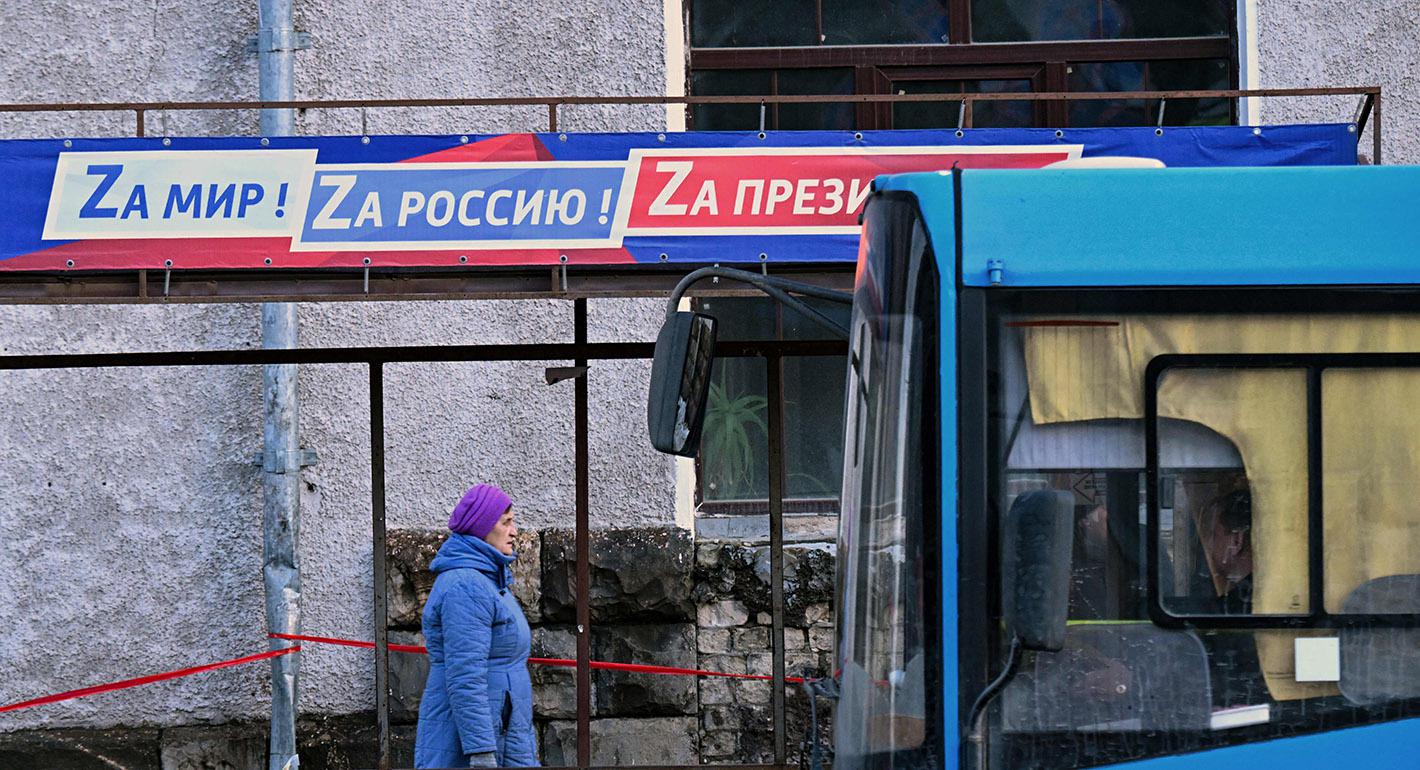
Source: Getty
Weariness of the “special military operation” in Russia is expressed not only in calls for peace, but also in either more aggressive or more passive, incurable support for the authorities.
There is an old Italian joke that explains a lot about the nature of conformism in authoritarian and totalitarian societies: one of Mussolini’s sons asks his father what form of government he has established in the country, to which Il Duce replies irritably: “Eat up and shut up!”
This formula describes an authoritarian model in which “eating up and shutting up” is enough for the bulk of the population to appear law-abiding. Until recently, this was the model in place in Russia: in exchange for relatively decent conditions, ordinary people kept quiet, stayed out of the authorities’ affairs, and automatically voted in favor of any initiatives.
Following Russia’s partial mobilization last year, the social contract model changed. Now Russians are expected to share responsibility with the autocrat and express their voice in support of his actions with increasing frequency. It’s no coincidence that denunciations are the new social norm, along with violence and a ramping up of talk of nuclear strikes. As Russia progresses to a hybrid totalitarian model, this behavior is effectively encouraged.
As the Putin regime approaches full maturity, Russians are expected to pay their dues: with their bodies (under the partial military mobilization), through correct behavior (including denunciations), or with their money—big business is now expected to contribute 5 percent of its surplus profits to a state that is hemorrhaging income while expanding its military expenditure.
This raises many questions, not least: What counts as surplus profit? Where in the law does it say that businesses should surrender 5 percent to the state? Is this a one-off levy or a permanent tribute for security and defense? But what’s important is that the state is involving extremely varied layers of society and groups in its “special operation,” which looks set to drag on for years.
The Kremlin has managed to transform the “special operation” into a “people’s war,” a shared task that should unite the nation. Anyone who is against the Kremlin—“national traitors,” in Putin’s words—must be fought against.
Previously, the model was one of “us” at the bottom of the social pyramid and “them” at the very top—in charge of the country and living well, with their yachts and palaces. Now that vertical construction has been made horizontal. “We” Russians are all together and we’re fighting “them”—the Ukrainians, NATO, the United States, the EU, and the collective West.
The new “we” are developing a collective goal which, just like Communism under the Soviets, is forever being pushed further into the distance, but can nevertheless be glimpsed on the horizon. The goal is victory over the West. The specific parameters of what such a victory would look like or how it may be achieved remain entirely unclear, but the rest of eternity can be spent moving toward that horizon.
The movement of this new “we” toward a perpetually receding target justifies certain socioeconomic insufficiencies. This semi-martial era requires understanding from the public, and for ordinary Russians to tighten their belts, for the depletion of the state budget is becoming ever more pressing. Mantras on the success of import substitution, which so far appears to mean Western goods and technologies being replaced with Chinese equivalents, are insufficient.
As federal and regional budgets expand to cover ever greater numbers of people becoming involved in the war, there’s no certainty that they can manage to carry this burden. It’s not so much a social, military, or financial burden as psychological, for large masses of the population are now directly involved in the special operation: the families of those drafted during the mobilization, those who have been killed and injured, and the soldiers who are returning from the trenches in various psychological and physical states.
What’s happening in the minds and souls of those who have witnessed the fighting firsthand; who have been wounded; who have lost their fathers, brothers, and sons? Will these groups of people become a political force? Will they support Putin’s regime or become a “fifth column” on the conservative rather than the liberal flank? There are no answers to these questions so far.
It is astonishing that a contemporary, modernized, and urbanized society is capable of degrading at such breakneck speed, particularly ethically and psychologically. Even if we suppose that a major part of that society doesn’t support Putin and the special operation, merely coming to terms with it, not offering resistance, and adapting to external circumstances still looks like support in a practical sense.
Putin’s unique selling point for the nation—a “special operation” and the sharing of responsibility for the country’s isolation and regression—has turned out to be so atypical for the twenty-first century that the shock has reverberated through all of the normative models of behavior in modern consumer societies. The country has been thrown back not just forty years—to a time when behavioral patterns largely consisted of adapting to the decline of the Soviet system—but seventy to seventy-five years: to the beginning of the Cold War, the struggle against “cosmopolitans” and any “kowtowing to the West”; to an epidemic of denunciations and new waves of repression.
What’s unique here is that the characteristics of twentieth-century totalitarian regimes are being repeated in a society which in the interceding years could easily have been described as being open and operating as a market economy, with the free movement of people, ideas, technology, and capital.
If we view society through the German economist Albert Hirschman’s triad of options open to disgruntled consumers or citizens, the “Exit, Voice, and Loyalty” model, then the signal Putin sent out in 2022 was answered by the bulk of the population with varying degrees of aggression and indifference, but also with “Loyalty.”
In a military-police state, the “Voice” option of attempting to improve matters by communicating is quickly suppressed, as evidenced by the increasingly shocking statistics for the prosecution of dissenters. Yet that option still exists: the “Voices” of the people can be heard not only from abroad, but also within Russia itself.
After “Loyalty,” the most popular behavioral model was “Exit.” For some, this was expressed in politically motivated emigration or flight from prosecution and mobilization. For others, “Exit” means “internal emigration”: an attempt to live through darker times by hiding away or imitating obedient behavior.
For people who are to some extent involved in administrative practices, whether as bureaucrats, deputies, or law enforcement and judicial system personnel, “Loyalty” involves public demonstrations of ultra-obedience. Every boss, investigator, and judge sees themselves as a miniature Putin, especially since during the year that the “special operation” has been under way, they have been given sweeping mandates and their power is largely unlimited.
Ultimately, every form of totalitarianism must be “popular,” founded on approval and loud acclamation embodied by mass rallies at Moscow’s Luzhniki Stadium, where people in the crowd try to show loyalty, whether real or fake. This “popular” state of miniature Putins is what ends up forming the intimidating majority that ordinary Russians find it difficult to avoid joining in with: some for reasons of comfort, some because they’re genuinely afraid. Under Russia’s internal rules, a “good Russian” is someone who at the very least does not rock the boat.
The state feeds this obedient mass with rituals of unity, a national history of uninterrupted victories, and an ideology of imperialism. Consequently, weariness of the “special military operation” is not expressed in calls for peace and more transparency in Russia, but in either more aggressive or more passive, incurable support for the authorities. The scale of this adaptability is such that Russian society is giving Putin carte blanche to continue both his war on the country’s borders and the repressive practices within it.
Former Senior Fellow, Carnegie Russia Eurasia Center
Kolesnikov was a senior fellow at the Carnegie Russia Eurasia Center.
Recent Work
Andrei Kolesnikov
Andrei Kolesnikov
Carnegie does not take institutional positions on public policy issues; the views represented herein are those of the author(s) and do not necessarily reflect the views of Carnegie, its staff, or its trustees.

Depleted financial reserves and a shrinking tax base mean it is no longer possible to simultaneously deliver high defense spending, price stability, and economic growth.

Alexandra Prokopenko
Blurring the line between humans and animals is a long-standing tradition in social utopian prose. In his latest novel, Leonid Bershidsky reminds us that in social experiments, people are often treated no differently than animals.
Alexander Baunov

In the tenth year of his presidency, President Mirziyoyev’s system is becoming even more personalized than that of his predecessor Karimov.

Galiya Ibragimova
While France and Australia are seeking to establish the legal obligations of messaging apps like Telegram, Russia wants total subordination.

Maria Kolomychenko
The recent uncovering of Dmitry Donskoy’s relics in the Cathedral of the Archangel is yet another attempt by the Russian Orthodox Church to help the state solve its problems. However, parroting the state’s version of Russian history leaves the Church with no message except “patriotism.”
Alexander Zanemonets