

Commentary
Andrey Pertsev
{
  "authors": [
    "Andrey Pertsev"
  ],
  "type": "commentary",
  "blog": "Carnegie Politika",
  "centerAffiliationAll": "dc",
  "centers": [
    "Carnegie Endowment for International Peace",
    "Carnegie Russia Eurasia Center"
  ],
  "collections": [],
  "englishNewsletterAll": "ctw",
  "nonEnglishNewsletterAll": "",
  "primaryCenter": "Carnegie Russia Eurasia Center",
  "programAffiliation": "russia",
  "programs": [
    "Russia and Eurasia"
  ],
  "projects": [],
  "regions": [
    "Russia",
    "Caucasus"
  ],
  "topics": [
    "Political Reform",
    "Economy",
    "Domestic Politics"
  ]
}
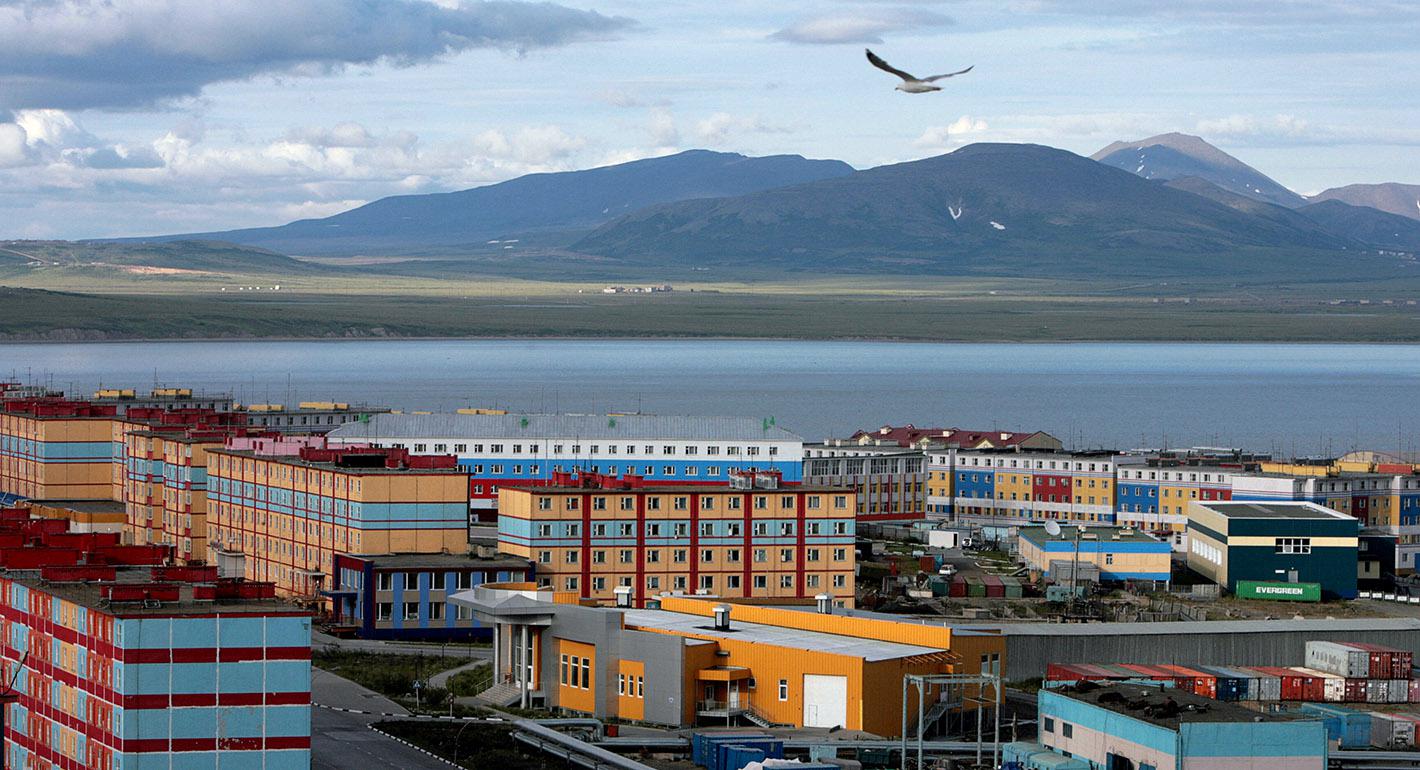
Source: Getty
For all the talk within the Kremlin of a career elevator, the federal government has very few attractive posts to offer to regional executives, leaving ambitious careerists vying for third-rate jobs.
At first glance, Russia’s invasion of Ukraine has finally provided government officials with opportunities for career advancement. Russian President Vladimir Putin has started rewarding those who have worked in territories annexed by Russia with positions as governors of Russian regions.
Vitaly Khotsenko, former prime minister of the self-proclaimed Donetsk People’s Republic, has been appointed acting governor of Siberia’s Omsk region; Vasily Kuznetsov, deputy prime minister of the Luhansk People’s Republic, has been given the same role in Chukotka in Russia’s Far North; and the parliamentarian Sergei Sokol, who is currently at the front line, looks set to challenge the Communist governor Valentin Konovalov for the top post in Khakassia.
The appointments are apparently designed to demonstrate that the Kremlin is willing to reward officials who have proven themselves at the front or close to the fighting. But a closer look shows that ambitious politicians shouldn’t get their hopes up. For all the talk within the Kremlin of a career elevator, in reality, the federal government has very little to offer to regional executives. Prestigious positions inside Russia are already occupied by people whom the Kremlin needs, and there is nothing to offer them instead. Career-minded politicians are therefore forced to content themselves with vying for third-rate jobs.
None of the regions bestowed on the politicians who have done a stint in Donbas are particularly appealing: they are economically depressed and heavily subsidized by the federal government. The Omsk region has been struggling with budget issues since 2005, when the Sibneft oil company switched its registration to St. Petersburg and started paying taxes there, while Khakassia and Chukotka are sparsely populated, poor, and remote.
The Donbas officials could have received far more attractive appointments to the Krasnoyarsk, Nizhny Novgorod, and Samara regions, whose governors’ terms expire this year, but those regional leaders are staying put. The industrial lobbies that support incumbent governors have proved to be more powerful than the frontline career elevator.
The new posts given to the Donbas officials can even be construed as effective demotions. In Donetsk and Luhansk, they were responsible for substantial cash flows allocated for the territories’ reconstruction, and were in regular communication with very senior federal officials. There will be no such opportunities in Chukotka or Omsk: only budget woes and powerful local elites.
It’s unlikely that the depressed regions will serve as a springboard to federal appointments for the new acting governors. The first wave of gubernatorial appointees from the late 2010s who hoped to return to better positions in Moscow are still in their seats and running for new terms in their regions. The best-case scenario for Khotsenko, Kuznetsov, and Sokol, therefore, appears to be being reappointed as regional leaders in a few years’ time.
Ironically, all three would probably have become governors in any case—even without going to the Donbas—and of more successful and significant regions to boot. Before the war, Sokol had been mentioned as a possible future governor of the Krasnoyarsk or Irkutsk regions, while Kuznetsov was tipped for governor of the Orenburg region.
This isn’t to say that the career elevator doesn’t work, per se: it does, but is very slow and only reaches the lower levels. In the past, personal or family connections were sufficient for a successful career. Later, attending the School of Governors training program or taking part in the Leaders of Russia state contest became another requirement. Now people also need to have done a stint in the newly annexed territories or on the front lines. But even after all those efforts, public officials might end up in worse positions than those who started ascending the career ladder earlier.
Governor posts have been one of the last avenues for career growth in the Russian government since the mid-2010s. Back then, governors were a motley crew of old-timers from the 1990s, representatives of lobby groups, political appointees, and in-system opposition politicians. Following his appointment as first deputy chief of staff in 2016, Sergei Kiriyenko set about gradually creating a more uniform corps of governors by promoting younger officials on the informal promise that the post of regional governor was a stepping stone in a career in federal government.
At the outset, Kiriyenko proteges were appointed to fairly attractive regions like Nizhny Novgorod or Samara. But over the years, the appointments have increasingly gravitated toward more depressed regions, and the promise of working at the federal level has never materialized, even for the first wave of Kiriyenko governors.
The reason is that the best positions in the capital have already been assigned to indispensable figures, and replacing them would endanger the stability of the system. That’s why the Nizhny Novgorod and Samara governors remain in their posts, and the only regions left to offer those returning from the front lines are depressed and remote areas. Even these areas only became available because the Chukotka governor retired, and Khakassia and Omsk were two of the last regions headed by governors from in-system opposition parties.
Without making serious changes to the system, the Kremlin can only offer politicians who have served in the newly annexed regions positions currently held by in-system opposition party members. But they are running out of those as well: if the fall elections go as planned, there will be just three such seats left.
Other governors’ seats are firmly held by the technocrats recruited before the war. It’s even harder to rotate people working in federal ministries, let alone those in the presidential administration or the Security Council. Russian stability has become too fragile to allow high-level personnel changes to be made.
As a result, even the ambitious officials prepared to go to the front line for the sake of career advancement simply have no room for growth. While their resumes are getting longer, there are hardly any jobs for them to fill. The system remains hermetically sealed and incapable of rewarding those who have put a lot on the line for it.

Andrey Pertsev is a journalist with Meduza website.
Recent Work
Andrey Pertsev
Andrey Pertsev
Carnegie does not take institutional positions on public policy issues; the views represented herein are those of the author(s) and do not necessarily reflect the views of Carnegie, its staff, or its trustees.

The truth of the strategic situation is that Europe and Russia are extremely unlikely to be able to “turn the page” on their confrontation within the next two decades.

Arkady Moshes

Russia spent years building a “sovereign internet,” concentrating web infrastructure exclusively within Russian territory. Ukrainian drone attacks have shown how vulnerable that approach has left the Russian internet.

Maria Kolomychenko

Putin’s conservative staffing policies and search for ever greater control have cemented parliament’s transformation into a bureaucratic appendage of the executive branch.
Andrey Pertsev

Russia’s AI-driven propaganda campaigns operate in a fragmented, chaotic, and often illogical manner. That’s not necessarily a problem for the Kremlin, though: It’s much easier to mimic genuine public debate that way.

Ilya Klishin

Russian strikes are weakening the economy sustaining Ukraine’s war effort. Closing the growing funding gap will require more European support and politically contentious reforms in Kyiv.

Balázs Jarábik