

Commentary
Tatiana Stanovaya
{
  "authors": [
    "Tatiana Stanovaya"
  ],
  "type": "commentary",
  "blog": "Carnegie Politika",
  "centerAffiliationAll": "dc",
  "centers": [
    "Carnegie Endowment for International Peace",
    "Carnegie Russia Eurasia Center"
  ],
  "collections": [],
  "englishNewsletterAll": "ctw",
  "nonEnglishNewsletterAll": "",
  "primaryCenter": "Carnegie Russia Eurasia Center",
  "programAffiliation": "russia",
  "programs": [
    "Russia and Eurasia"
  ],
  "projects": [],
  "regions": [
    "Caucasus",
    "Russia"
  ],
  "topics": [
    "Economy",
    "Political Reform",
    "Domestic Politics"
  ]
}
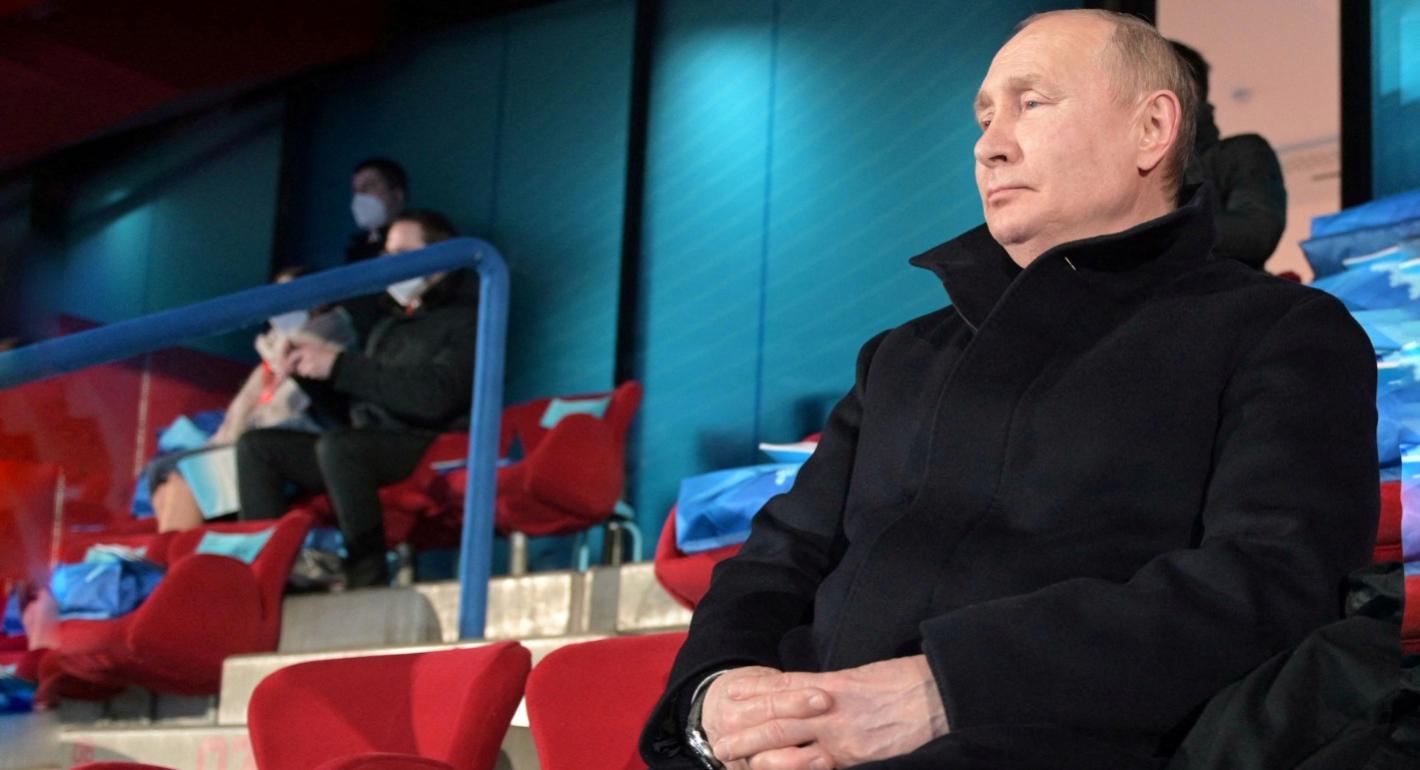
Source: Getty
Putin’s plan is to wait out what he sees as inevitable changes in the West and Ukraine. These days, however, Russia’s elites are liable to see defeatism in inaction.
Nothing is happening in Russia. At least, that’s the impression given by Vladimir Putin over the past six months.
On some level, the president has been extremely active, secretly micromanaging the war effort and publicly pretending to be dealing with routine matters from meetings on the economy to the launch of a tram line in the occupied Ukrainian city of Mariupol. Yet there are no presidential initiatives in the works for adapting the country to the new wartime reality and all that it involves.
Putin has stubbornly remained disengaged in this sense, despite drone strikes on the Kremlin, mercenary boss Yevgeny Prigozhin’s crusade against the Defense Ministry, and even Ukraine’s looming counteroffensive. He prefers to give lectures on history and offer optimistic assessments of Russia’s economic prospects—and pessimistic ones of the West’s.
This doesn’t mean, of course, that there really is nothing happening in Russia: quite the contrary. But what is happening has far less to do with the president’s plans or strategic interests than it does with the corporate interests of individual departments and figures. What is happening is largely a response to the worsening conditions facing Russia.
Take the digitization of Russia’s system for issuing conscription notices, a move forced by the difficulties surrounding conscription during a war that is not going according to plan. Or how repression has deepened, in an attempt at self-preservation by the system amid fast-growing geopolitical risks and fears of defeat.
Repressive inertia and self-aggrandizement by major institutions such as the FSB and the defense and finance ministries have driven many recent decisions, including the return of ideology. Justice Minister Konstantin Chuichenko has spoken openly about the possibility of introducing a new official ideology that would extend to education, cinema, theater, and poetry. This process has long since ceased to be under Putin’s direct control and is now developing independently of him, albeit with his passive consent.
Here and in other important debates, Putin’s voice is absent. Should Russia’s borders be closed? Should those who have already left have their rights restricted? Who is to be exempted from mobilization? How are those designated as “foreign agents” by the state to be punished? What should be done about Prigozhin? How should the country respond to incidents like drone strikes and attempts to assassinate “ultra-patriots”?
The stances of parliamentarians, party leaders, cabinet ministers, military bloggers, and the security services on these and other matters are all well known. Yet Putin says nothing, intervening only to take steps such as retreating from the key Ukrainian city of Kherson, suspending Russia’s participation in the New START nuclear agreement, or pulling out of the Treaty on Conventional Armed Forces in Europe. Even in his long-awaited address to the Federal Assembly, he merely listed measures already taken by the government.
Today, Putin is just about the only person in Russia who is not increasingly engaged in politics, from former president Dmitry Medvedev, State Duma speaker Vyacheslav Volodin, and Security Council head Nikolai Patrushev to Prigozhin, the war bloggers, and television hosts. It is as though the president has recused himself, devoting himself to secret military and geopolitical matters, the details of which are known to few.
This is not a sign of fear or weakness. Rather, it reflects Putin’s growing messiah complex. At present, literally all his political hopes and plans hinge on external changes that are out of his control. Putin has no instruments or resources with which to change the situation in his favor. Yet he believes that the world will change all the same and deliver him Kyiv’s capitulation.
Putin’s plan is to wait out what he sees as the inevitable transformation of the West and Ukraine. Any fear of a Ukrainian counteroffensive has given way to the conviction that little will change on the battlefield, beyond minor setbacks that he is prepared to tolerate. The calculation in the Kremlin is that absent a military breakthrough, Ukraine’s elite will fracture, leading to the emergence of a “party of peace” (i.e., capitulation), while in the West, internal divisions will force cuts to military and political support for Kyiv.
Putin’s hopes cannot be dismissed as completely baseless, but his problem is that this approach is anathema to Russia’s restless political class. For all its loyalty and pliability, it has evolved dramatically during the war. These days, Russia’s elites are liable to see defeatism in inaction.
All of this creates the conditions for the political ambitions of parastatal actors to soar. Despite their reputation for being instruments of the Kremlin, they are gradually building political capital and may one day run out of patience with the regime and challenge it. Already, Putin is struggling to explain what exactly he is waiting for.
In the first months of the war, many took notice of how the once-marginal pro-war “ultra-patriots” had matured politically and come to dominate the information space. Today, the officious hawks, such as Medvedev, Volodin, and Patrushev, are losing their place in Russian politics to the angry patriots, including Prigozhin, former Donbas commander Igor Strelkov, and the war bloggers. Compared to each other, the former seem like opportunists and armchair generals, while the latter, having emerged in combat conditions, look much more like the real thing.
The regime is not under threat so long as Putin’s ratings remain stable, and besides, the mechanism of power is still completely under his control. Yet his public paralysis and refusal to assume responsibility for the resolution of the most pressing problems facing Russia cannot but render him and his courtiers politically irrelevant and create a vacuum to be filled by the ultra-patriots. The day may come when Putin finds himself dependent on a once harmless bunch made dangerous by his opacity and inaction.

Senior Fellow, Carnegie Russia Eurasia Center
Tatiana Stanovaya is a senior fellow at the Carnegie Russia Eurasia Center.
Recent Work
Tatiana Stanovaya
Tatiana Stanovaya
Carnegie does not take institutional positions on public policy issues; the views represented herein are those of the author(s) and do not necessarily reflect the views of Carnegie, its staff, or its trustees.

Japan’s long-term security policy is driven by concerns about China, and there is little appetite for (or interest in) pursuing a confrontation with Moscow.

James D.J. Brown
The truth of the strategic situation is that Europe and Russia are extremely unlikely to be able to “turn the page” on their confrontation within the next two decades.
Arkady Moshes
Russia spent years building a “sovereign internet,” concentrating web infrastructure exclusively within Russian territory. Ukrainian drone attacks have shown how vulnerable that approach has left the Russian internet.

Maria Kolomychenko

Putin’s conservative staffing policies and search for ever greater control have cemented parliament’s transformation into a bureaucratic appendage of the executive branch.

Andrey Pertsev

Russia’s AI-driven propaganda campaigns operate in a fragmented, chaotic, and often illogical manner. That’s not necessarily a problem for the Kremlin, though: It’s much easier to mimic genuine public debate that way.

Ilya Klishin