

Commentary
Tatiana Stanovaya
{
  "authors": [
    "Tatiana Stanovaya"
  ],
  "type": "commentary",
  "blog": "Carnegie Politika",
  "centerAffiliationAll": "dc",
  "centers": [
    "Carnegie Endowment for International Peace",
    "Carnegie Russia Eurasia Center"
  ],
  "collections": [],
  "englishNewsletterAll": "ctw",
  "nonEnglishNewsletterAll": "",
  "primaryCenter": "Carnegie Russia Eurasia Center",
  "programAffiliation": "russia",
  "programs": [
    "Russia and Eurasia"
  ],
  "projects": [],
  "regions": [
    "Russia",
    "Caucasus"
  ],
  "topics": [
    "Foreign Policy",
    "Economy",
    "Political Reform",
    "Domestic Politics"
  ]
}
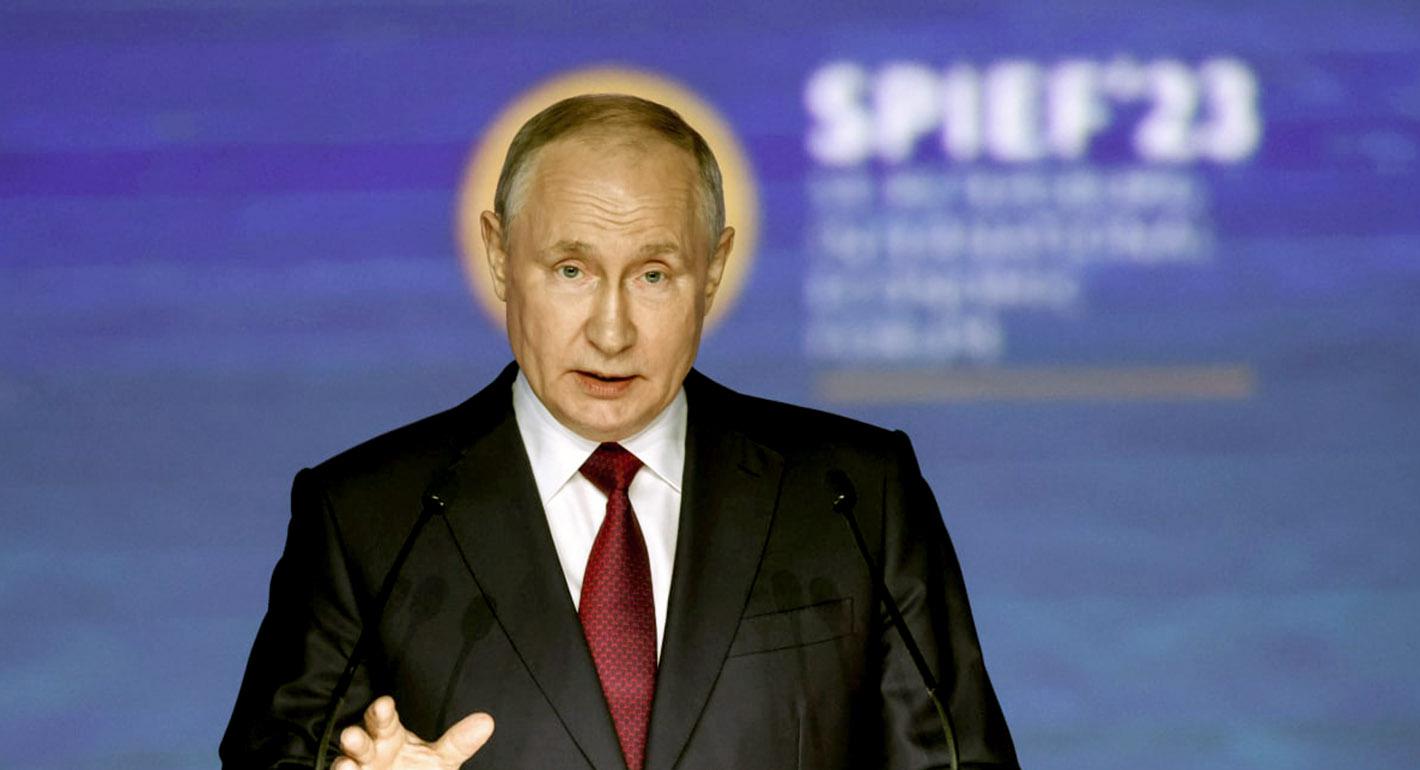
Source: Getty
While saying little, Putin has revealed that military failures are entirely at odds with his vision for the future, while several more rounds of escalation—up to and including strikes on a third country—are something he can envisage.
As usual, Russian President Vladimir Putin paid little attention to the most pressing public questions during his keynote speech at the annual St. Petersburg International Economic Forum (SPIEF) last week. He spoke only briefly about the war in Ukraine, and mostly in a historical context, but even the little he did say shed light on his strategy as Ukraine’s counteroffensive gets under way.
The SPIEF audience was shown a specially made video about murderous Ukrainian Nazis, demonstrating yet again how deeply Putin has internalized Russia’s “denazification” narrative and how convinced he is of the historical righteousness of his cause. This means there is no chance he will ever realize quite how disastrous his decision to invade Ukraine was. Putin appears to believe that history has shown that Russia cannot suffer a military defeat.
Amid drones attacking the Kremlin and the unfolding Ukrainian counteroffensive, Putin preferred to focus on the supposedly bright prospects of the Russian economy. This could be interpreted as a desire to avoid further military escalation. But such a reading would be a mistake.
Firstly, the president made it clear that Russia is doomed to a long, almost unresolvable conflict and that there is no hope of reaching an understanding with the West. In this respect, his answer to a question about what advice he would give U.S. President Joe Biden spoke volumes. The Russian leader mumbled something about how it was not his place to teach the U.S. president, but also issued a threat. “We will do what we think is in the interests of the Russian Federation and the people of Russia,” he said. “And everybody will have to take this into account.”
There are no longer any illusions that the spirit of peace may prevail, just as there is no counting on negotiations with the West. Any such hopes were shattered in Moscow once and for all in November last year, following the failed negotiations in Ankara between Foreign Intelligence Service head Sergei Naryshkin and CIA director William Burns.
Secondly, Putin did not hide the fact that he is prepared to escalate matters even further. He confirmed that Russia has handed over the first (but not last) tactical nuclear warheads to Belarus, and said if U.S. F-16 fighter aircraft are used in the hostilities, they “will be burning too,” even if they are located at air bases outside Ukraine. In other words, Moscow is prepared to carry out strikes on the territory of other countries, too.
The paradox here is that while Putin is prepared for escalation, he also fears it. He is afraid that his opponents would ramp up the spiral of confrontation to the extent that Russia loses control of the military situation and the initiative passes to the enemy. “Everyone is waiting for us to start pushing buttons. There is no need for that,” said Putin, adding that “they are provoking us into a harsh response.”
His words reveal both an attempt to make sure Russia is not seen as a country that is rattling the nuclear saber and his fear of finding himself in a situation in which he will have no choice but to take drastic action. Putin senses that if Russia loses control of the situation, he will be defenseless. In addition, he is becoming uncomfortable about rising domestic political pressure in which the party of war is openly demanding more aggressive action from the Kremlin.
A fear that escalation could be initiated by the enemy is one of the reasons for Putin’s silence about incidents like the drone attacks on Moscow and armed cross-border incursions onto Russian territory. If he mentions them at all, it’s as something routine, predictable, and of secondary significance. “There is nothing unusual about that. We will react calmly, and we will fight back,” he told the SPIEF audience, promising that in a worst-case scenario, he would look at the creation of a buffer zone: i.e., seize control of enough Ukrainian territory that Ukrainian artillery is out of range of Russian territory.
Putin said the same thing a few days earlier at a meeting with military bloggers. But he gave himself away a little when he admitted that the issue was a complicated one that required careful analysis. The reason for his caution is clear: there are serious doubts over whether Russia’s armed forces are capable of carving out a buffer zone.
Putin wants to avoid taking risky steps because his main plan is simply to wait for systemic changes in the West. In particular, this entails waiting for the appearance of a more pragmatic, more rational, and less pro-Ukraine president in the United States: one who would reverse the position of the current White House when it comes to the war and toward Russia.
Putin reaffirmed his faith in this plan at SPIEF. He suggested that it was Western countries which had decided to stop talking with Russia, but that a day will come when they will change their position and end military support for Kyiv. Putin is certain that this will be fatal for Ukraine: according to him, Russia has already nearly achieved its goal of the demilitarization of Ukraine, since the country has little of its own hardware left.
According to the Russian president, Ukraine will soon find itself in a one-on-one fight with Russia and will be forced to negotiate. Of course, a precondition for this will be recognition of Crimea, which Russia annexed in 2014, and the four other Ukrainian regions that Russia announced it was annexing last fall.
On the surface, Putin did not say anything new at SPIEF. Yet it was significant that he revealed that military failures are entirely at odds with his vision for the future, while several more rounds of escalation—up to and including strikes on a third country—are something he can envisage.
It’s possible that the Ukrainian counteroffensive will falter and that attacks on Russian territory will remain localized and without serious consequences. In that case, the status quo will continue for a long time to come. However, a worse outcome for Russia is also very possible, and Putin’s speech at SPIEF revealed that he is not psychologically prepared for such an eventuality. If that happens, the current calm facade will quickly give way to desperate measures and further escalation.

Senior Fellow, Carnegie Russia Eurasia Center
Tatiana Stanovaya is a senior fellow at the Carnegie Russia Eurasia Center.
Recent Work
Tatiana Stanovaya
Tatiana Stanovaya
Carnegie does not take institutional positions on public policy issues; the views represented herein are those of the author(s) and do not necessarily reflect the views of Carnegie, its staff, or its trustees.
A leak of Russian gas price data helps establish that China is paying Russia far less than Central Asian countries and Gazprom’s former European customers.

Sergey Vakulenko

Japan’s long-term security policy is driven by concerns about China, and there is little appetite for (or interest in) pursuing a confrontation with Moscow.

James D.J. Brown

The truth of the strategic situation is that Europe and Russia are extremely unlikely to be able to “turn the page” on their confrontation within the next two decades.
Arkady Moshes
Russia spent years building a “sovereign internet,” concentrating web infrastructure exclusively within Russian territory. Ukrainian drone attacks have shown how vulnerable that approach has left the Russian internet.

Maria Kolomychenko

Putin’s conservative staffing policies and search for ever greater control have cemented parliament’s transformation into a bureaucratic appendage of the executive branch.

Andrey Pertsev