

Commentary
Mikhail Korostikov
{
  "authors": [
    "Mikhail Korostikov"
  ],
  "type": "commentary",
  "blog": "Carnegie Politika",
  "centerAffiliationAll": "dc",
  "centers": [
    "Carnegie Endowment for International Peace",
    "Carnegie Russia Eurasia Center"
  ],
  "collections": [],
  "englishNewsletterAll": "ctw",
  "nonEnglishNewsletterAll": "",
  "primaryCenter": "Carnegie Russia Eurasia Center",
  "programAffiliation": "russia",
  "programs": [
    "Russia and Eurasia"
  ],
  "projects": [],
  "regions": [
    "East Asia",
    "China",
    "Russia",
    "Caucasus"
  ],
  "topics": [
    "Foreign Policy",
    "Economy",
    "Political Reform",
    "Domestic Politics"
  ]
}
Source: Getty
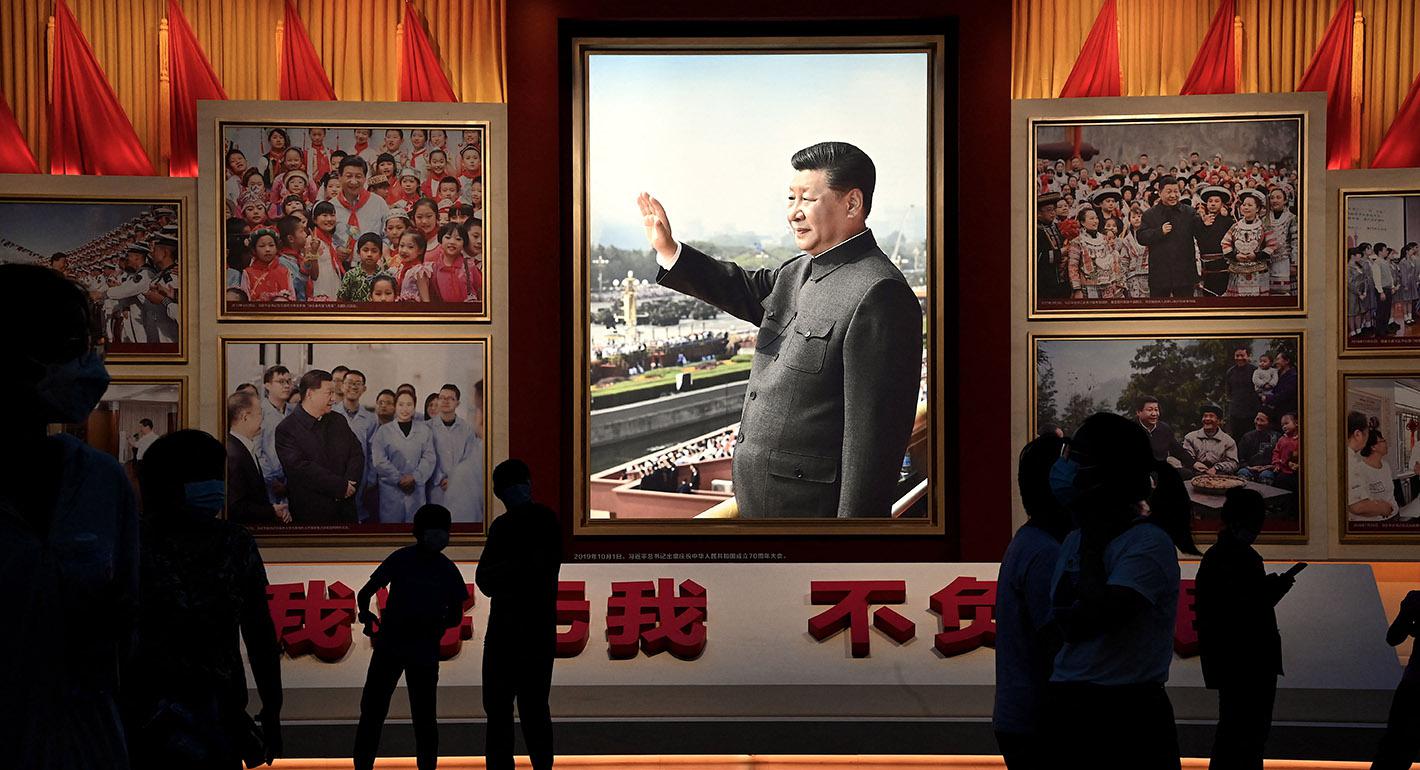
Beijing has nothing to offer Moscow in terms of ideology, but will gladly share its ideas for the economy and political control.
The world’s first center for studying the ideas of Chinese leader Xi Jinping has opened in Moscow within Russia’s Institute of China and Modern Asia, part of the Academy of Sciences. The news has been widely discussed since it was announced in June, with some suggesting that it foreshadows greater Russian dependence on China, that the Kremlin is interested in Chinese-style socialism, or—in line with the principle of reciprocity—that a center for studying the ideas of Russian President Vladimir Putin will soon open in Beijing.
Although such speculation is unfounded, it is true that an exchange of ideas between the two countries has been under way for a long time, and that the Chinese influence on Russia’s elite is becoming more and more noticeable.
The news about the opening of the Xi Jinping Thought Research Laboratory was so widely reported by both Russian and foreign media that its name was subsequently changed to something more neutral. It will now be known as the laboratory for the study of the “modern ideology of the People’s Republic of China,” according to Kirill Babayev, head of the Institute of China and Modern Asia.
Its main task, according to Babayev, will be to research the ideas behind Beijing’s policymaking, because the “era of Xi Jinping will be a long one, and his ideas will have a major influence on Chinese politics in a variety of different spheres.” All the center’s experts will be Russian, and it is stated that all the funding is Russian: there is no Chinese money in the project.
Once the phrase “Xi Jinping Thought” is removed from the center’s title, there is nothing unusual about this sort of research project. Indeed, it is good practice to study the ideology of a major trade, political, and technological partner, at the very least to have confidence in the prospect of preserving that partnership. There are similar setups attached to universities all over the world, though as a rule, they have broader mandates and less intriguing names. The absence of such a center in Russia has long been a source of concern for the country’s Chinese studies community.
Even if this sort of project were financed by Chinese money, it would be an unlikely sign that Beijing was seeking to secure some sort of ideological dominance over Moscow. While Xi Jinping’s ideas may be ubiquitous inside China, it must be acknowledged that Beijing has not traditionally gone to much effort to spread them abroad. It’s true that Beijing is interested in what the West refers to as the “export of authoritarianism” and projecting its economic power—but Xi Jinping’s ideas are too China-centered, which makes them largely irrelevant to other countries.
More importantly, the current similarities of the Chinese and Russian regimes mean there are growing opportunities: if not for ideas, then at least for political management strategies. When it comes to human rights and domestic freedoms, the Chinese and Russian regimes have generally looked very different over the last forty years. In 2023, however, they have converged sharply. At this moment in time, each country is ruled by an unreplaceable leader and is in the grip of a rigid autocracy that rejects democratic rights and norms, persecutes dissidents, and excludes the opposition from political life.
It’s unsurprising that they are learning from one another—and not just about political authoritarianism techniques. Russia’s isolation from the West amid the Ukraine war is pushing the country toward greater economic autarky, import substitution, and control over society. At the St. Petersburg International Economic Forum last month, Putin said Russia needed a “sovereign economy” and “supply-side economics” to boost its production power, strengthen infrastructure, help develop cutting-edge technologies, create whole new sectors, and accelerate domestic investment.
China has a lot of practical experience with all of this. Putin’s concept of “supply-side economics” may even have been borrowed from China, where supply-side reforms have been ongoing since 2018 and are considered part of the “Xi Jinping Thought on Socialist Economy With Chinese Characteristics for a New Era”—a set of ideas and principles sometimes referred to as Xi’ism.
The theory of “supply-side economics” originally emerged in the West and was associated with U.S. President Ronald Reagan. But in China, it’s understood to mean destocking, deleveraging, and dismantling “zombie companies” that depend on state support. Almost all these approaches could be relevant in Russia.
Another area in which China has technological experience that could be useful for the Kremlin is mass surveillance. The recent introduction of face recognition systems in Russia is a step in this direction, but Beijing is far ahead. Since 2014, Chinese people can only upload a video online if they have registered using their internal passport. And since 2017, that has been extended so that you can’t even use a social media website without such registration.
China’s Sharp Eyes program includes a provision for the video surveillance of almost the entire population. And ordinary people have access to this system, which incentivizes informing on those suspected of doing something illegal. Police big data systems in Chinese regions collect and store information about people, including passport details and medical histories. All this technology could realistically be transferred to Russia.
There is no point in China attempting to introduce Xi Jinping’s ideas in Russia, as it would reap no rewards. Even without Chinese ideology, Putin is an extremely useful partner for Beijing. However, the growing similarities between the two regimes mean that there is significant overlap when it comes to political management—and it’s here that an exchange of ideas could be useful for both sides.

Sinologist
Recent Work
Mikhail Korostikov
Mikhail Korostikov
Carnegie does not take institutional positions on public policy issues; the views represented herein are those of the author(s) and do not necessarily reflect the views of Carnegie, its staff, or its trustees.

Russian strikes are weakening the economy sustaining Ukraine’s war effort. Closing the growing funding gap will require more European support and politically contentious reforms in Kyiv.

Balázs Jarábik

Ex-president Gurbanguly Berdimuhamedov remains interested in politics, but his son Serdar, Turkmenistan’s current president, is becoming increasingly independent and willing to break with his father’s legacy. If their covert rivalry goes too far, both risk losing power.

Galiya Ibragimova

Despite a new textbook, an influx of Russian teachers and managers, and an end to the teaching of Ukrainian, the Kremlin is unlikely to have “reprogrammed” locals.

Konstantin Skorkin

For every ruble allocated to social policy, health, and education in 2027, double that amount is earmarked for the army, the police, and the security services.

Alexandra Prokopenko

Cargo traffic through Russia’s Northern Sea Route has increased because of the disruption caused by the conflict in the Middle East, the Ukraine war, and U.S.-China tensions.
Mikhail Korostikov