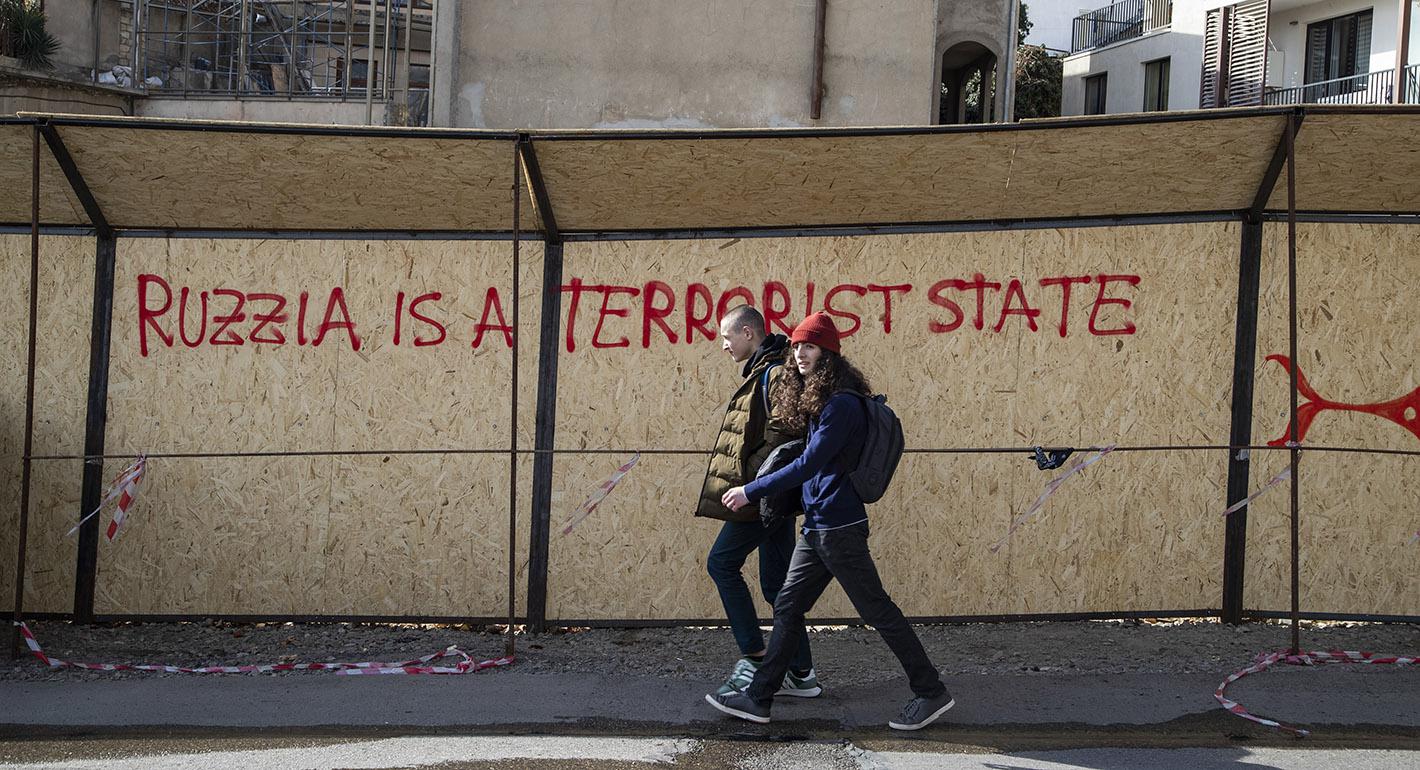
A week after Russia’s full-scale invasion of Ukraine last February prompted an influx of Russian immigrants into neighboring Georgia, a young Georgian politician published a series of instructions on “how to treat Russians” on social media. “Maintain a cold distance,” advised Giorgi Noniashvili, a member of the European Georgia opposition party. Other advice included not smiling—“you don’t smile at the enemy”—and not responding to questions asked in Russian.
Noniashvili’s suggestions encapsulate widespread attitudes in Georgian society toward recent waves of Russian immigration: a certain sense of inevitability, but also a deep distrust, if not outright fear. Since the outbreak of the war, and particularly after the partial mobilization declared by President Vladimir Putin last September, the number of Russian nationals crossing into Georgia has risen significantly: 148,000 in the third quarter of 2022 alone, and 160,000 in the first three quarters of 2023, a roughly five-fold increase from the corresponding period in 2021.
There was also a huge spike in the number of Russian businesses registered in Georgia. According to Transparency International, between March 2022 and June 2023, Russian nationals registered 21,000 companies: almost three times as many as the entire total of the preceding quarter of a century.
The economic impact of these developments has been major. On the one hand, the country has seen double-digit economic growth for the first time since 2007. The Georgian lari has risen in value by 18 percent. At the same time, the country has experienced runaway inflation of almost 12 percent, and rent prices have almost doubled in major cities, making life difficult for locals, especially groups such as students and day laborers.
Still, the main concerns regarding Russian immigration are not economic, but political: specifically, the perceived security challenges. Georgian policy experts and politicians have expressed concerns that undercover operatives may infiltrate immigrant communities to turn them into tools of Russian soft power—and a pretext for yet more military aggression by Russia, which fought a five-day war with Georgia back in 2008, and still has military control over one-fifth of Georgian territory. A rise in crime and corruption has been identified as another major risk.
None of these concerns are unfounded. On October 10, two former Russian agents admitted they had been sent to Georgia for espionage purposes following the invasion of Ukraine. There has already been an instance of an establishment of a Russian-language school that was illegally using materials from Russia’s heavily ideological school curricula. Most ominously, Russia has indicated that it will monitor the protection of the Russian-speaking minority’s rights in Georgia: the pretext cited by Moscow for sending troops to Georgia’s breakaway territory back in 2008, and to parts of Ukraine in 2014.
These concerns are shared by the majority of the Georgian population. Graffiti reading “Russians go home” is not an uncommon sight on the streets of Tbilisi; immigrants have been met with demonstrations at the Larsi crossing into Georgia; and, according to an International Republican Institute survey, as of early 2023, 79 percent of Georgians believed that Russian nationals should not have the right to enter the country without a visa, purchase property, or open a business. As early as March 2022, 66 percent of Georgians supported the introduction of visa requirements between the two countries (Russian nationals can currently reside in Georgia without a visa for up to a year).
These attitudes are not, however, reflected in the Georgian government’s policy or rhetoric. From the onset of the war, members of the ruling Georgian Dream party have downplayed concerns over Russian immigration as “hysterical.” The party’s chairman, Irakli Kobakhidze, even threatened to toughen up anti-discriminatory legislation in response to what he described as a campaign of ethnic discrimination against Russians. In April 2023, Georgian Airways reinstated direct flights between Moscow and Tbilisi with explicit government approval and coordination with the Russian authorities, easing the way for further Russian immigration into the country.
This discrepancy between public opinion and government policy regarding Russian immigration and overall relations with Russia has led to multiple protests and demonstrations. The most serious was in March 2023 against the introduction of the so-called “Russian Law.” The draft law would have obligated organizations receiving funding from outside the country to register as foreign agents, mirroring controversial legislation already in place in Russia.
The government was quick to link the dissent to party politics, attributing it to provocations by the “party of war” and accusing the protesters of having connections to the previous government, led by the United National Movement (UNM). But amid violent clashes between protesters and the police, Georgian Dream was forced to withdraw the proposed legislation, proving the potency of anti-Russian sentiment as a mobilizing force in Georgian politics.
Unsurprisingly, the opposition is trying to capitalize on this sentiment and the government’s unwillingness to address it ahead of parliamentary elections scheduled for 2024. On November 20, Mamuka Khazaradze, head of the pro-Western Lelo party, proposed a series of restrictions for Russian immigrants, including introducing visa requirements and a ban on land and real estate purchases.
Just a few days later, Mikheil Saakashvili, who was president of Georgia during the 2008 war with Russia and is now the de facto leader of UNM, the largest opposition party, promised to enact even more radical legislation that would force Russian nationals to sell their assets in Georgia and leave the country within a year.
These initiatives show that the presence of Russian immigrants has become a thorny and divisive issue that is set to gain further political significance as the election season heats up. Despite the public outcry, the Georgian Dream government has so far remained steadfast in its refusal to curb or regulate Russian immigration in any manner. Time will tell whether that policy will have a political price.