

Commentary
Andrey Pertsev
{
  "authors": [
    "Andrey Pertsev"
  ],
  "type": "commentary",
  "blog": "Carnegie Politika",
  "centerAffiliationAll": "dc",
  "centers": [
    "Carnegie Endowment for International Peace",
    "Carnegie Russia Eurasia Center"
  ],
  "collections": [],
  "englishNewsletterAll": "ctw",
  "nonEnglishNewsletterAll": "",
  "primaryCenter": "Carnegie Russia Eurasia Center",
  "programAffiliation": "russia",
  "programs": [
    "Russia and Eurasia"
  ],
  "projects": [],
  "regions": [
    "Russia",
    "Caucasus"
  ],
  "topics": [
    "Political Reform",
    "Economy",
    "Domestic Politics"
  ]
}
Source: Getty
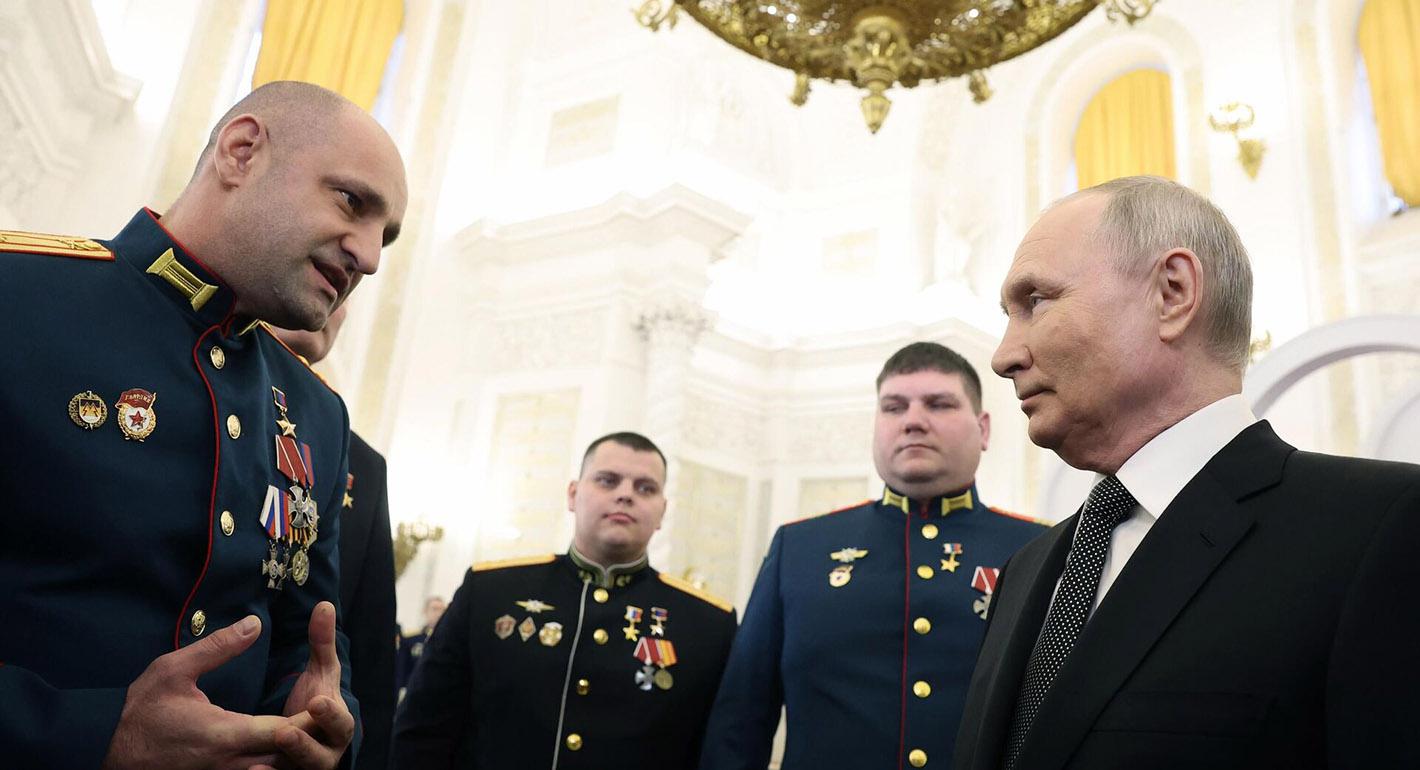
The president’s inclination to ignore his administration and act upon his own initiative is damaging to both himself and the power vertical he created.
The Kremlin’s domestic policy bloc had carefully prepared a choice of platforms for President Vladimir Putin to announce that he would run for a fifth presidential term, and all of them were deliberately far removed from the war. Russians are tired of the topic of war, and announcing his candidacy at a decidedly nonmilitary event would have created the illusion of stability and a prevailing mood of calm. Putin, however, apparently had other ideas, and chose instead to confirm he would run at a military awards ceremony—and in response to a request from a former commander from the annexed war-torn Donbas region, no less.
Putin confirmed he would run again in the 2024 presidential election following a Kremlin ceremony on December 8 to award the title of Hero of Russia. His comments were made in reply to an impassioned plea from Artyom Zhoga, a former military commander who fought in Ukraine’s Donbas region and is now speaker of the self-proclaimed Donetsk People’s Republic parliament.
Footage of Putin’s mumbled confirmation did not appear in the media straight away, and when it finally surfaced, it only strengthened the impression that the painfully obviously staged request and response had been put together in a rush, which is hardly in keeping with the Kremlin’s statements about the historical significance of the upcoming vote. Zhoga visibly struggled to get his question out as other participants in the awards ceremony crowded around him and Putin to shake hands with the president, clearly unaware that something important was happening right in front of them.
This disorderly haste is especially surprising, given that the parts of the presidential administration responsible for domestic policy and PR had been busy preparing several possible platforms for Putin’s nomination as a candidate that were more in keeping with the status of a “historic event.” The political bloc’s preference was for the gigantic “Russia” exhibition and forum currently being held at Moscow’s VDNKh pavilion complex. Back in the summer, there were media reports that Putin would announce his candidature at its opening on November 4, amid a grandiose display of his virtual achievements. In the end, however, Putin did not even attend the opening of the exhibition.
Another option was his Direct Line phone-in with members of the public and press conference, scheduled for December 14. The merger of the two formats (previously separate affairs) has added to the event’s gravitas. The optics would also have been good: a “representative of the people”—a public sector employee, worker, or even a businessman—could have implored Putin to run again, and the president would have graciously acquiesced.
It’s hardly news, of course, that Putin will run again. Any remaining doubts were dispelled when the constitution was altered in 2020 to “reset the clock” on his presidential terms, overcoming a previous ban on holding office for more than two consecutive terms. Announcing his candidacy at the exhibition or during the phone-in were supposed to offset this predictability by turning it into something of an event.
It would appear that the initiative to divert away from the planned scenario came from Putin himself. Given his KGB background, the president does not like it when his plans are known in advance, since that may give ill-wishers (both foreign and domestic) the chance to use those plans against him. But since Putin’s “enemies” had no illusions about him running for election, this chaotic smokescreen was entirely unnecessary.
This isn’t the first time the president has gone rogue. In 2017, the Kremlin’s political bloc planned for him to announce he would run again during an appearance at a volunteer forum. A duly briefed participant even asked the corresponding question, but did not receive an answer from the president. Instead, Putin announced his campaign at the anniversary celebrations of the GAZ automobile plant.
Previously, Putin listened to his political advisers. But now he is the problematic type of candidate who prefers to be their own strategist. These politicians still hire professionals for some reason, but then insist on coming up with the key elements of their campaign themselves in the belief that they know what voters want. This approach tends to generate unsuccessful slogans, ideas, and PR formats, which interfere with campaigning. Putin’s semi-spontaneous announcement will also make it difficult for his staff to maintain interest in the “Russia” exhibition and the phone-in.
There will always be people in the president’s entourage who are prepared to humor his whims. In this case, that person was apparently Andrei Turchak, head of the ruling party United Russia, who is closely involved in military affairs and has known Zhoga for a long time.
The bumpy start to Putin’s campaign will not affect the election results, of course. Over the course of several years, the political bloc has fine-tuned the corporate mobilization machine, which is now also supported by electronic voting and three-day elections. But it will certainly be harder to create the required mood of optimism among voters.
Putin chose a military awards ceremony as his platform, and Zhoga made the request on the behalf of “our Donbas.” Yet ordinary Russians are clearly tired of the war. According to recent polls, more people in Russia are now in favor of entering into peace talks than want to continue the hostilities.
Announcing his intention to run at a “peaceful” event would have projected the message that everything was stable, that Russia has nothing to fear from war and sanctions. But the president decided otherwise.
In addition, by agreeing to a request “from the Donbas,” Putin touched on another sore point. Surveyed Russians readily say that more than enough funds are being allocated for the reconstruction of Donbas infrastructure (53 percent of respondents), or even “excessive” amounts (a far from insignificant 28 percent). Putin’s focus on the annexed Ukrainian territory is directly at odds with such sentiment.
The domestic policy bloc will have to somehow soften the consequences of Putin taking matters into his own hands. That won’t be easy, since the Kremlin had deliberately talked up the “historical significance” of the moment. Now that hype needs to be dialed back down, and First Deputy Chief of Staff Sergei Kiriyenko’s political bloc has already begun work.
Putin will officially be nominated as a presidential candidate (a requirement for those running as independents) by a committee of voters in Moscow’s Zaryadye concert hall on December 16. Officials must accordingly now start work on preparing that event, on top of all the previously planned events—not least the phone-in on December 14.
The president’s inclination to act upon his own initiative is increasingly ruining the plans of his administration. His actions are out of touch with reality, and are damaging to both himself and the power vertical he created.
The unofficial announcement involving Zhoga will not have critical consequences, but it shows that the president is ready to derail carefully laid plans at the most inopportune moment. In the event of plans related to war or the economy, such interference could have far more serious consequences.

Andrey Pertsev is a journalist with Meduza website.
Recent Work
Andrey Pertsev
Andrey Pertsev
Carnegie does not take institutional positions on public policy issues; the views represented herein are those of the author(s) and do not necessarily reflect the views of Carnegie, its staff, or its trustees.

Japan’s long-term security policy is driven by concerns about China, and there is little appetite for (or interest in) pursuing a confrontation with Moscow.

James D.J. Brown
The truth of the strategic situation is that Europe and Russia are extremely unlikely to be able to “turn the page” on their confrontation within the next two decades.
Arkady Moshes

Russia spent years building a “sovereign internet,” concentrating web infrastructure exclusively within Russian territory. Ukrainian drone attacks have shown how vulnerable that approach has left the Russian internet.

Maria Kolomychenko

Putin’s conservative staffing policies and search for ever greater control have cemented parliament’s transformation into a bureaucratic appendage of the executive branch.
Andrey Pertsev

Russia’s AI-driven propaganda campaigns operate in a fragmented, chaotic, and often illogical manner. That’s not necessarily a problem for the Kremlin, though: It’s much easier to mimic genuine public debate that way.

Ilya Klishin