

Commentary
Maxim Starchak
{
  "authors": [
    "Maxim Starchak"
  ],
  "type": "commentary",
  "blog": "Carnegie Politika",
  "centerAffiliationAll": "",
  "centers": [
    "Carnegie Endowment for International Peace",
    "Carnegie Russia Eurasia Center"
  ],
  "englishNewsletterAll": "",
  "nonEnglishNewsletterAll": "",
  "primaryCenter": "Carnegie Russia Eurasia Center",
  "programAffiliation": "",
  "programs": [],
  "projects": [],
  "regions": [
    "Russia"
  ],
  "topics": [
    "Nuclear Policy"
  ]
}
Source: Getty
Russia’s nuclear development of the Arctic continues apace, but with the country cut off from regional cooperation initiatives and foreign funding, many worry it may struggle to respond to a nuclear emergency.
The war in Ukraine continues to drain Russia’s resources away from critical areas, including nuclear security in the Arctic. Despite this, Moscow remains committed to the development of this strategic region, and has not stopped building nuclear sites there. In September, Norway detected elevated levels of radioactive Cesium-137 near its Arctic border with Russia. As Russia is no longer cooperating with other nations on nuclear safety in the Arctic, this is unlikely to be the last such report.
Around the same time that Norway reported the surge in radiation levels, Russian Foreign Minister Sergey Lavrov accused NATO of militarizing the Arctic through increasingly frequent crisis response exercises. Yet Russia is guilty of the same. Its new foreign policy concepts and doctrines call the Arctic “a vital area for ensuring our national interests in the global ocean,” and Moscow has warned that it will use “any means necessary” to secure its interests there. Those means include the Northern Fleet, whose ships regularly—and conspicuously—traverse the Arctic Ocean, training to counter Western submarines.
Particularly crucial to Russia’s plans is its fleet of nuclear submarines, which has become significantly more active in northern waters in the past decade. The fleet consists of twelve strategic nuclear submarines carrying up to 192 nuclear-capable ballistic missiles, twenty-four nuclear submarines armed with cruise missiles, and ten special-purpose nuclear submarines, with another twelve nuclear submarines under construction or nearly ready for commission.
The Arctic is also a testing ground for new nuclear-powered, nuclear-armed weapons—from the Burevestnik cruise missile to the Poseidon torpedo—contributing to both regional tensions and the risk of radiation accidents.
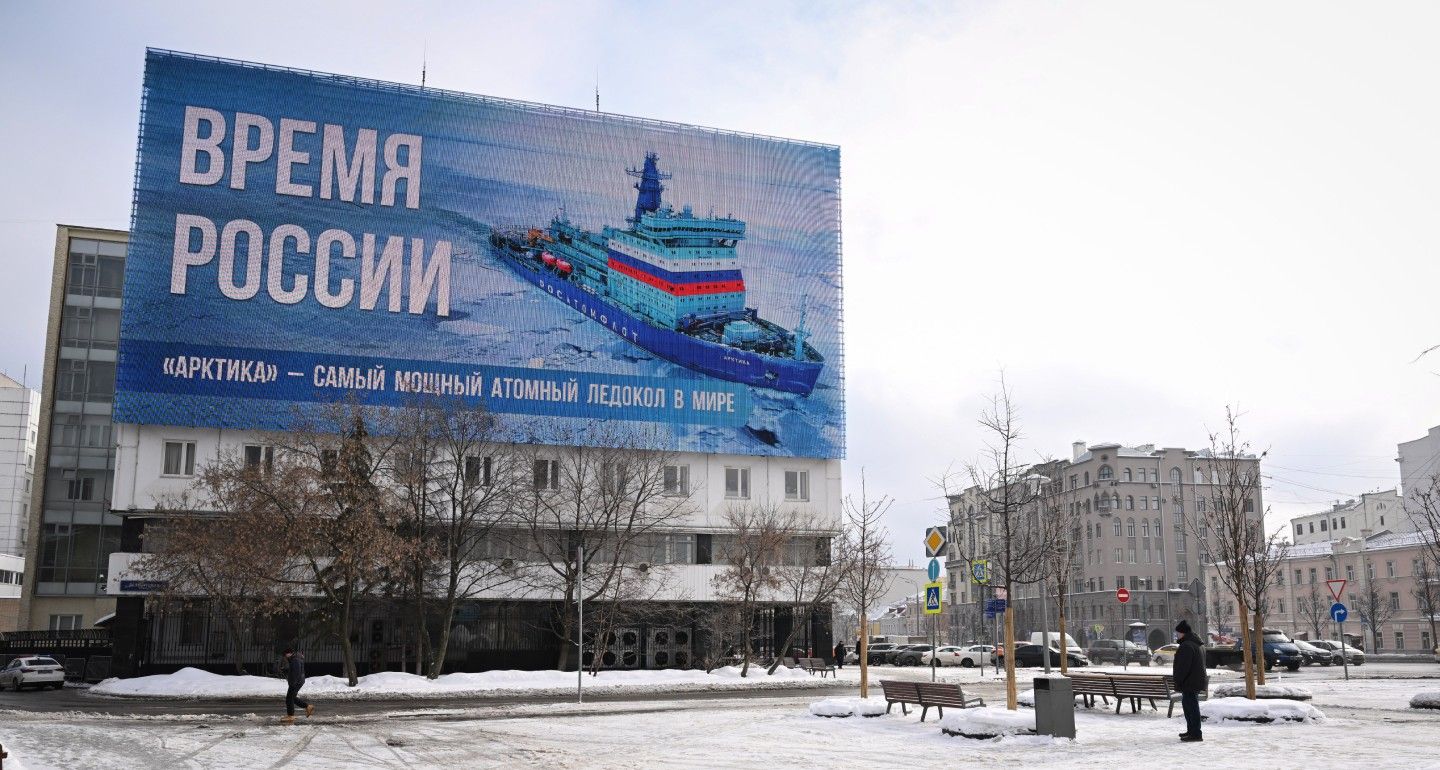
That risk is growing, not only because of Russia’s military activities, but also because of its increasing economic activity in the Arctic. Rosatom, the state nuclear company, operates the eight-ship nuclear icebreaker fleet that is key to the Northern Sea Route, along which 36 million tons of cargo were transported in 2023, up from 4 million in 2014. That number is expected to reach 270 million tons in 2035, while the nuclear icebreaker fleet is to expand by seven more vessels.
Rosatom’s footprint in the Arctic extends to Russia’s two nuclear power plants there: Kola and Bilibino. They do not generate enough energy for the country’s Arctic development needs (the region contains trillions of cubic meters of natural gas and billions of tons of oil), for which Rosatom estimates that no fewer than fifteen floating nuclear power plants are required. The company separately plans to build several small modular reactors (SMRs), the first of which should be up and running by 2028.
In the past five years, Russia’s development of the Arctic has seen the number of civil and military nuclear reactors in the region increase by 30 percent, from sixty-two to eighty-one. By 2035, it is estimated there may be 118.
In response to growing concerns about nuclear safety, Rosatom has offered reassurances on SMRs’ passive safety systems. But environmentalists stress that SMRs are experimental, and therefore high-risk. Of particular concern is how they will be transported. It has already been reported that ships not designed to transport nuclear materials have been used to do just that, and further nuclear safety violations cannot be ruled out. In addition, a 2022 study found that SMRs produce more radioactive waste than conventional nuclear power plants.
The Arctic’s radiation risks are therefore only rising. The situation was far from ideal to begin with, thanks to the region’s rich Soviet nuclear inheritance. There are some 18,000 sunken assets that were or remain dangerously radioactive, a thousand of which continue to pose a threat. They include submarines, reactors, and high-level waste. In addition, the Russian Arctic is peppered with facilities for storing nuclear fuel—fresh and spent alike—and refining it.
Ensuring the safety of new nuclear assets and managing the Soviet nuclear inheritance is difficult and expensive, and an endeavor in which Russia used to work closely with foreign partners. It was not uncommon for projects to be 50 percent or even 60 percent foreign funded, and some were wholly financed from abroad. The Bellona Foundation estimates that Russia received some $2.5 billion in international assistance in this area, in addition to all the political, technological, informational, and other support from which it benefited.
Years of international cooperation on nuclear security ended with the invasion of Ukraine. Russia was cut off from foreign funding, not only bilaterally but also through EU and European Bank for Reconstruction and Development programs. Technical assistance dried up as well, precluding the maintenance of foreign equipment and halting the supply of spare parts.
Institutions also stopped working together, with Russia leaving the Barents Euro-Arctic Council and being suspended from the Organization for Economic Cooperation and Development’s Nuclear Energy Agency. The European Technical Safety Organisations Network cut ties with Russia’s Scientific and Engineering Center for Nuclear and Radiation Safety.
Crucially, it has become more difficult for Russia to respond promptly to nuclear emergencies. The Arctic is marked by extreme weather conditions, huge distances, and poor infrastructure. Notifying partners of a nuclear incident as soon as possible is of the utmost importance, so that complicated interagency and international coordination may commence. Yet Russia is out of the Norwegian-led Arctic and North Atlantic Security and Emergency Preparedness Network and is no longer invited to nuclear incident response exercises, even as an observer.
As the 2000 Kursk submarine disaster made painfully clear, Russia was never inclined to accept outside assistance in nuclear emergencies. However, cooperation with partners was at least theoretically possible. Now, any prospect of a regional agreement on nuclear security in the Arctic establishing a joint emergency response mechanism is as good as dead.
Rosatom admits that Russia being cut off from foreign funding means projects related to nuclear safety in the Arctic will stall. Yet it maintains that they will not be canceled altogether, which would seem plausible given the company’s financials.
However, in practice, funding is being cut, and the results are clear. Hitherto largely financed by Norway, efforts to remove solid radioactive waste from Andreyeva Bay may be suspended indefinitely, Bellona experts fear.
Rosatom’s accounts show that nuclear safety is not a priority. Federal spending on nuclear and radiation safety has steadily been falling since about 2020, and is expected to be cut by a further 1.5 billion rubles between 2024 and 2026. Cuts of 2.3 billion rubles are planned for efforts related to radioactive waste disposal and management and the cleanup of nuclear legacy sites. At the same time, tariffs for the disposal of radioactive waste are to increase by an average of 33 percent by 2027.
The opacity of the Russian state does not help matters. Gone are the days when many projects were implemented with the involvement of NGOs, and Rosatom’s disclosures offer so little information as to be useless as a guide to Russia’s plans for the cleanup of nuclear legacy sites.
The same concerns extend to Russia’s response to nuclear emergencies. Since many sites are operated by the military or considered key to national security, gathering information about incidents is extremely difficult.
Before the war, the prospect of a nuclear accident in the Arctic seemed remote. It was only slightly easier to imagine one involving a nuclear vessel or a floating nuclear power plant. Today, the situation is deteriorating rapidly, as Russia continues to build new nuclear sites while halting the cleanup of nuclear legacy sites. The absence of international assistance and regional cooperation, along with the dwindling attention paid to nuclear safety in the Arctic by the federal authorities, spells further trouble.
That the risks are growing is no concern to Russia, which may in fact see the peril of its development of the Arctic as a feature, not a bug. It could form part of its policy of blackmail, with Russia taking things to the brink to force concessions from the West such as the resumption of financing and technical assistance—irrespective of developments on other fronts.

Expert on Russian nuclear policy
Recent Work
Maxim Starchak
Maxim Starchak
Carnegie does not take institutional positions on public policy issues; the views represented herein are those of the author(s) and do not necessarily reflect the views of Carnegie, its staff, or its trustees.

Russian strikes are weakening the economy sustaining Ukraine’s war effort. Closing the growing funding gap will require more European support and politically contentious reforms in Kyiv.

Balázs Jarábik

Despite a new textbook, an influx of Russian teachers and managers, and an end to the teaching of Ukrainian, the Kremlin is unlikely to have “reprogrammed” locals.

Konstantin Skorkin

For every ruble allocated to social policy, health, and education in 2027, double that amount is earmarked for the army, the police, and the security services.

Alexandra Prokopenko

Cargo traffic through Russia’s Northern Sea Route has increased because of the disruption caused by the conflict in the Middle East, the Ukraine war, and U.S.-China tensions.

Mikhail Korostikov
An analysis of traffic accident data suggests that Ukrainian drone attacks caused a material but not disastrous fall in Russian gasoline consumption over the summer.

Sergey Vakulenko