

Commentary
Ruslan Suleymanov
{
  "authors": [
    "Ruslan Suleymanov"
  ],
  "type": "commentary",
  "blog": "Carnegie Politika",
  "centerAffiliationAll": "",
  "centers": [
    "Carnegie Endowment for International Peace",
    "Carnegie Russia Eurasia Center"
  ],
  "englishNewsletterAll": "",
  "nonEnglishNewsletterAll": "",
  "primaryCenter": "Carnegie Russia Eurasia Center",
  "programAffiliation": "",
  "programs": [],
  "projects": [],
  "regions": [
    "Russia",
    "Syria",
    "Middle East",
    "Türkiye"
  ],
  "topics": [
    "Security",
    "Military",
    "Global Governance"
  ]
}
Source: Getty
The loss of Aleppo is a major reversal for Damascus and its allies and will return the issue of Syria to the top of the agenda in Russia-Türkiye relations.
The speed of recent advances made by armed groups in northern Syria came as a surprise for Damascus. But the inability of Bashar al-Assad’s regime to hold back the rebels is easily explainable by the weakness of its allies: Iran and Hezbollah have been damaged by the conflict with Israel, while Russia is preoccupied with its war in Ukraine.
Although some rebel groups are known to be loyal to Ankara, Türkiye’s exact role in the rebels’ success is unclear. Either way, Türkiye has the most to gain. It will now be much harder for Assad to demand that Turkish forces withdraw, and Türkiye will gain additional leverage over Russia.
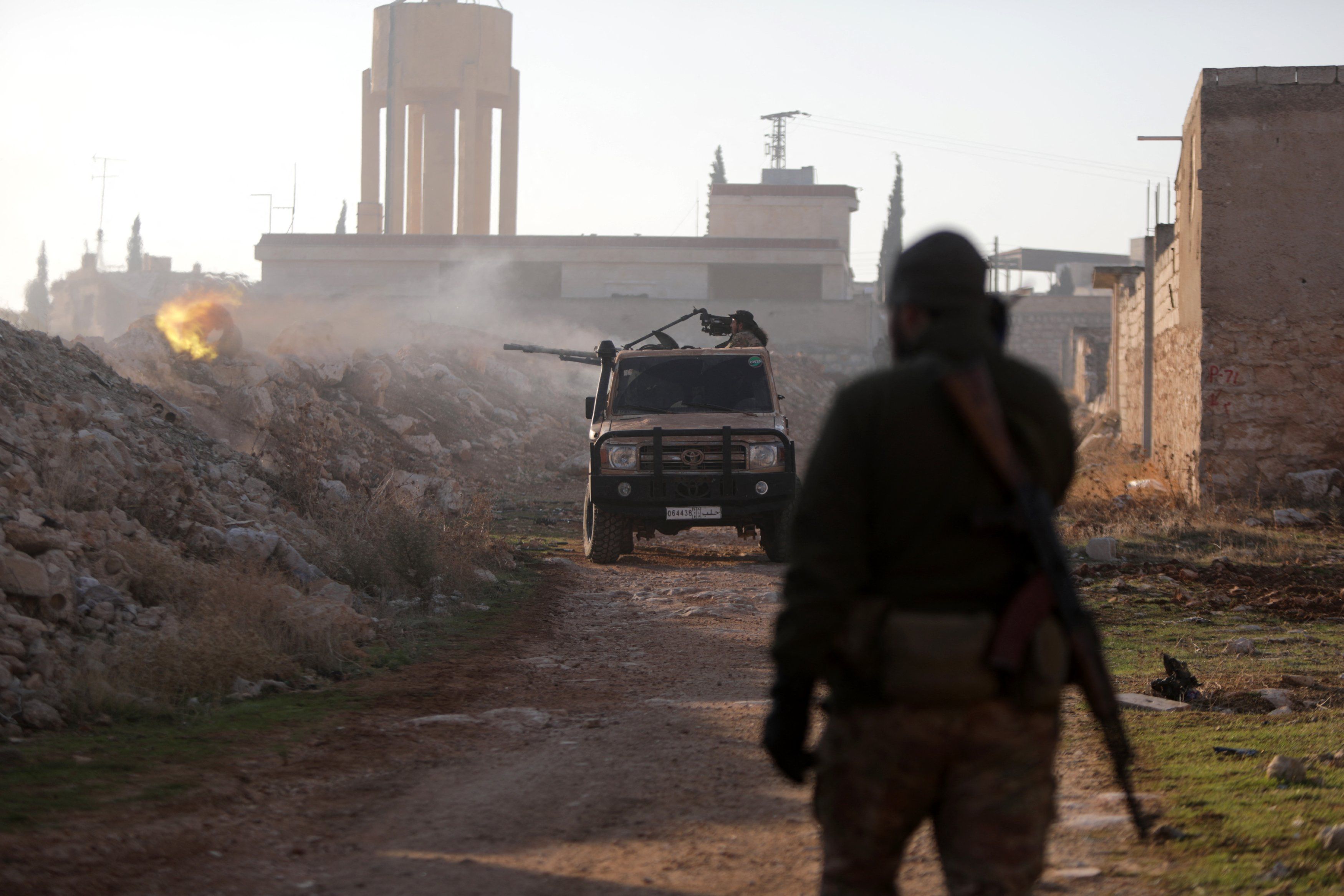
The offensive by Islamic militants and allied pro-Turkish groups in Syria’s Idlib and Aleppo provinces is the biggest military escalation in Syria since Russia and Türkiye brokered a ceasefire in 2020. Rebel fighters have seized dozens of towns, including Hama and Aleppo, the country’s second largest city. The fall of Aleppo is particularly symbolic: Assad wrested it from rebels in 2016 after four years of fighting and a devastating siege; this time around, he lost it in under four days.
Russia, Iran, and Iranian-backed groups like Hezbollah were key backers of the Syrian army in Aleppo, but they have been severely weakened over the last year. Hezbollah has been battered by Israel in Lebanon, while Russia has suffered significant losses in Ukraine. This has created a vacuum in several areas controlled on paper by Damascus, blighted by economic problems and corruption. Now, Islamic militants will fill that vacuum.
The Kremlin is not currently paying as much attention to Syria as it was a decade ago. Russian President Vladimir Putin’s spokesman, Dmitry Peskov, gave a bland answer about “restoring order” when asked about recent developments. The Defense Ministry issued a statement claiming Russia was providing air support to the Syrian army, and promising additional military assistance. However, it doesn’t look like that assistance will be enough for Damascus to mount a counteroffensive or regain control over Aleppo.
The Russian military presence in Syria has shrunk since the full-scale invasion of Ukraine. The number of Russian soldiers posted there is not public information (and Moscow denies the contingent has been reduced), but we know that Russia has moved perhaps several thousand mercenaries and regular troops to Ukraine.
In any case, the fighting in Ukraine means that the Kremlin cannot devote nearly as many resources as it did in the 2010s. In recent years, Russia has sought instead to focus on political issues in Syria, pushing for a normalization of ties between Ankara and Damascus. The first meeting between the Syrian defense minister and his Turkish counterpart in eleven years took place in Moscow in December 2022.
While direct negotiations between Turkish President Recep Tayyip Erdoğan and Assad have been impossible to arrange because of Assad’s intransigence (he has insisted on the withdrawal of Turkish troops from Syria as a precondition for normalizing relations), the recent events in Aleppo might change the balance of power, forcing Damascus to soften its demands. There are already reports in the Turkish press that Assad has reached out to Ankara.
It’s difficult to gauge how deeply Ankara is involved in the recent rebel successes. The main Syrian rebel group—Hayat Tahrir al-Sham (HTS)—has been designated a terrorist entity by Türkiye. However, Erdoğan has expressed support for Syrian rebels, particularly the Syrian National Army, which is fighting shoulder to shoulder with HTS.
For now, Ankara has voiced concern about events in Aleppo, and denied its involvement. But that doesn’t negate the fact that Türkiye is the main political beneficiary of the rebel offensive, which strengthens Erdoğan’s position in relation to Damascus. At the very least, Ankara wants good relations in order to solve the issue of the more than 3 million Syrian refugees in Türkiye.
In the past, Assad—with the backing of Iran and Russia—felt strong enough to dictate terms to Ankara. But the rout of his forces in the north means his hand is weakening. With Moscow acting as an intermediary, a face-to-face meeting between Assad and Erdoğan now seems inevitable.
The current escalation will also encourage Türkiye in its ambition to clear all of northern Syria of armed groups, including Kurdish-led forces. The victory of Donald Trump in U.S. presidential elections in November has fueled hopes in Ankara that the United States will decide to withdraw all its troops from Syria—allowing Türkiye to move against the Kurds.
Moscow has always opposed such an approach by Ankara, and Russian officials have openly referred to Türkiye as an “occupying power.” However, it will now be much harder for the Kremlin to obstruct Türkiye.
Indeed, it appears that the Kremlin believes the latest events in Aleppo to be yet another attempt by Türkiye to exploit Russia’s vulnerability while it is bogged down in Ukraine. There have been a number of sources of friction in the Russian-Turkish relationship since the full-scale invasion, including Ankara’s 2022 ban on Russian planes traveling to Syria using its airspace, Turkish banks refusing to deal with Russian companies because of the threat of U.S. sanctions, and Türkiye’s sale of Bayraktar drones to Kyiv.
While Assad should be able to stop the rebels from advancing much further south, it’s unlikely his forces will be able to retake Aleppo. There will be a constant risk of further escalation, and Türkiye will be able to threaten Iran and Russia with the prospect of continued rebel military attacks.
This means the situation in Syria will once again become a key issue in talks between Putin and Erdoğan, having been downgraded following the start of the war in Ukraine. It will be an awkward topic for Russian officials, who will find it much harder to strongarm Ankara now over issues such as Turkish aid to Ukraine and Russia’s banking woes.
In addition, Syria will become part of the multidimensional conflict between Russia and NATO. Erdoğan has demonstrated repeatedly that he’s happy to use his influence over issues that are painful for Russia to improve relations with the West (for example, Türkiye’s approval of Finland and Sweden’s accession to NATO). Syria looks set to become a significant addition to this list, strengthening Türkiye’s hand in its relations with both Russia and the West.
Non-resident research fellow, the Institute for Development and Diplomacy (Azerbaijan)
Recent Work
Ruslan Suleymanov
Ruslan Suleymanov
Carnegie does not take institutional positions on public policy issues; the views represented herein are those of the author(s) and do not necessarily reflect the views of Carnegie, its staff, or its trustees.

For every ruble allocated to social policy, health, and education in 2027, double that amount is earmarked for the army, the police, and the security services.

Alexandra Prokopenko

Cargo traffic through Russia’s Northern Sea Route has increased because of the disruption caused by the conflict in the Middle East, the Ukraine war, and U.S.-China tensions.

Mikhail Korostikov
An analysis of traffic accident data suggests that Ukrainian drone attacks caused a material but not disastrous fall in Russian gasoline consumption over the summer.

Sergey Vakulenko

Sergei Kiriyenko used Russia’s parliamentary vote to further hone his strategy of corporate mobilization that is designed to maximize votes for United Russia.

Andrey Pertsev

Trump has promised Belarus a massive potash deal. But Minsk is seeking something greater: restored Western transit and greater room for maneuver from Russia.

Balázs Jarábik