

Commentary
Alexander Baunov
{
  "authors": [
    "Alexander Baunov"
  ],
  "type": "commentary",
  "blog": "Carnegie Politika",
  "centerAffiliationAll": "",
  "centers": [
    "Carnegie Endowment for International Peace",
    "Carnegie Russia Eurasia Center"
  ],
  "englishNewsletterAll": "",
  "nonEnglishNewsletterAll": "",
  "primaryCenter": "Carnegie Russia Eurasia Center",
  "programAffiliation": "",
  "programs": [],
  "projects": [],
  "regions": [
    "Russia",
    "Ukraine",
    "United States"
  ],
  "topics": [
    "Foreign Policy",
    "Security",
    "Military",
    "Global Governance"
  ]
}
Source: Getty
A Russian memorandum recently handed to Ukraine was crafted to satisfy Washington, create an illusion of progress, and allow Moscow to continue fighting.
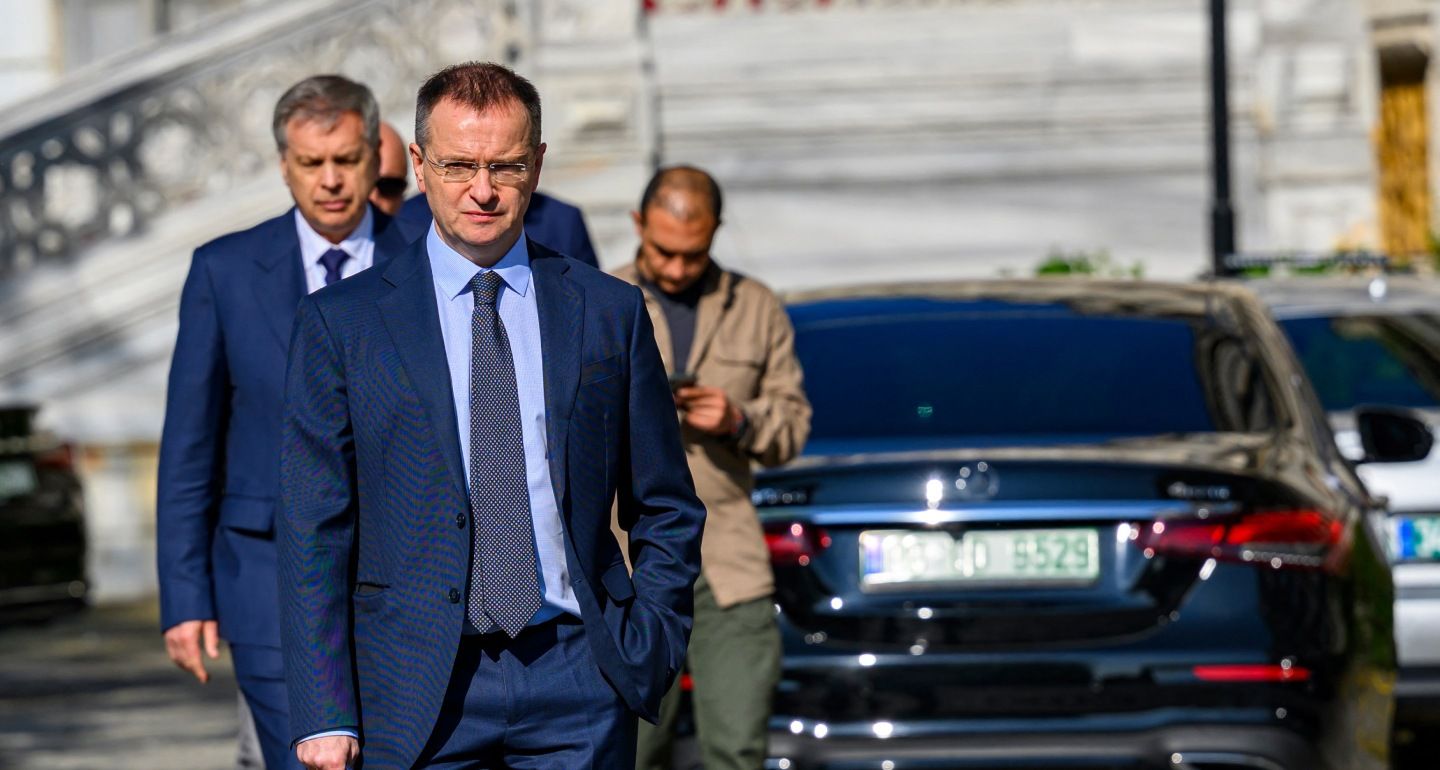
The second round of direct Russia–Ukraine peace negotiations that took place in Istanbul on June 2 lasted just an hour. That was significantly less than the telephone calls between U.S. President Donald Trump and his Russian counterpart Vladimir Putin. Of course, that turns normal practice on its head—contact between negotiators is usually much more intense than between heads of state—but then again, much about the Ukraine war negotiations has been irregular.
The role of the two delegations in Istanbul, therefore, was not to engage in a meaningful discussion. Their role was to prove to Trump that he is not wasting his time.
It’s widely accepted that more and more of what goes on in Russia—from speeches by governors and deputies to news bulletins on state television—has an intended audience of just one man, Putin. This dynamic was also at work in the memorandum presented by the Russian delegation to their Ukrainian counterparts at the meeting in Turkey. The document was designed to be a piece of professional diplomacy and to deliver a propaganda message for a domestic Russian audience, above all Putin. However, this time there was one major difference: it was also supposed to appeal to Trump.
Russian diplomats were trying to satisfy leaders on both sides of the Atlantic. They want Trump to be more enamored with Putin than with Zelensky, and they want Trump to see Putin as an ally when it comes to ending the war. It’s important for Putin to believe that the actions of his delegation show he is really in control. In other words, Russian diplomats were supposed to please both Trump and Putin—but please Putin more because the Russian leader needs to think he is winning.
The Ukrainian delegation were the last people on the Russian delegation’s minds. At least for the moment, the Russian negotiators are unbothered about what Ukraine’s rulers or its broader population might say about their position.
A closer look at the text of the Russian memorandum reveals that it was actually not one text, but three. That is the result of its authors needing to square the circle of combining diplomacy and propaganda, and pleasing all the parties that need to be pleased. The first Russian text concerned the conditions for a long-term peace agreement; the other two were about the conditions for a ceasefire.
The Kremlin’s well-known maximalist demands were laid out in the first text, while the terms for a ceasefire in the subsequent two were more of a realistic starting point for dialogue. In other words, Russia split its demands into those that have no chance of being met, and those that could be used constructively.
The first of the two texts about a ceasefire consists of just one phrase demanding the full withdrawal of Ukrainian troops from four regions that Russia claimed to have annexed in 2022 (but which it has never fully controlled militarily). The brevity of this text suggests it was never intended to be a point of discussion. The second text about a ceasefire is a “package” of measures that, taken together, link a ceasefire with a change of government in Kyiv.
Even aside from the concrete demands in this second ceasefire text, the grouping as a “package” seems to be a Russian trap. If the first steps—including an exchange of prisoners and bodies of dead soldiers—are implemented, then it provides momentum for the next steps, which include things like a Ukrainian troop withdrawal and a long-term agreement. And that would mean Moscow’s enemy was moving in the direction it wanted.
In contrast, Ukraine’s memorandum was simpler and more internally consistent, though it, too, was trying to please multiple audiences: the domestic one, the Europeans, and Trump. At the same time, because Kyiv has already quarreled with Washington over refusing to unquestioningly accept the U.S. terms for negotiations, it is less bothered about another divergence of opinion with Trump.
Notably, the Ukrainian document did not include the maximalist demand to restore Kyiv’s control over all of Ukraine’s 1991 borders.
Not only does the Russian memorandum look more uncompromising than the Ukrainian one, it also gives the impression of a document that was more hurriedly put together. But that’s if it is considered from the point of view of facilitating a constructive dialogue about ending the ongoing conflict. In reality, the aims of the Russian memorandum are more complicated and multi-faceted.
The “show” Russia staged in Istanbul needed not only to please Trump and Putin, but also to bolster Putin’s reputation. For those Russians who are tired of war, the Kremlin wants to conjure an image of a genuine peace effort (not peace at any price, but peace on Russian terms—which is what most Russians would like to see). For the warmongers and ultra-nationalists who fear Russia might concede hard-won battlefield gains, the Russian memorandum seems to guarantee a maximalist form of victory.
For Russia’s negotiators, there are several points in the memorandum on which concessions are possible. And that opens up, if necessary, the prospect of some real diplomacy. The humanitarian gestures outlined in the memorandum such as the exchange of prisoners and bodies were included for Trump’s benefit.
Trump has received an answer of sorts from Putin about his drive for peace in Ukraine. The Russian proposal as laid out in its memorandum is full of many linked and contradictory points and sub-points—which would make it the basis for a long, slow process of discussion, clarification, and attempts to find agreement. And that, most importantly of all, allows the Kremlin to continue waging war in Ukraine while this process unfolds.

Senior Fellow, Editor-in-Chief, Carnegie Russia Eurasia Center
Baunov is a senior fellow and editor-in-chief at the Carnegie Russia Eurasia Center.
Recent Work
Alexander Baunov
Alexander Baunov
Carnegie does not take institutional positions on public policy issues; the views represented herein are those of the author(s) and do not necessarily reflect the views of Carnegie, its staff, or its trustees.
A leak of Russian gas price data helps establish that China is paying Russia far less than Central Asian countries and Gazprom’s former European customers.

Sergey Vakulenko

Japan’s long-term security policy is driven by concerns about China, and there is little appetite for (or interest in) pursuing a confrontation with Moscow.

James D.J. Brown

The truth of the strategic situation is that Europe and Russia are extremely unlikely to be able to “turn the page” on their confrontation within the next two decades.

Arkady Moshes

Russia spent years building a “sovereign internet,” concentrating web infrastructure exclusively within Russian territory. Ukrainian drone attacks have shown how vulnerable that approach has left the Russian internet.

Maria Kolomychenko

Putin’s conservative staffing policies and search for ever greater control have cemented parliament’s transformation into a bureaucratic appendage of the executive branch.

Andrey Pertsev