

Book
Dimitar Bechev
{
  "authors": [
    "Dimitar Bechev"
  ],
  "type": "commentary",
  "blog": "Carnegie Politika",
  "centerAffiliationAll": "",
  "centers": [
    "Carnegie Endowment for International Peace",
    "Carnegie Russia Eurasia Center"
  ],
  "englishNewsletterAll": "",
  "nonEnglishNewsletterAll": "",
  "primaryCenter": "Carnegie Russia Eurasia Center",
  "programAffiliation": "",
  "programs": [],
  "projects": [],
  "regions": [
    "Ukraine",
    "Europe",
    "United States"
  ],
  "topics": [
    "Security",
    "EU Foreign Policy",
    "Global Governance",
    "Foreign Policy",
    "EU"
  ]
}
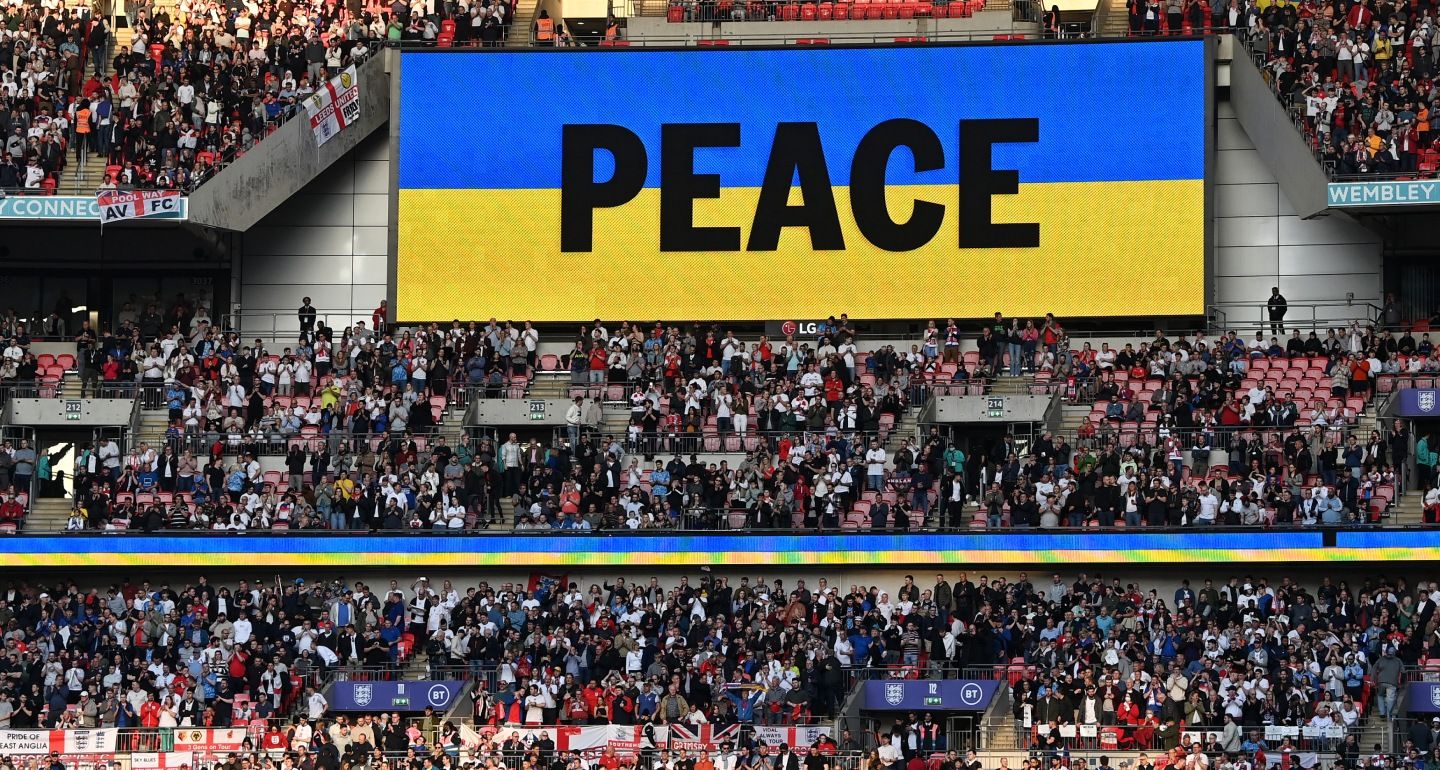
Source: Getty Images
In the long term, it will be the pull of integration with the EU—not the benefits of U.S. patronage—that is most important for Ukraine.
What will happen to Ukraine when the guns finally fall silent? Many believe it will be up to two people: U.S. President Donald Trump and Russian President Vladimir Putin. Though there is some truth to this, it misses the point. The future will also depend on the relationship that Ukraine and Europe forge with one another.
Ever since Trump returned to the White House, his attention has been fixed on the Ukraine war. For its part, Russia has done its best to sweet-talk the U.S. president, betting on the calculation that he will eventually give up and let Moscow deal with what Russian officials see as a rebellious vassal. Putin’s surprise call for direct negotiations with Ukraine in early May 2025 serves precisely that objective, paying lip service to Trump’s mediation efforts while continuing to press Russia’s advantage on the battlefield.
The Europeans, led by France and the United Kingdom, are going along with Trump’s peacemaking in the hope of freezing the war on terms favorable to Ukraine. That would mean preserving Ukraine as a viable state that could pursue a pro-Western course in domestic and foreign affairs. The visit to Kyiv on May 10 by French President Emmanuel Macron, UK Prime Minister Keir Starmer, German Chancellor Friedrich Merz, and Polish Prime Minister Donald Tusk was as much about signaling unity as it was a nod to Trump.
It’s always hard to tell which way the wind is blowing with a leader as fickle as Trump. Likely, the pendulum in Washington will swing back and forth, with different factions within the U.S. administration pulling in different directions. A total U.S. pullout from Ukraine looks unlikely thanks to perseverance from Ukrainian President Volodymyr Zelensky and efforts to engage Trump from Macron and Starmer. But Trump’s first 100 days in office show that at the very least, the United States can no longer be taken for granted.
Without the United States, the Europeans would be in a bind. As defense analysts have pointed out, a peacekeeping force spearheaded by France and the UK could not be rolled out without Washington. From intelligence to air defenses, the U.S. contribution would be crucial.
Yet capability deficiencies are not reason enough to write off Europe. In the long term, it will be the pull of EU integration—not U.S. patronage—that is most important for Ukraine. And that will likely be coupled with economic assistance from Brussels and defense aid that includes joint ventures on Ukrainian soil. The preservation of Ukrainian statehood will be inextricably linked with Europe’s bid to upgrade its geopolitical role. Truthfully, NATO membership would have been a preferable alternative for Kyiv. But with Trump in power, the chances of NATO expansion are close to zero. So the EU is the only game in town.
Ukraine’s EU trajectory should come as no surprise. It’s an ongoing process driven by geography and economic interdependence. Ever since the 2004 enlargement brought the EU to the Poland-Ukraine border, economic and social ties have grown deeper. The root cause for the Russian invasion of Ukraine in 2014 was not encirclement by NATO (a thesis oft-repeated by Putin)—it was an economic association agreement that Ukraine was about to sign with the EU.
However, there are stumbling blocks. One is the EU’s chronic inability to live up to expectations. This June will mark a year since Ukraine began membership talks, and it’s still unclear whether accession is actually viable. A host of factors also conspire against Ukrainian membership: the surge of populist parties in countries such as Germany and France, constitutional clauses requiring referendums on entrants to the EU, and opposition from countries like Hungary. The issue of Ukrainian membership may get caught up in squabbles over internal EU policymaking, not least subsidies for farmers. Finally, the idea of letting in a country that does not control a part of its territory is sure to stir controversy. All in all, the chances of Ukraine quickly becoming a part of the EU are not great.
Protracted accession talks might also cause a shift in Ukrainian public opinion. Euroskepticism (the sort of sentiment often encountered in the Western Balkans and Turkey) might grow, while the idea that Ukraine spilt blood to protect Europe from Russia only to be given the cold shoulder by the EU could breed resentment. Needless to say, Moscow would hone its propaganda messaging to exploit the growth of such sentiments.
It’s not that a majority of Ukrainians will turn against Europe: after all, millions of Ukrainians are already residing in the EU as a result of labor migration and the full-scale invasion. But Ukrainian disenchantment will be a gift to populists.
Even so, Ukraine will continue to gravitate toward the EU. Membership negotiations will integrate the country ever deeper, from the EU’s green agenda to the Common Agricultural Policy and, most importantly, security and defense.
One possible outcome is that Ukraine ends up as part of the European Economic Area, giving it access to the EU’s single market (a similar model to Norway). That would mean the free movement of people, goods, services, and capital. Having already opened EU labor markets to Ukrainian nationals in response to the full-scale invasion in 2022, EU member states might find it politically difficult to now shut that door. For Ukraine, labor mobility in conjunction with financing and a seat at the table on some issues could end up being a substitute for full EU membership.
Ultimately, Ukraine’s path will be determined by the nature of the transformation that Europe undergoes in the coming years. On the one hand, the EU needs to be stronger to counter disruption associated with globalization, the rise of China, Russian aggression, and Trump. On the other, geopolitics compels the bloc to be more flexible when it comes to foreign policy. A reset between the EU and the UK is already under way, while Europe is in reengagement mode with Turkey, and concerns about Russia are broadly shared. Ukraine has plenty to offer a reformed EU—both when it comes to security and the economy.

Senior Fellow, Carnegie Europe
Dimitar Bechev is a senior fellow at Carnegie Europe, where he focuses on EU enlargement, the Western Balkans, and Eastern Europe.
Recent Work
Dimitar Bechev
Carnegie does not take institutional positions on public policy issues; the views represented herein are those of the author(s) and do not necessarily reflect the views of Carnegie, its staff, or its trustees.

Russia’s AI-driven propaganda campaigns operate in a fragmented, chaotic, and often illogical manner. That’s not necessarily a problem for the Kremlin, though: It’s much easier to mimic genuine public debate that way.

Ilya Klishin

Without a ceasefire with Ukraine on attacking each other’s energy infrastructure—to which the Kremlin is unlikely to agree—the diesel agreement between Putin and Trump is largely for show, rather than representing a genuine increase in the volumes of Russian diesel on the global market.

Sergey Vakulenko

Russian strikes are weakening the economy sustaining Ukraine’s war effort. Closing the growing funding gap will require more European support and politically contentious reforms in Kyiv.

Balázs Jarábik

Despite a new textbook, an influx of Russian teachers and managers, and an end to the teaching of Ukrainian, the Kremlin is unlikely to have “reprogrammed” locals.

Konstantin Skorkin

Cargo traffic through Russia’s Northern Sea Route has increased because of the disruption caused by the conflict in the Middle East, the Ukraine war, and U.S.-China tensions.

Mikhail Korostikov