

Commentary
Balázs Jarábik
{
  "authors": [
    "Balázs Jarábik"
  ],
  "type": "commentary",
  "blog": "Carnegie Politika",
  "centerAffiliationAll": "",
  "centers": [
    "Carnegie Endowment for International Peace",
    "Carnegie Russia Eurasia Center"
  ],
  "englishNewsletterAll": "",
  "nonEnglishNewsletterAll": "",
  "primaryCenter": "Carnegie Russia Eurasia Center",
  "programAffiliation": "",
  "programs": [],
  "projects": [],
  "regions": [
    "Moldova",
    "Russia",
    "Ukraine",
    "Europe",
    "Eastern Europe"
  ],
  "topics": [
    "Domestic Politics",
    "EU",
    "EU Foreign Policy",
    "Political Reform",
    "Civil Society"
  ]
}
Фото: Getty Images
As Russia’s war in Ukraine reshapes domestic standards across the region, Moldova’s path of political consolidation makes it a frontier—rather than an outlier—in a broader European trend.
With Moldova heading to parliamentary elections on September 28, most observers remain cautious about making predictions. The bitter experience of last fall’s referendum on enshrining EU integration in the constitution and the presidential election that followed, in which results diverged significantly from polling projections, has left political actors and analysts wary. Two key variables shaping electoral outcomes are the growing influence of the sizeable Moldovan diaspora and the inevitable Russian factor.
There is a broad consensus in Chișinău that the ruling PAS party is likely to win the upcoming parliamentary elections, despite the severe social and economic pressures Moldova has faced as a consequence of Russia’s war in Ukraine. Routinely described as “sandwiched” between its two larger neighbors—Ukraine and Romania—Moldova today resembles more of a geopolitical cul-de-sac. Cut off from the strategic Ukrainian port city of Odesa and with only one viable transit route through Romania, Moldova has been forced to import energy and goods from the European Union at Western market prices, exacerbating existing economic hardships.
GDP grew by just 0.1 percent in 2024, even as real estate prices in the capital Chișinău and the number of luxury cars and electric vehicles hit record highs. The result of this widening inequality is growing social tensions, particularly in rural areas.
The economic and social burden has pushed PAS to center its political narrative on EU integration, much like President Maia Sandu’s presidential campaign last year. The launch of accession talks, coupled with the July 4 “historic” EU–Moldova summit in Chișinău, should give the PAS government a boost ahead of the vote.
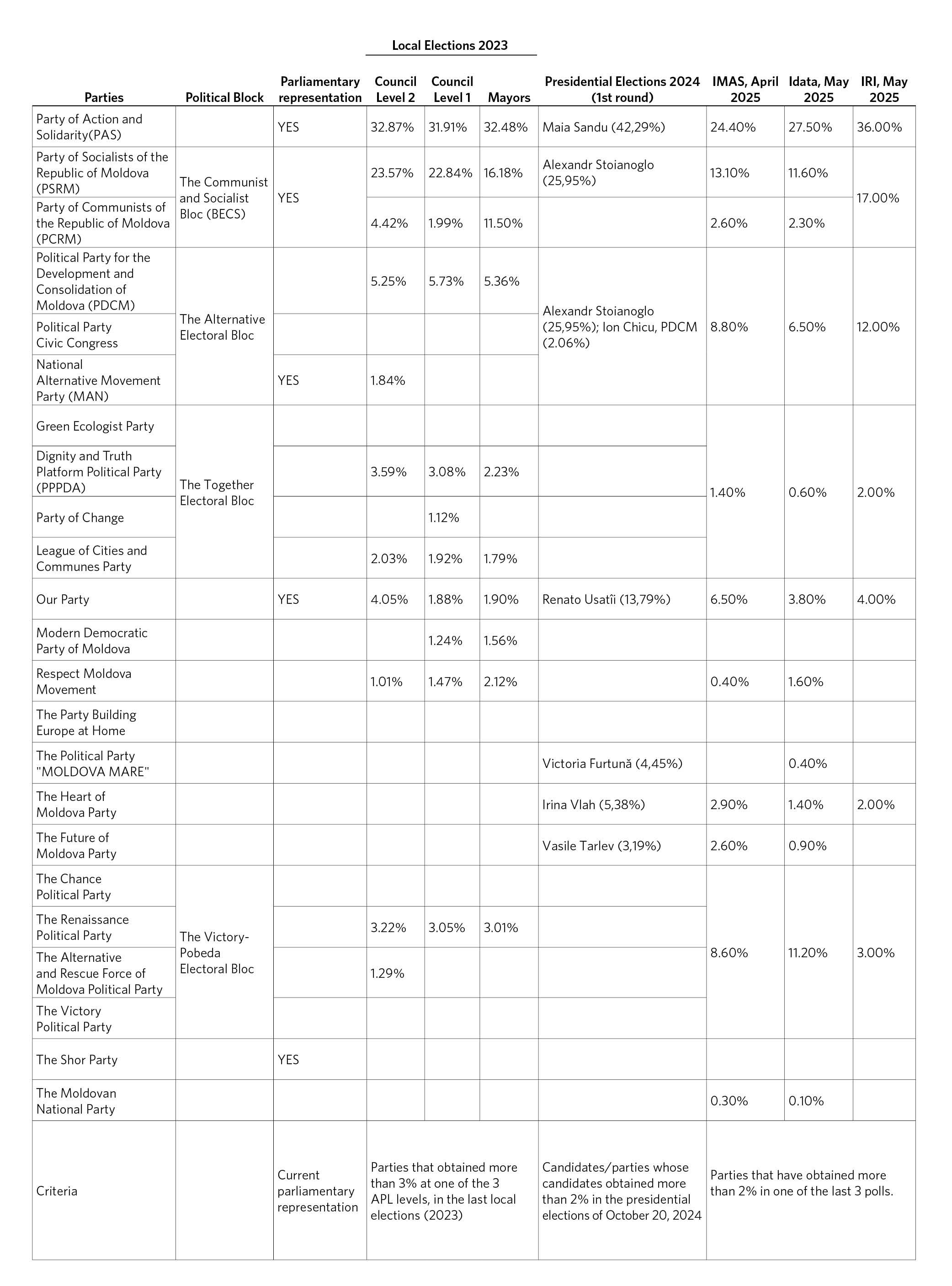
The key instrument for pro-government mobilization, however, is the Russian hybrid threat. Moscow actively meddled in last year’s presidential campaign, and it is doing the same this year. Still, the “pro-Russian” label has been increasingly instrumentalized, being applied not only against the minions of the notorious Moscow-based oligarch Ilan Șor and former president Igor Dodon’s Socialist Party, but, more recently, against other opposition forces including the emerging Alternativa bloc.
This new political formation—bringing together Chișinău Mayor Ion Ceban, 2024 presidential candidate Alexandr Stoianoglo, former prime minister Ion Chicu, and Mark Tkaciuk, former chief of staff to president Vladimir Voronin—has accused the PAS authorities of applying political pressure in the form of changes to electoral rules, as well as investigations and criminal proceedings.
Despite active campaigning in the countryside, Alternativa lacks both financial and organizational resources. Unlike the ruling PAS, it cannot rely on the embedded infrastructure of Western-funded civil society, which has increasingly become an extension of governmental capacity.
The bloc’s political positioning is notably more social than geopolitical. While it claims to support continued EU integration, it also advocates restoring access to Russian gas. That stance is widely seen as a pragmatic response to high energy costs—but gas was traditionally Russia’s main lever of influence in Moldova.
Chișinău, long a bastion of pro-European sentiment, is now emerging as a key electoral battleground. Although the city has traditionally favored PAS, Mayor Ceban remains highly popular, credited with overseeing a visible modernization and beautification of the city.
There is no substantive evidence that the Alternativa bloc is pro-Russian in orientation or that it enjoys the Kremlin’s support in a way comparable to Ilan Șor or the Socialist Party. That said, the bloc is far from internally coherent. Ceban, for instance, has flirted with MAGA-style rhetoric, and his decision to ban the annual Pride march drew criticism not only from European diplomats, but also from within the bloc’s own ranks.
However, Romania’s recent intention to ban Ceban from the entire Schengen zone of visa-free travel—the same day the United States slapped 25 percent tariffs on Moldova—has effectively confined him to Moldova, reinforcing attempts to tie Alternativa to the pro-Russian camp and raising the specter of legal disqualification. Meanwhile, openly pro-Russian parties have called for the formation of a union state with Russia.
PAS and its allies have reinforced a narrative positioning themselves as the sole legitimate pro-EU force, effectively framing the election as a binary choice between European integration and regression. The EU has echoed this exclusivist framing, raising the stakes of accession and reinforcing PAS’s centrality. Paradoxically, Russia appears to be playing into this narrative. Russian officials have recently revived rhetoric about claims to Odesa, including in informal track-two discussions, even though a military push toward the port city appears highly implausible given current battlefield realities.
The Moldovan government has pointed to Șor-affiliated payment networks as evidence of systemic vote-buying. Thousands of fines have been issued in connection with these schemes, though many have been contested and are currently under judicial review. But the Kremlin has multiple tactical entry points into Moldova’s domestic politics through its potent toolkit of financial resources, nostalgia, entrenched social and political networks, and the ability to instill fear. Financial and informational support from Russia could also be channeled to amplify certain political narratives or stoke public protest.
Still, absent major government missteps—such as verifiable electoral manipulation, which the pro-Russian opposition is already preemptively alleging—the likelihood of large-scale unrest appears limited, especially amid Russia’s ongoing military escalation in Ukraine. While rumors of election manipulation persist—particularly around the diaspora vote, which some consider structurally unfair despite its legal standing—no concrete evidence has emerged to support these claims.
Russia’s war in Ukraine, combined with the accelerated EU integration trajectories of both Moldova and Ukraine, has fundamentally reshaped the strategic context for Moldova’s breakaway statelet of Transnistria. Since the full-scale Russian invasion, the Transnistrian authorities in Tiraspol have quietly signaled a degree of openness to reintegration. Yet Chișinău has opted to prioritize its EU accession path, effectively treating Transnistria as a frozen anomaly that can be sidestepped rather than solved. Dominated by the privately held Sheriff conglomerate, the statelet has little appetite for the arrival of the “Russian world” on the Dniester River. It instead preserves a neo-Soviet aesthetic to cater to local nostalgia while defending its core economic privileges.
In tandem with worsening relations between Chișinău and the autonomous region of Gagauzia, Tiraspol increasingly sees the Moldovan government’s posture as coercive rather than conciliatory. From Tiraspol’s vantage point, EU alignment appears not as an invitation to dialogue, but as a vehicle for marginalization. Its overriding interest lies in preserving the status quo—particularly the export of goods manufactured with subsidized Russian gas and rebranded under Moldovan customs. As Moldova moves forward with EU integration and adopts stricter regulatory standards, that arrangement will become increasingly difficult to sustain.
The Moldovan government has opened informal communication channels with Tiraspol to clarify what EU accession would mean in practice—especially for businesses operating under Moldova’s customs regime. But these consultations remain constrained by structural limitations and a lack of trust on both sides.
The energy crisis of early 2025 was resolved through a temporary workaround, but one that placed Transnistria more squarely under Moscow’s control. This outcome underscores not only Russia’s tightening grip on the region, but also its waning confidence—both in Tiraspol’s ability to manage its own affairs and in the Kremlin’s own capacity to shape Moldovan dynamics through traditional means.
Moldova’s EU path will continue after the elections: its pace will hinge more on Brussels’s readiness to enlarge than on Chișinău’s readiness to reform. A government coalition led by the opposition remains highly improbable, even if PAS falls short of securing an outright majority. Affiliation with Ilan Șor has become both criminalized and politically toxic, while Russia’s war in Ukraine has rendered any overtly pro-Russian course untenable for serious political actors. In the current regional climate of securitization, the greater risk lies not in a reversal of integration, but in the escalation of domestic tensions—possibly even conflict—should the electoral process be mismanaged, which Russia could exploit.
The opposition lacks both financial capital and organizational capacity. A profound demographic shift—accompanied by generational and attitudinal change—continues to tilt the electorate toward Europe. Yet issues such as constitutional neutrality and widespread socioeconomic grievances, particularly those linked to energy policy, remain deeply salient. These concerns should not be dismissed as “pro-Russian.” They reflect real anxieties among voters, especially outside the urban middle class.
What further compounds the opposition’s weakness is its exclusion from the ecosystem of Western-funded civil society and European institutional channels: spaces dominated by PAS and its affiliates. Beyond the formalities of the EU accession process, Moldova’s political system stands in urgent need of renewal: more political diversity, greater institutional accountability, and a more socially responsive economic framework. PAS has relied heavily on civil society to make up for limited state capacity, but this approach risks further hollowing out Moldova’s already fragile mechanisms of civic oversight and pluralist politics.
Moldova was once hailed as a “success story” of the EU’s Eastern Partnership after 2012—only to descend into deep corruption and state capture by the mid-2010s. The Sandu presidency marks a clear break from that era. Yet a success model built on securitization, identity politics, political monopoly, and administrative pressure may not be sustainable. Moldova’s integration should not rely on unconditional political endorsement grounded in a narrative of geopolitical alignment. European standards—democratic pluralism, institutional resilience, and social cohesion—should remain the benchmark. However, Moldova is not an outlier but a frontier: Russia’s war in Ukraine is reshaping domestic standards across the region, where real or perceived threats from Moscow are increasingly used to justify political means.

Political analyst, former Slovak diplomat, and consultant specializing in Eastern Europe
Recent Work
Balázs Jarábik
Balázs Jarábik
Carnegie does not take institutional positions on public policy issues; the views represented herein are those of the author(s) and do not necessarily reflect the views of Carnegie, its staff, or its trustees.

Japan’s long-term security policy is driven by concerns about China, and there is little appetite for (or interest in) pursuing a confrontation with Moscow.

James D.J. Brown

The truth of the strategic situation is that Europe and Russia are extremely unlikely to be able to “turn the page” on their confrontation within the next two decades.

Arkady Moshes
Russia spent years building a “sovereign internet,” concentrating web infrastructure exclusively within Russian territory. Ukrainian drone attacks have shown how vulnerable that approach has left the Russian internet.

Maria Kolomychenko

Putin’s conservative staffing policies and search for ever greater control have cemented parliament’s transformation into a bureaucratic appendage of the executive branch.

Andrey Pertsev

Russia’s AI-driven propaganda campaigns operate in a fragmented, chaotic, and often illogical manner. That’s not necessarily a problem for the Kremlin, though: It’s much easier to mimic genuine public debate that way.

Ilya Klishin