

Commentary
Vladimir Solovyov
{
  "authors": [
    "Vladimir Solovyov"
  ],
  "type": "commentary",
  "blog": "Carnegie Politika",
  "centerAffiliationAll": "",
  "centers": [
    "Carnegie Endowment for International Peace",
    "Carnegie Russia Eurasia Center"
  ],
  "englishNewsletterAll": "",
  "nonEnglishNewsletterAll": "",
  "primaryCenter": "Carnegie Russia Eurasia Center",
  "programAffiliation": "",
  "programs": [],
  "projects": [],
  "regions": [
    "Russia"
  ],
  "topics": [
    "Domestic Politics",
    "Political Reform",
    "Foreign Policy"
  ]
}
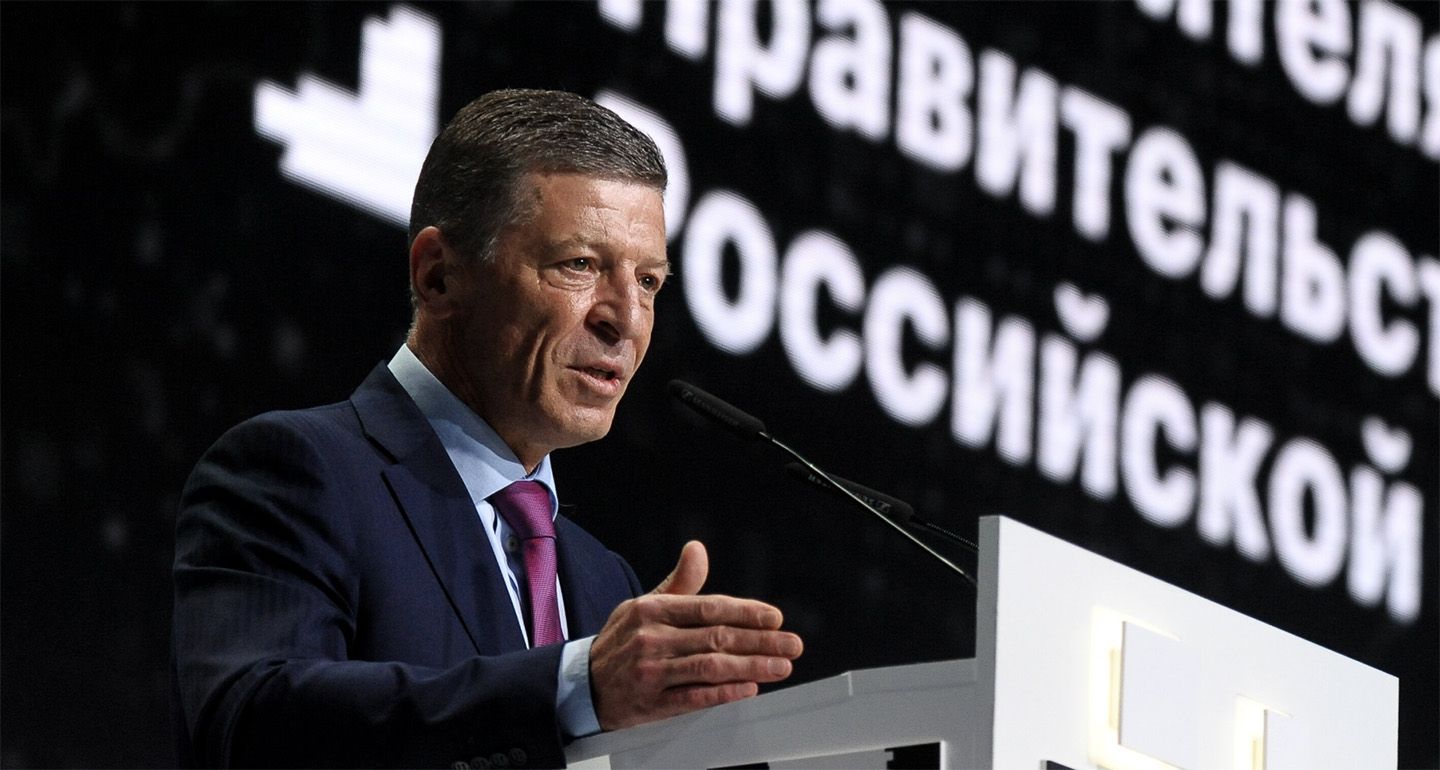
Source: Getty
For decades, Dmitry Kozak was one of Putin’s most trusted mediators when it came to post-Soviet countries. But the war in Ukraine has made his services redundant.
On September 18, Vladimir Putin accepted the resignation of Kremlin deputy chief of staff Dmitry Kozak, who had been by his side since the start of the president’s political career in St. Petersburg in the 1990s. For years, Kozak oversaw Russia’s relations with post-Soviet countries, and he was in charge of negotiations with Ukraine before the full-scale invasion. While it was apparently Kozak’s own decision to step down, rumors about his departure had been circulating for some time.
Kozak has become known for his apparent opposition to Russia’s full-scale invasion of Ukraine. At the now infamous meeting of Russia’s Security Council on February 21, 2022—three days before Russian tanks rolled across the border—he is supposed to have argued against military action.
Kozak’s anti-war speech has never been published. According to media leaks, he spoke for about forty minutes, though his words were cut from the televised version. Nevertheless, the transcript of the meeting on the Kremlin’s website does suggest his opinion went against the grain: he was the only person present not to say that Russia should recognize the independence of the so-called Donetsk People’s Republic and Luhansk People’s Republic, or annex eastern Ukraine.
Since the start of the full-scale war, Kozak has not appeared in public, or indeed released any statements. He was not included in the Russian delegation for talks with Ukraine in Belarus, or later in Istanbul. If Western media is to be believed, Kozak considers the full-scale invasion a mistake, and has tried to get Putin to end the fighting.
While it appears to have been Kozak’s own decision to resign, we do not know this for certain. If true, perhaps it was because he realized that the war meant there was no longer any need for his brand of negotiating skills.
A lawyer by training, Kozak met Putin when they were both working in St. Petersburg in the 1990s. When Putin was elected president, Kozak moved to the Kremlin. His first major foreign policy assignment came shortly afterward: to try to find a resolution to the conflict between Moldova and its breakaway province of Transnistria. When then Moldovan president Vladimir Voronin asked Putin to help restart negotiations in 2003, Putin put Kozak in charge, rather than Russian diplomats.
Between July and November of that year, Kozak engaged in intensive shuttle diplomacy, travelling between Moscow, Chisinau, Kyiv, and Tiraspol. The biggest stumbling block to unification reportedly turned out to be the Transnistrian authorities, and Igor Smirnov, the leader in Tiraspol, was not afraid to stand up to Moscow. During one of Kozak’s visits, Smirnov said that Transnistria had existed for thirteen years—and would exist for at least as long again. Kozak’s response was to throw a pack of cigarettes at him.
However, by the end of that year, a plan had emerged to resolve the conflict. That plan was known as the Kozak Memorandum. It envisaged Moldova becoming a federation that would include Transnistria as an autonomous region with additional rights. Moldova was also supposed to be neutral and fully demilitarized. Finally, both Russian and Moldovan were to be state languages, and the newly unified country was to have a Russian military presence through 2020.
Putin was planning to fly to Moldova for the document’s signing when Voronin backed out at the eleventh hour. According to the version of events widely believed in Moscow, the Moldovan leader changed his mind under pressure from Western countries. Voronin himself says Moscow tried to impose last-minute conditions.
That failure, however, did not impact Kozak’s domestic position. He was subsequently made Putin’s envoy to the Southern Federal District, which included the troubled North Caucasus. In that role, he oversaw preparations for the 2014 Winter Olympics in Sochi and was in charge of integrating Crimea following its annexation from Ukraine. During Kozak’s “Crimea period,” he suggested holding a second referendum in the disputed peninsula—and inviting international observers this time around to try to obtain international recognition of Russian rule. Putin did not give it the green light.
In 2018, Kozak was again put in charge of overseeing the post-Soviet space, and given another opportunity to address the Transnistria issue. This time, he helped to end the oligarchic regime of Vladimir Plahotniuc by pressuring Moldova’s pro-Moscow socialist party to enter a coalition with pro-Western parties. It hadn’t been Kozak’s plan to pave the way for the election of the pro-Western Maia Sandu as Moldovan president, which is subsequently what happened. Instead, he was trying to reset the government in Moldova as a first step toward a new peace process. In other words, he was half successful.
Kozak has also been deeply involved in negotiations with Ukraine. He quarreled with presidential aide Vladislav Surkov, who was put in charge of overseeing negotiations with Kyiv following the Euromaidan revolution in 2014, and replaced him in 2020. After the election of Volodymyr Zelensky as Ukrainian president in 2019, the Kremlin believed there was a window to implement the Minsk Agreements aimed at ending the conflict in the Donbas (notably, they are quite similar to Moldova’s Kozak Memorandum). Kozak managed to build a good working relationship with Zelensky’s chief of staff, Andriy Yermak. However, the honeymoon period did not last long, and it soon became clear that Ukraine was not going to meet Moscow’s demands.
When Russia began moving troops to the Ukrainian border, Kozak made a last-ditch effort to stop the escalation. His idea was simple: find a quick resolution to the Transnistria issue via a direct agreement between Chisinau and Tiraspol, hoping this could be both a model for Ukraine, and a way to persuade the West that direct talks between Kyiv and the Russia-backed rebel statelets in eastern Ukraine would yield results. The haste with which Kozak conducted this round of Moldova diplomacy makes it look like he knew a war in Ukraine was brewing. However, Kozak was unable to secure a deal with Moldova, and after his unsuccessful meetings with Yermak in Paris in early 2022, Putin opted for a military solution in Ukraine.
Since the start of the full-scale invasion, Russia has not entered into any substantive negotiations with former Soviet countries that look to the West. And if there are no negotiations, that means there is no need for an experienced negotiator like Kozak. Putin’s first deputy chief of staff Sergei Kiriyenko has been handed the brief of overseeing the post-Soviet space for the Kremlin. And Kiriyenko has no intention of engaging in negotiations.
Journalist
Recent Work
Vladimir Solovyov
Vladimir Solovyov
Carnegie does not take institutional positions on public policy issues; the views represented herein are those of the author(s) and do not necessarily reflect the views of Carnegie, its staff, or its trustees.

Despite a new textbook, an influx of Russian teachers and managers, and an end to the teaching of Ukrainian, the Kremlin is unlikely to have “reprogrammed” locals.

Konstantin Skorkin

For every ruble allocated to social policy, health, and education in 2027, double that amount is earmarked for the army, the police, and the security services.

Alexandra Prokopenko

Cargo traffic through Russia’s Northern Sea Route has increased because of the disruption caused by the conflict in the Middle East, the Ukraine war, and U.S.-China tensions.

Mikhail Korostikov
An analysis of traffic accident data suggests that Ukrainian drone attacks caused a material but not disastrous fall in Russian gasoline consumption over the summer.

Sergey Vakulenko

Sergei Kiriyenko used Russia’s parliamentary vote to further hone his strategy of corporate mobilization that is designed to maximize votes for United Russia.

Andrey Pertsev