

Commentary
Russia spent years building a “sovereign internet,” concentrating web infrastructure exclusively within Russian territory. Ukrainian drone attacks have shown how vulnerable that approach has left the Russian internet.
Maria Kolomychenko
{
  "authors": [
    "Friedrich Conradi",
    "Jurek Wille"
  ],
  "type": "commentary",
  "blog": "Carnegie Politika",
  "centerAffiliationAll": "",
  "centers": [
    "Carnegie Endowment for International Peace",
    "Carnegie Russia Eurasia Center"
  ],
  "englishNewsletterAll": "",
  "nonEnglishNewsletterAll": "",
  "primaryCenter": "Carnegie Russia Eurasia Center",
  "programAffiliation": "",
  "programs": [],
  "projects": [],
  "regions": [
    "Germany",
    "Russia",
    "Ukraine",
    "Europe"
  ],
  "topics": [
    "NATO",
    "Security",
    "Military",
    "EU Foreign Policy",
    "Defense",
    "EU"
  ]
}
Source: Getty Images
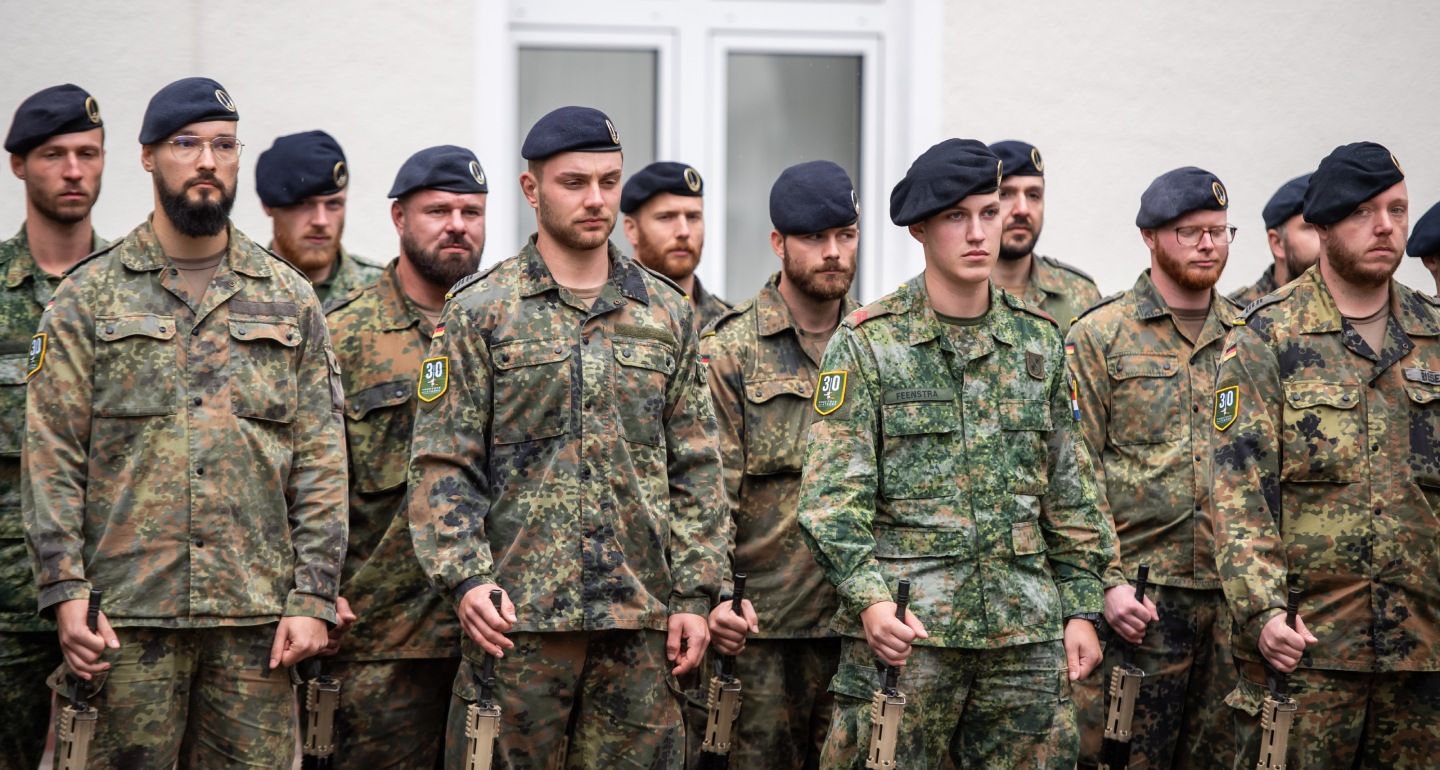
Passing a military service reform that is unpopular even within the governing coalition could distract from more immediate obstacles on the path to becoming a key security provider in Europe.
The German Cabinet’s approval of the introduction of partial conscription is the clearest sign yet that the country’s leadership has internalized the need to implement the Zeitenwende, the historic reversal in foreign and security policy, and defend Europe against Russian aggression. Far from champing at the bit to provoke an escalation, as Russian media have suggested following the news, Berlin is scrambling to restore a minimum level of defensive capability.
Three decades of peace have left the Bundeswehr, Germany’s armed forces, notoriously understaffed and ill-equipped. The piecemeal approach to defense modernization, the arms industries’ risk aversion to scaling up, weak demographics, a competitive labor market, and the legacies of post–Second World War pacifism continue to obstruct Chancellor Friedrich Merz’s declared goal of building Europe’s strongest army. Thus, passing a conscription reform that is unpopular even within the governing coalition could distract from the more immediate obstacles on the path to becoming a key security provider in Europe.
Germany suspended the draft in 2011 after the Weise Commission, set up to reform the military, argued that it could no longer be justified given “the elimination of the massive, immediate military threat, i.e., the Soviet Union.” The focus on international crisis management required a smaller, but more specialized Bundeswehr than that needed for national and alliance defense. At that time, Russia was seen more as a partner for European security than as a threat to it.
This sentiment still influences the reasoning of some members of the German establishment who see conscription as a provocative rather than prudent move. In this light, the decision to introduce selective military service backed by broad public support is more than a compromise, it’s proof that Germans have finally come to terms with the threats posed by a revisionist Russia. The significance of this mental shift cannot be overstated and will be much welcomed from Vilnius to Washington.
The government’s proposal, expected to be debated in the Bundestag in the coming weeks, is based on Sweden’s selective service model: all German men turning eighteen must complete an enlistment questionnaire and state whether they are willing to volunteer for military service. Men are required to complete the questionnaire, while women can choose to do so, as obliging women to serve would require amendments to the German constitution. In exchange for what the defense ministry has promised will be decent pay and other benefits, the most able and motivated 20,000 will be invited to serve for a minimum of six months, starting as early as next year.
While military service would initially be voluntary, the new legislation introduces the option to make it mandatory, should it be needed, though that measure would first have to be approved by the Bundestag.
Over time, the recruitment targets will increase as the Bundeswehr expands its training capacity. In the short term, however, the service model would miss the mark and create more challenges than it solves. “Conscription doesn’t help us at all right now, because we simply don’t have the capacity—not in the barracks, and not in training,” Defense Minister Boris Pistorius said back in June.
In the medium term, conscription will be indispensable for meeting Germany’s commitments to NATO. By mid-2030, the Bundeswehr must field 460,000 soldiers: double its current size and a mammoth task for an organization notorious for inertia. Personnel demands are determined by the country’s size and its dual role in NATO: mobilizing, conducting, and sustaining operations in a high-intensity conflict, while securing the logistics and mobility corridors that run through its territory. Germany’s share of responsibility is only becoming more important as the United States reduces its involvement in European security.
Germany’s decisionmakers are under no illusion that voluntarism can only go so far. Merz predicts that the recruitment of up to 40,000 volunteers per year by 2031 will require “additional elements of compulsory military service,” a claim backed by Pistorius.
Although the majority of Germans favor a return to full conscription, support among the draftable cohorts drops to about one-third, according to a YouGov poll. Asked if they would personally take up arms to defend Germany, just 17 percent responded in the affirmative. Presumably, even fewer would put their lives on the line to defend the Baltics.
Well-documented support for the Bundeswehr and Zeitenwende in German society doesn’t translate into a personal willingness to serve, let alone defend every inch of NATO territory. This is just a snapshot, and the level of support could change should the security situation deteriorate. But as it stands, the odds are not good that many Germans would volunteer to fight in a scenario involving national and allied defense, which shows how difficult it will be to avoid some form of conscription moving forward.
But transitioning from voluntarism to conscription and only calling up as many conscripts as the Bundeswehr can currently train raises constitutional concerns—for which there is precedent. After the end of the Cold War, the armed forces decreased in size and began drafting only a third of all liable men. In 2003, a student appealed his draft notice and won. The Federal Administrative Court ruled that selectivity violates the Wehrgerechtigkeit, the constitutional norm guaranteeing equal and nondiscriminatory treatment in conscription. Either most liable men had to be called up or none.
The ruling became one of the grounds for suspending conscription in 2011 and will end up playing an outsized role in future challenges to the selective service model. This puts one of the Merz government’s flagship national security projects on shaky ground and will likely exacerbate the obstacles to its implementation for years to come.
Germany may find no way around a (partial) draft if it wants to honor NATO’s targets by the mid-2030s. But managing multiple generational projects simultaneously requires a lot of strategic and organizational acumen, of which there has been little evidence lately. Three and a half years into Russia’s full-scale invasion of Ukraine, only half of the armed forces are considered operational, donated material is replaced too slowly, and multiple combat units had to be combined to stand up a single brigade in Lithuania.
Meanwhile, General Carsten Breuer, head of the Bundeswehr, warned that Russia could attack NATO’s eastern flank by 2029, and the recent violations of Polish and Estonian airspace suggest that Moscow is already ramping up its provocations and testing NATO’s resolve. Time is running out for Germany to learn how to walk and chew gum. The logistical demands of any form of the draft, therefore, are only the tip of the iceberg. Priority should be given to restoring a minimum level of combat readiness among the existing forces.

Friedrich Conradi
Journalist and student of international relations at Johns Hopkins SAIS in Washington D.C. Student researcher on critical minerals trade and investment in a SAIS–World Bank program.
Jurek Wille
Jurek Wille is a student of international relations at Johns Hopkins SAIS. Before joining SAIS, he worked for the German government.

Russia spent years building a “sovereign internet,” concentrating web infrastructure exclusively within Russian territory. Ukrainian drone attacks have shown how vulnerable that approach has left the Russian internet.

Maria Kolomychenko

Putin’s conservative staffing policies and search for ever greater control have cemented parliament’s transformation into a bureaucratic appendage of the executive branch.

Andrey Pertsev

Russia’s AI-driven propaganda campaigns operate in a fragmented, chaotic, and often illogical manner. That’s not necessarily a problem for the Kremlin, though: It’s much easier to mimic genuine public debate that way.

Ilya Klishin

Russian strikes are weakening the economy sustaining Ukraine’s war effort. Closing the growing funding gap will require more European support and politically contentious reforms in Kyiv.

Balázs Jarábik

Despite a new textbook, an influx of Russian teachers and managers, and an end to the teaching of Ukrainian, the Kremlin is unlikely to have “reprogrammed” locals.

Konstantin Skorkin